Doubt's Silent Sacrifice
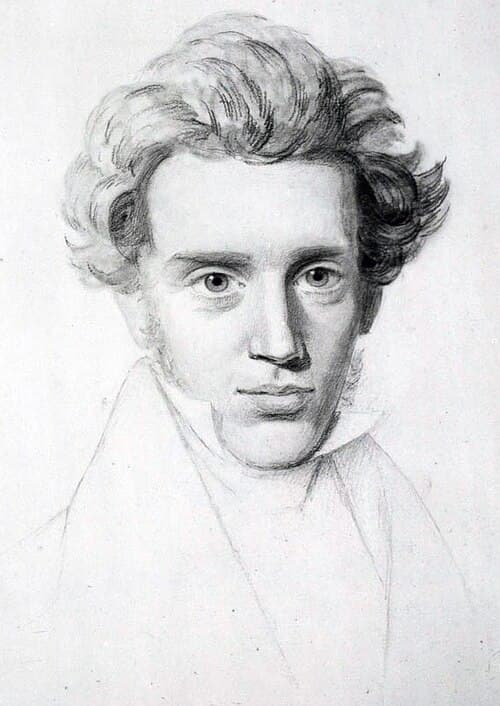
Søren Kierkegaard
Fear and Trembling

The author describes a 'sympathetic' Faust who hides his world-shaking doubts within himself, sacrificing his own peace for the sake of the universal's stability.

...upon the power of spirit but is easily explicable as an unreflected happiness. As a doubter, as the doubter, he is higher than all this, and if anyone would deceive him by making him believe that he has passed through a course of training in doubt, he readily sees through the deception; for the man who has made a movement in the world of spirit, hence an infinite movement, can at once hear through the spoken word whether it is a tried and experienced man who is speaking or a Münchhausen.
What a Tamberlane is able to accomplish by means of his Huns, that Faust is able to accomplish by means of his doubt: to frighten men up in dismay, to cause existence to quake beneath their feet, to disperse men abroad, to cause the shriek of dread to be heard on all sides. And if he does it, he is nevertheless no Tamberlane, he is in a certain sense warranted and has the warranty of thought. But Faust is a sympathetic nature, he loves existence, his soul is acquainted with no envy, he perceives that he is unable to check the raging he is well able to arouse, he desires no Herostratic honor–he keeps silent, he hides the doubt in his soul more…
When an eccentric pate raises a whirlwind of doubt one may sometimes hear people say, "Would that he had kept silent." Faust realizes this idea. He who has a conception of what it means to live upon spirit knows also what the hunger of doubt is, and that the doubter hungers just as much for the daily bread of life as for the nutriment of the spirit. Although all the pain Faust suffers may be a fairly good argument that is was not pride possessed him, yet to test this further I will emplo...
Continue reading →
2
Love's Paradoxical Duty
Søren Kierkegaard
Fear and Trembling

The author explains the paradox of faith where the sacrifice is only valid if the father continues to love the son he is commanded to kill, creating a tension between the ethical and the absolute.

...ould regard as a sign of egoism and stupidity, that one is to regard by the help of an exegete as a worthy conception of the Deity. But how hate them? I will not recall here the human distinction between loving and hating–not because I have much to object to in it (for after all it is passionate), but because it is egoistic and is not in place here. However, if I regard the problem as a paradox, then I understand it, that is, I understand it in such a way as one can understand a paradox.
The absolute duty may cause one to do what ethics would forbid, but by no means can it cause the knight of faith to cease to love. This is shown by Abraham. The instant he is ready to sacrifice Isaac the ethical expression for what he does is this: he hates Isaac. But if he really hates Isaac, he can be sure that God does not require this, for Cain and Abraham are not identical. Isaac he must love with his whole soul; when God requires Isaac he must love him if possible even more dearly, and only on this condition can he sacrifice him; for in fact it is this love for Isaac which, by its paradoxical opposition to his love for God, makes his…
But the distress and dread in this paradox is that, humanly speaking, he is entirely unable to make himself intelligible. Only at the moment when his act is in absolute contradiction to his feeling is his act a sacrifice, but the reality of his act is the factor by which he belongs to the universal, and in that aspect he is and remains a murderer. Moreover, the passage in Luke must be understood in such a way as to make it clearly evident that the knight of faith has no higher expression...
Continue reading →
2
Abraham's Procrastination Trial
Søren Kierkegaard
Fear and Trembling

The author portrays Abraham's long life of waiting and his ultimate trial as a unique form of 'procrastination' that transcends the social duties of a tragic hero.

...what did Abraham accomplish for the universal? Let me speak humanly about it, quite humanly. He spent seventy years in getting a son of his old age. What other men get quickly enough and enjoy for a long time he spent seventy years in accomplishing. And why? Because he was tried and put to the test. Is not that crazy? But Abraham believed, and Sarah wavered and got him to take Hagar as a concubine–but therefore he also had to drive her away. He gets Isaac, then he has to be tried again.
He knew that it is glorious to express the universal, glorious to live with Isaac. But this is not the task. He knew that it is a kingly thing to sacrifice such a son for the universal, he himself would have found repose in that, and all would have reposed in the commendation of his deed, as a vowel reposes in its consonant, but that is not the task–he is tried. That Roman general who is celebrated by his name of Cunctator checked the foe by procrastination–but what a procrastinator Abraham is in comparison with him! … yet he did not save the state. This is the content of one hundred and thirty years.
Who can bear it? Would not his contemporary age, if we can speak of such a thing, have said of him, "Abraham is eternally procrastinating. Finally he gets a son. That took long enough. Now he wants to sacrifice him. So is he not mad? And if at least he could explain why he wants to do it–but he always says that it is a trial." Nor could Abraham explain more, for his life is like a book placed under a divine attachment and which never becomes publici juris. This is the terrible thing....
1
Sacrificing Another for Self
Søren Kierkegaard
Fear and Trembling

The author argues that Abraham's silence transcends aesthetic justification because aesthetics only permits sacrifice for the sake of another, not the sacrifice of another for God's sake.

...e moment of variation [from Abraham's case] indicate as it were the boundary of the unknown land. If there might be any analogy, this must be found in the paradox of sin, but this again lies in another sphere and cannot explain Abraham and is itself far easier to explain than Abraham. So then, Abraham did not speak, he did not speak to Sarah, nor to Eleazar, nor to Isaac, he passed over three ethical authorities; for the ethical had for Abraham no higher expression than the family life.
Aesthetics permitted, yea, required of the individual silence, when he knew that by keeping silent he could save another. This is already sufficient proof that Abraham does not lie within the circumference of aesthetics. His silence has by no means the intention of saving Isaac, and in general his whole task of sacrificing Isaac for his own sake and for God's sake is an offense to aesthetics, for aesthetics can well understand that I sacrifice myself, but not that I sacrifice another for my own sake.
The aesthetic hero was silent. Ethics condemned him, however, because he was silent by virtue of his accidental particularity. His human foreknowledge was what determined him to keep silent. This ethics cannot forgive, every such human knowledge is only an illusion, ethics requires an infinite movement, it requires revelation. So the aesthetic hero can speak but will not. The genuine tragic hero sacrifices himself and all that is his for the universal, his deed and every emotion with him...
2
Admiration vs Guidance
Søren Kierkegaard
Fear and Trembling

The author imagines an alternative scenario where Abraham doubted, suggesting he would still be a tragic hero, but would have lost the unique status of being a 'guiding star' for the anguished.

...ham believed precisely for this life, that he was to grow old in the land, honored by the people, blessed in his generation, remembered forever in Isaac, his dearest thing in life, whom he embraced with a love for which it would be a poor expression to say that he loyally fulfilled the father's duty of loving the son, as indeed is evinced in the words of the summons, "the son whom thou lovest." Jacob had twelve sons, and one of them he loved; Abraham had only one, the son whom he loved.
Yet Abraham believed and did not doubt, he believed the preposterous. If Abraham had doubted–then he would have done something else, something glorious; for how could Abraham do anything but what is great and glorious! He would have marched up to Mount Moriah, he would have cleft the fire-wood, lit the pyre, drawn the knife–he would have cried out to God, "Despise not this sacrifice, it is not the best thing I possess, that I know well, for what is an old man in comparison with the child of promise; but it is the best I am able to give Thee. Let Isaac never come to know this, that he may console himself with his youth." He would have plunged…
But Abraham believed. He did not pray for himself, with the hope of moving the Lord–it was only when the righteous punishment was decreed upon Sodom and Gomorrha that Abraham came forward with his prayers. We read in those holy books: "And God tempted Abraham, and said unto him, Abraham, Abraham, where art thou? And he said, Here am I." Thou to whom my speech is addressed, was such the case with thee? When afar off thou didst see the heavy dispensation of providence approaching thee, di...
Continue reading →
1