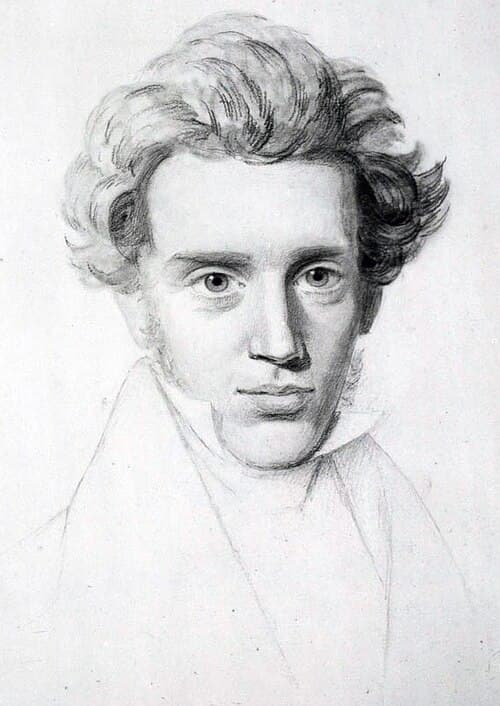
The author asserts that one must have the romantic enthusiasm to renounce everything for God, even in the face of madness, or else risk losing one's soul.
Soul's Final Glance
Søren Kierkegaard
Fear and Trembling...on that rich young man should have given away everything, but then when he had done that, the knight of faith should have said to him, "By virtue of the absurd thou shalt get every penny back again. Canst thou believe that?" And this speech ought by no means to have been indifferent to the aforesaid rich young man, for in case he gave away his goods because he was tired of them, his resignation was not much to boast of. It is about the temporal, the finite, everything turns in this case.
I am able by my own strength to renounce everything, and then to find peace and repose in pain. I can stand everything–even though that horrible demon, more dreadful than death, the king of terrors, even though madness were to hold up before my eyes the motley of the fool, and I understood by its look that it was I who must put it on, I still am able to save my soul, if only it is more to me than my earthly happiness that my love to God should triumph in me. A man may still be able at the last instant to concentrate his whole soul in a single glance toward that heaven from which cometh every good gift, and his glance will be intelligible to…
But by my own strength I am not able to get the least of the things which belong to finiteness, for I am constantly using my strength to renounce everything. By my own strength I am able to give up the princess, and I shall not become a grumbler, but shall find joy and repose in my pain; but by my own strength I am not able to get her again, for I am employing all my strength to be resigned. But by faith, says that marvellous knight, by faith I shall get her in virtue of the absurd. So t...
Continue reading →
4
⚖Holding Fast After Surrender

Søren Kierkegaard
Fear and TremblingThe author defines the greatness of faith as the ability to hold fast to a temporal wish even after it has been spiritually surrendered, using Abraham's persistence as the primary example.
...e passed, he did not look at Sarah with a suspicious glance, wondering whether she were growing old, he did not arrest the course of the sun, that Sarah might not grow old, and his expectation with her. He did not sing lullingly before Sarah his mournful lay. Abraham became old, Sarah became a laughingstock in the land, and yet he was God's elect and inheritor of the promise that in his seed all the races of the world would be blessed. So were it not better if he had not been God's elect?
What is it to be God's elect? It is to be denied in youth the wishes of youth, so as with great pains to get them fulfilled in old age. But Abraham believed and held fast the expectation. If Abraham had wavered, he would have given it up. If he had said to God, "Then perhaps it is not after all Thy will that it should come to pass, so I will give up the wish. It was my only wish, it was my bliss. My soul is sincere, I hide no secret malice because Thou didst deny it to me"–he would not have been forgotten, he would have saved many by his example, yet he would not be the father of faith. For it is great to give up one's wish, but it is greater…
Then came the fulness of time. If Abraham had not believed, Sarah surely would have been dead of sorrow, and Abraham, dulled by grief, would not have understood the fulfilment but would have smiled at it as at a dream of youth. But Abraham believed, therefore he was young; for he who always hopes for the best becomes old, and he who is always prepared for the worst grows old early, but he who believes preserves an eternal youth. Praise therefore to that story! For Sarah, though stricken...
Continue reading →
1
⚖Faith's Impossible Leap

Søren Kierkegaard
Fear and TremblingThe author admits a personal limitation, stating that while he can achieve the strength of resignation, he lacks the faith required to believe in the 'absurd' return of what was lost.
...hich cometh every good gift, and his glance will be intelligible to himself and also to Him whom it seeks as a sign that he nevertheless remained true to his love. Then he will calmly put on the motley garb. He whose soul has not this romantic enthusiasm has sold his soul, whether he got a kingdom for it or a paltry piece of silver. But by my own strength I am not able to get the least of the things which belong to finiteness, for I am constantly using my strength to renounce everything.
By my own strength I am able to give up the princess, and I shall not become a grumbler, but shall find joy and repose in my pain; but by my own strength I am not able to get her again, for I am employing all my strength to be resigned. But by faith, says that marvellous knight, by faith I shall get her in virtue of the absurd. So this movement I am unable to make. As soon as I would begin to make it everything turns around dizzily, and I flee back to the pain of resignation. I can swim in existence, but for this mystical soaring I am too heavy. To exist in such a way that my opposition to existence is expressed as the most beautiful and…
And yet it must be glorious to get the princess, that is what I say every instant, and the knight of resignation who does not say it is a deceiver, he has not had one only wish, and he has not kept the wish young by his pain. Perhaps there was one who thought it fitting enough that the wish was no longer vivid, that the barb of pain was dulled, but such a man is no knight. A free-born soul who caught himself entertaining such thoughts would despise himself and begin over again, above all...
Continue reading →
2
⚖Resignation vs Faith

Søren Kierkegaard
Fear and TremblingThe author distinguishes between infinite resignation, which is a philosophical act, and faith, which is the paradoxical act of regaining the finite.
...y in comparison with the firmness faith displays notwithstanding it has perceived the impossibility. Whenever I essay to make this movement, I turn giddy, the very instant I am admiring it absolutely a prodigious dread grips my soul–for what is it to tempt God? And yet this movement is the movement of faith and remains such, even though philosophy, in order to confuse the concepts, would make us believe that it has faith, and even though theology would sell out faith at a bargain price.
For the act of resignation faith is not required, for what I gain by resignation is my eternal consciousness, and this is a purely philosophical movement which I dare say I am able to make if it is required, and which I can train myself to make, for whenever any finiteness would get the mastery over me, I starve myself until I can make the movement, for my eternal consciousness is my love to God, and for me this is higher than everything. For the act of resignation faith is not required, but it is needed when it is the case of acquiring the very least thing more than my eternal consciousness, for this is the paradoxical. The movements are…
In resignation I make renunciation of everything, this movement I make by myself, and if I do not make it, it is because I am cowardly and effeminate and without enthusiasm and do not feel the significance of the lofty dignity which is assigned to every man, that of being his own censor, which is a far prouder title than that of Censor General to the whole Roman Republic. This movement I make by myself, and what I gain is myself in my eternal consciousness, in blissful agreement with my...
Continue reading →
3
⚖Spiritual Possibility

Søren Kierkegaard
Fear and TremblingThe author describes the 'knight of resignation' who transforms an impossible earthly wish into a spiritual reality by internalizing it and keeping it alive through memory.
...resignation he is reconciled with existence. Love for that princess became for him the expression for an eternal love, assumed a religious character, was transfigured into a love for the Eternal Being, which did to be sure deny him the fulfilment of his love, yet reconciled him again by the eternal consciousness of its validity in the form of eternity, which no reality can take from him. Fools and young men prate about everything being possible for a man. That, however, is a great error.
Spiritually speaking, everything is possible, but in the world of the finite there is much which is not possible. This impossible, however, the knight makes possible by expressing it spiritually, but he expresses it spiritually by waiving his claim to it. The wish which would carry him out into reality, but was wrecked upon the impossibility, is now bent inward, but it is not therefore lost, neither is it forgotten. At one moment it is the obscure emotion of the wish within him which awakens recollections, at another moment he awakens them himself; for he is too proud to be willing that what was the whole content of his life should be the…
On the other hand, he has no need of the intervention of the finite for the further growth of his love. From the instant he made the movement the princess is lost to him. He has no need of those erotic tinglings in the nerves at the sight of the beloved etc., nor does he need to be constantly taking leave of her in a finite sense, because he recollects her in an eternal sense, and he knows very well that the lovers who are so bent upon seeing "her" yet once again, to say farefell for the...
Continue reading →
2