Each Generation's Primitive Start
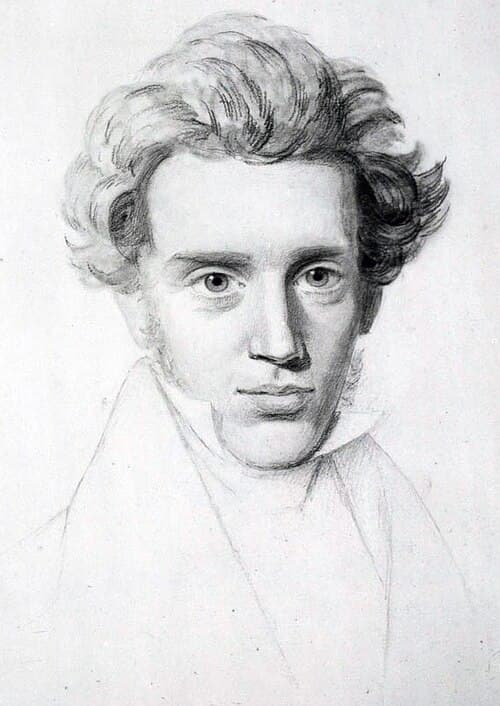
Søren Kierkegaard
Fear and Trembling

The text asserts that every generation must begin from the same starting point regarding human passion and love, as these essential experiences cannot be inherited or bypassed.

...n the art of deceiving itself? Or rather is not the thing most needed an honest seriousness which dauntlessly and incorruptibly points to the tasks, an honest seriousness which lovingly watches over the tasks, which does not frighten men into being over hasty in getting the highest tasks accomplished, but keeps the tasks young and beautiful and charming to look upon and yet difficult withal and appealing to noble minds. For the enthusiasm of noble natures is aroused only by difficulties.
Whatever the one generation may learn from the other, that which is genuinely human no generation learns from the foregoing. In this respect every generation begins primitively, has no different task from that of every previous generation, nor does it get further, except in so far as the preceding generation shirked its task and deluded itself. This authentically human factor is passion, in which also the one generation perfectly understands the other and understands itself. Thus no generation has learned from another to love, no generation begins at any other point than at the beginning, no generation has a shorter task assigned to it than…
But the highest passion in a man is faith, and here no generation begins at any other point than did the preceding generation, every generation begins all over again, the subsequent generation gets no further than the foregoing–in so far as this remained faithful to its task and did not leave it in the lurch. That this should be wearisome is of course something the generation cannot say, for the generation has in fact the task to perform and has nothing to do with the consideration that...
Continue reading →
6
Movement of Repentance
Søren Kierkegaard
Fear and Trembling

The author argues that returning to reality after repentance requires a movement of the 'absurd' fueled by passion, without which one merely loiters in spiritual delusion.

...nce he could work Agnes loose, then he finds peace indeed but is lost for this world. If he becomes revealed and allows himself to be saved by Agnes, then he is the greatest man I can picture to myself; for it is only the aesthetic writer who thinks lightmindedly that he extols the power of love by letting the lost man be loved by an innocent girl and thereby saved, it is only the aesthetic writer who sees amiss and believes that the girl is the heroine, instead of the man being the hero.
So the merman cannot belong to Agnes unless, after having made the infinite movement, the movement of repentance, he makes still one more movement by virtue of the absurd. By his own strength he can make the movement of repentance, but for that he uses up absolutely all his strength and hence he cannot by his own strength return and grasp reality. If a man has not enough passion to make either the one movement or the other, if he loiters through life, repenting a little, and thinks that the rest will take care of itself, he has once for all renounced the effort to live in the idea–and then he can very easily reach and help others to reach the…
One can therefore divert oneself by reflecting how strange it is that precisely in our age when everyone is able to accomplish the highest things doubt about the immortality of the soul could be so widespread, for the man who has really made even so much as the movement of infinity is hardly a doubter. The conclusions of passion are the only reliable ones, that is, the only convincing conclusions. Fortunately existence is in this instance more kindly and more faithful than the wise maint...
Continue reading →
2
Faith's Narrow Way
Søren Kierkegaard
Fear and Trembling

The author posits that faith is a miracle and a passion that unifies human life, yet it remains a solitary path that cannot be understood by others.

...ame higher than the universal. This is the paradox which does not permit of mediation. It is just as inexplicable how he got into it as it is inexplicable how he remained in it. If such is not the position of Abraham, then he is not even a tragic hero but a murderer. To want to continue to call him the father of faith, to talk of this to people who do not concem themselves with anything but words, is thoughtless. A man can become a tragic hero by his own powers–but not a knight of faith.
When a man enters upon the way, in a certain sense the hard way of the tragic hero, many will be able to give him counsel; to him who follows the narrow way of faith no one can give counsel, him no one can understand. Faith is a miracle, and yet no man is excluded from it; for that in which all human life is unified is passion,* and faith is a passion.
PROBLEM II Is there such a thing as an absolute duty toward God? The ethical is the universal, and as such it is again the divine. One has therefore a right to say that fundamentally every duty is a duty toward God; but if one cannot say more, then one affirms at the same time that properly I have no duty toward God. Duty becomes duty by being referred to God, but in duty itself I do not come into relation with God. Thus it is a duty to love one's neighbor, but in performing this dut...
2
Abraham's Prodigious Passion
Søren Kierkegaard
Fear and Trembling

The author offers a poetic tribute to Abraham, praising his 'divine madness' and his century-long journey toward a faith that required him to be willing to sacrifice his own son.

...ully with him in thy tent, as thou cost in the beyond to all eternity. Venerable Father Abraham! Thousands of years have run their course since those days, but thou hast need of no tardy lover to snatch the memorial of thee from the power of oblivion, for every language calls thee to remembrance–and yet thou cost reward thy lover more gloriously than does any other; hereafter thou cost make him blessed in thy bosom; here thou cost enthral his eyes and his heart by the marvel of thy deed.
Venerable Father Abraham! Second Father of the human race! Thou who first wast sensible of and didst first bear witness to that prodigious passion which disdains the dreadful conflict with the rage of the elements and with the powers of creation in order to strive with God; thou who first didst know that highest passion, the holy, pure and humble expression of the divine madness which the pagans admired–forgive him who would speak in praise of thee, if he does not do it fittingly. He spoke humbly, as if it were the desire of his own heart, he spoke briefly, as it becomes him to do, but he will never forget that thou hadst need of a hundred…
PROBLEMATA: PRELIMINARY EXPECTORATION An old proverb fetched from the outward and visible world says: "Only the man that works gets the bread." Strangely enough this proverb does not aptly apply in that world to which it expressly belongs. For the outward world is subjected to the law of imperfection, and again and again the experience is repeated that he too who does not work gets the bread, and that he who sleeps gets it more abundantly than the man who works. In the outward world ev...
Continue reading →
1
Passion's Reliable Conclusions
Søren Kierkegaard
Fear and Trembling

The author asserts that only the conclusions of passion are reliable and that in the spiritual world, one is only deceived if they choose to deceive themselves.

...the highest attainments, i.e. delude himself and others with the notion that in the world of spirit everything goes as in a well-known game of cards where everything depends on haphazard. One can therefore divert oneself by reflecting how strange it is that precisely in our age when everyone is able to accomplish the highest things doubt about the immortality of the soul could be so widespread, for the man who has really made even so much as the movement of infinity is hardly a doubter.
The conclusions of passion are the only reliable ones, that is, the only convincing conclusions. Fortunately existence is in this instance more kindly and more faithful than the wise maintain, for it excludes no man, not even the lowliest, it fools no one, for in the world of spirit only he is fooled who fools himself.
It is the opinion of all, and so far as I dare permit myself to pass judgment it is also my opinion, that it is not the highest thing to enter the monastery; but for all that it is by no means my opinion that in our age when nobody enters the monastery everybody is greater than the deep and earnest souls who found repose in a monastery. How many are there in our age who have passion enough to think this thought and then to judge themselves honestly? This mere thought of taking time upon...
4