The author admits that while he can intellectually grasp Hegelian philosophy, the paradox of Abraham's faith leaves him feeling paralyzed and spiritually annihilated.
Paradox's Paralyzing Grip
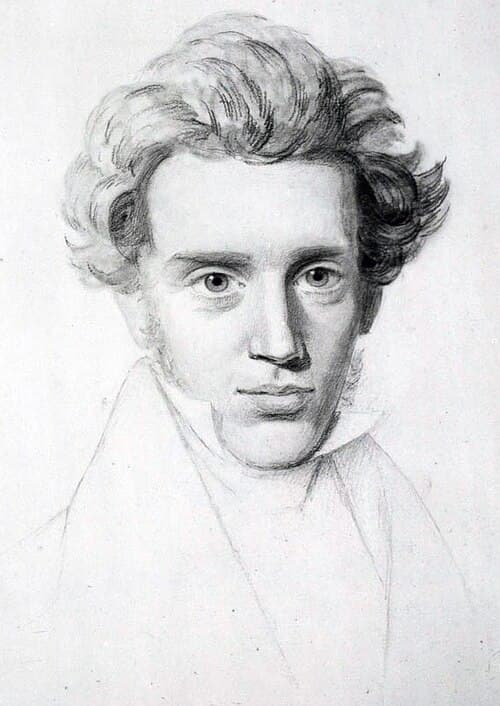
Søren Kierkegaard
Fear and Trembling..._ through the overcoming of it brought the clever head further than the point which the simplest and most ordinary man reaches more easily." After all, in the poets love has its priests, and sometimes one hears a voice which knows how to defend it; but of faith one hears never a word. Who speaks in honor of this passion? Philosophy goes further. Theology sits rouged at the window and courts its favor, offering to sell her charms to philosophy.
It is supposed to be difficult to understand Hegel, but to understand Abraham is a trifle. To go beyond Hegel is a miracle, but to get beyond Abraham is the easiest thing of all. I for my part have devoted a good deal of time to the understanding of the Hegelian philosophy, I believe also that I understand it tolerably well, but when in spite of the trouble I have taken there are certain passages I cannot understand, I am foolhardy enough to think that he himself has not been quite clear. All this I do easily and naturally, my head does not suffer from it. But on the other hand when I have to think of Abraham, I am as though annihilated. I…
I am not unacquainted with what has been admired as great and noble in the world, my soul feels affinity with it, being convinced in all humility that it was in my cause the hero contended, and the instant I contemplate his deed I cry out to myself, jam tua res agitur. I think myself into the hero, but into Abraham I cannot think myself; when I reach the height I fall down, for what I encounter there is the paradox. I do not however mean in any sense to say that faith is some...
Continue reading →
2
⚖Heaven's Separation

Søren Kierkegaard
Fear and TremblingThe author reflects on the spiritual paradox where heaven itself acts as the force of separation, challenging traditional proverbs about divine unions.
...tune_ would follow his marriage, suddenly changes his plan at the decisive moment when he comes to fetch the bride–he will not celebrate the wedding. I have no need of more.* In Delphi this event hardly passed without tears; if a poet were to have adopted it as his theme, he might have dared to count very surely upon sympathy. Is it not dreadful that love, which in human life often enough was cast into exile, is now deprived of the support of heaven?
Is not the old proverb that "marriages are made in heaven" here put to shame? Usually it is all the afflictions and difficulties of the finite which like evil spirits separate the lovers, but love has heaven on its side, and therefore this holy alliance overcomes all enemies. In this case it is heaven itself which separates what heaven itself has joined together.
And who would have guessed such a thing? The young bride least of all. Only a moment before she was sitting in her chamber in all her beauty, and the lovely maidens had conscientiously adorned her so that they could justify before all the world what they had done, so that they not merely derived joy from it but envy, yea, joy for the fact that it was not possible for them to become more envious, because it was not possible for her to become more beautiful. She sat alone in her chamber an...
2
⚖Movement Beyond Renunciation

Søren Kierkegaard
Fear and TremblingThe knight of faith is defined by a second movement beyond resignation: the belief that the impossible remains possible through God, a concept the understanding cannot grasp.
...lum one had to run through in order to catch up with oneself, and he who will not pass through this curriculum is helped very little by the fact that he was born in the most enlightened age. The infinite resignation is the last stage prior to faith, so that one who has not made this movement has not faith; for only in the infinite resignation do I become clear to myself with respect to my eternal validity, and only then can there be any question of grasping existence by virtue of faith.
Now we will let the knight of faith appear in the role just described. He makes exactly the same movements as the other knight, infinitely renounces claim to the love which is the content of his life, he is reconciled in pain; but then occurs the prodigy, he makes still another movement more wonderful than all, for he says, "I believe nevertheless that I shall get her, in virtue, that is, of the absurd, in virtue of the fact that with God all things are possible." The absurd is not one of the factors which can be discriminated within the proper compass of the understanding: it is not identical with the improbable, the unexpected, the unforeseen.
At the moment when the knight made the act of resignation he was convinced, humanly speaking, of the impossibility. This was the result reached by the understanding, and he had sufficient energy to think it. On the other hand, in an infinite sense it was possible, namely, by renouncing it; but this sort of possessing is at the same time a relinquishing, and yet there is no absurdity in this for the understanding, for the understanding continued to be in the right in affirming that in the...
2
⚖Sublime in Pedestrian

Søren Kierkegaard
Fear and TremblingThe author describes the 'prodigy' of the knight of faith as the ability to express the sublime through the mundane, making a leap of faith look like a normal walk.
...ceful to behold. But whenever they fall down they are not able at once to assume the posture, they vacillate an instant, and this vacillation shows that after all they are strangers in the world. This is more or less strikingly evident in proportion to the art they possess, but even the most artistic knights cannot altogether conceal this vacillation. One need not look at them when they are up in the air, but only the instant they touch or have touched the ground–then one recognizes them.
But to be able to fall down in such a way that the same second it looks as if one were standing and walking, to transform the leap of life into a walk, absolutely to express the sublime in the pedestrian–that only the knight of faith can do–and this is the one and only prodigy.
But since the prodigy is so likely to be delusive, I will describe the movements in a definite instance which will serve to illustrate their relation to reality, for upon this everything turns. A young swain falls in love with a princess, and the whole content of his life consists in this love, and yet the situation is such that it is impossible for it to be realized, impossible for it to be translated from ideality into reality.* The slaves of paltriness, the frogs in life's swamp, wil...
2
⚖Faith's Tremendous Paradox

Søren Kierkegaard
Fear and TremblingThe author urges the reader to either ignore Abraham or confront the terrifying paradox of his faith to determine if they possess the courage for such a spiritual trial.
...No miracle occurs. The whole of life is a trial." In proportion as the orator proceeds with his outpouring, he would get more and more excited, would become more and more delighted with himself, and whereas he had noticed no congestion of the blood while he talked about Abraham, he now felt how the vein swelled in his forehead. Perhaps he would have lost his breath as well as his tongue if the sinner had answered calmly and with dignity, "But it was about this you preached last Sunday.
"Let us then either consign Abraham to oblivion, or let us learn to be dismayed by the tremendous paradox which constitutes the significance of Abraham's life, that we may understand that our age, like every age, can be joyful if it has faith. In case Abraham is not a nullity, a phantom, a show one employs for a pastime, then the fault can never consist in the fact that the sinner wants to do likewise, but the point is to see how great a thing it was that Abraham did, in order that man may judge for himself whether he has the call and the courage to be subjected to such a test.
The comic contradiction in the behavior of the orator is that he reduced Abraham to an insignificance, and yet would admonish the other to behave in the same way. Should not one dare then to talk about Abraham? I think one should. If I were to talk about him, I would first depict the pain of his trial. To that end I would like a leech suck all the dread and distress and torture out of a father's sufferings, so that I might describe what Abraham suffered, whereas all the while he neverth...
2