Love's Proof Paradox
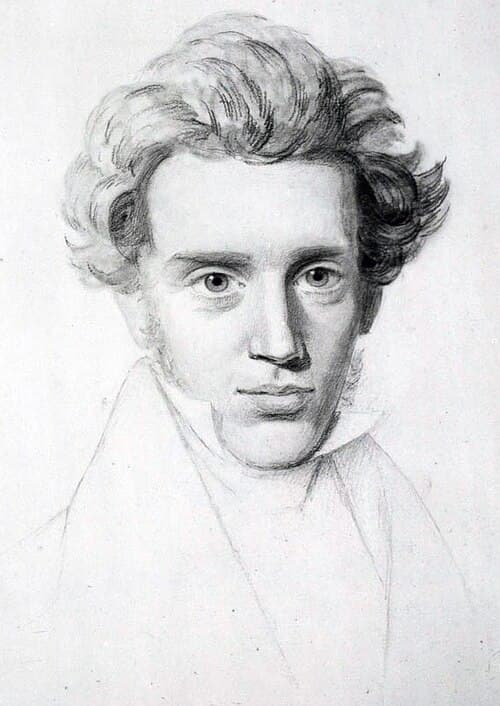
Søren Kierkegaard
Fear and Trembling

The author argues that true love for God or a spouse does not require becoming indifferent to previous duties, but rather that excellence in one's existing roles proves the capacity for deeper love.

...the courage for it. He who behaves thus will not find himself excluded from having part in that beautiful story which follows, for after all it contains consolation of a sort for the man who had not courage to begin the tower. But we must be honest, and not interpret this lack of courage as humility, since it is really pride, whereas the courage of faith is the only humble courage. One can easily perceive that if there is to be any sense in this passage, it must be understood literally.
God it is who requires absolute love. But he who in demanding a person's love thinks that this love should be proved also by becoming lukewarm to everything which hitherto was dear–that man is not only an egoist but stupid as well, and he who would demand such love signs at the same moment his own death-warrant, supposing that his life was bound up with this coveted love. Thus a husband demands that his wife shall leave father and mother, but if he were to regard it as a proof of her extraordinary love for him that she for his sake became an indolent, lukewarm daughter etc., then he is the stupidest of the stupid. If he had any notion of what…
What therefore in the case of a man one would regard as a sign of egoism and stupidity, that one is to regard by the help of an exegete as a worthy conception of the Deity. But how hate them? I will not recall here the human distinction between loving and hating–not because I have much to object to in it (for after all it is passionate), but because it is egoistic and is not in place here. However, if I regard the problem as a paradox, then I understand it, that is, I understand it in s...
Continue reading →
6
Sarah's Courage to Receive
Søren Kierkegaard
Fear and Trembling

The author provides a poetic appreciation of the biblical character Sarah, highlighting the immense faith and humility required to accept healing and love.

...ere to make use of it, I wager a hundred to one that he would lay all the emphasis upcn the young Tobias. His heroic courage in being willing to risk his life in such evident danger–which the narrative recalls once again, for the morning after the nuptials Raguel says to Edna, "Send one of the maidservants and let her see whether he be alive; but if not, that we may bury him and no man know of it" (:)–this heroic courage would be the poet's theme. I take the liberty of proposing another.
Tobias acted bravely, stoutheartedly and chivalrously, but any man who has not the courage for this is a molly- coddle who does not know what love is, or what it is to be a man, or what is worth living for; he had not even comprehended the little mystery, that it is better to give than to receive, and has no inkling of the great one, that it is far more difficult to receive than to give–that is, if one has had courage to do without and in the hour of need did not become cowardly. No, it is Sarah that is the heroine. I desire to draw near to her as I never have drawn near to any girl or felt tempted in thought to draw near to any girl I have…
Let Sarah be a man, and with that the demoniacal is close at hand. The proud and noble nature can endure everything, but one thing it cannot endure, it cannot endure pity. In that there is implied an indignity which can only be inflicted upon one by a higher power, for by oneself one can never become an object of pity. If a man has sinned, he can bear the punishment for it without despairing; but without blame to be singled out from his mother's womb as a sacrifice to pity, as a sweet-sm...
Continue reading →
2
Each Generation's Primitive Start
Søren Kierkegaard
Fear and Trembling

The text asserts that every generation must begin from the same starting point regarding human passion and love, as these essential experiences cannot be inherited or bypassed.

...n the art of deceiving itself? Or rather is not the thing most needed an honest seriousness which dauntlessly and incorruptibly points to the tasks, an honest seriousness which lovingly watches over the tasks, which does not frighten men into being over hasty in getting the highest tasks accomplished, but keeps the tasks young and beautiful and charming to look upon and yet difficult withal and appealing to noble minds. For the enthusiasm of noble natures is aroused only by difficulties.
Whatever the one generation may learn from the other, that which is genuinely human no generation learns from the foregoing. In this respect every generation begins primitively, has no different task from that of every previous generation, nor does it get further, except in so far as the preceding generation shirked its task and deluded itself. This authentically human factor is passion, in which also the one generation perfectly understands the other and understands itself. Thus no generation has learned from another to love, no generation begins at any other point than at the beginning, no generation has a shorter task assigned to it than…
But the highest passion in a man is faith, and here no generation begins at any other point than did the preceding generation, every generation begins all over again, the subsequent generation gets no further than the foregoing–in so far as this remained faithful to its task and did not leave it in the lurch. That this should be wearisome is of course something the generation cannot say, for the generation has in fact the task to perform and has nothing to do with the consideration that...
Continue reading →
6
Greatness by Expectation
Søren Kierkegaard
Fear and Trembling

The author presents a poetic hierarchy of greatness, concluding that while many are remembered for their love or expectations, he who expected the 'impossible' through faith is the greatest of all.

...out of his hero, then he has completed his work, then he is gathered to the hero, who has loved him just as faithfully, for the poet is as it were the hero's better nature, powerless it may be as a memory is, but also transfigured as a memory is. Hence no one shall be forgotten who was great, and though time tarries long, though a cloud of misunderstanding takes the hero away, his lover comes nevertheless, and the longer the time that has passed, the more faithfully will he cling to him.
No, not one shall be forgotten who was great in the world. But each was great in his own way, and each in proportion to the greatness of that which he loved. For he who loved himself became great by himself, and he who loved other men became great by his selfless devotion, but he who loved God became greater than all. Everyone shall be remembered, but each became great in proportion to his expectation. One became great by expecting the possible, another by expecting the eternal, but he who expected the impossible became greater than all.
Everyone shall be remembered, but each was great in proportion to the greatness of that with which he strove. For he who strove with the world became great by overcoming the world, and he who strove with himself became great by overcoming himself, but he who strove with God became greater than all. So there was strife in the world, man against man, one against a thousand, but he who strove with God was greater than all. So there was strife upon earth: there was one who overcame all by hi...
2
Love's Paradoxical Duty
Søren Kierkegaard
Fear and Trembling

The author explains the paradox of faith where the sacrifice is only valid if the father continues to love the son he is commanded to kill, creating a tension between the ethical and the absolute.

...ould regard as a sign of egoism and stupidity, that one is to regard by the help of an exegete as a worthy conception of the Deity. But how hate them? I will not recall here the human distinction between loving and hating–not because I have much to object to in it (for after all it is passionate), but because it is egoistic and is not in place here. However, if I regard the problem as a paradox, then I understand it, that is, I understand it in such a way as one can understand a paradox.
The absolute duty may cause one to do what ethics would forbid, but by no means can it cause the knight of faith to cease to love. This is shown by Abraham. The instant he is ready to sacrifice Isaac the ethical expression for what he does is this: he hates Isaac. But if he really hates Isaac, he can be sure that God does not require this, for Cain and Abraham are not identical. Isaac he must love with his whole soul; when God requires Isaac he must love him if possible even more dearly, and only on this condition can he sacrifice him; for in fact it is this love for Isaac which, by its paradoxical opposition to his love for God, makes his…
But the distress and dread in this paradox is that, humanly speaking, he is entirely unable to make himself intelligible. Only at the moment when his act is in absolute contradiction to his feeling is his act a sacrifice, but the reality of his act is the factor by which he belongs to the universal, and in that aspect he is and remains a murderer. Moreover, the passage in Luke must be understood in such a way as to make it clearly evident that the knight of faith has no higher expression...
Continue reading →
2