Faith's First Movement
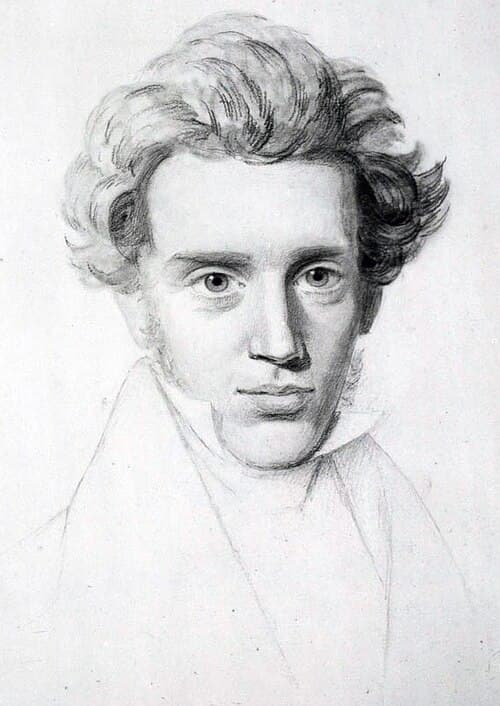
Søren Kierkegaard
Fear and Trembling

The author admits an inability to truly understand Abraham, expressing astonishment at his faith and critiquing those who try to bypass the 'infinite resignation' required to reach it.

...n times before his name and seventy times before his deed. For this indeed he did not do, as I can prove by the fact that he was glad at receiving Isaac, heartily glad, that he needed no preparation, no time to concentrate upon the finite and its joy. If this had not been the case with Abraham, then perhaps he might have loved God but not believed; for he who loves God without faith reflects upon himself, he who loves God believingly reflects upon God. Upon this pinnacle stands Abraham.
The last stage he loses sight of is the infinite resignation. He really goes further, and reaches faith; for all these caricatures of faith, the miserable lukewarm indolence which thinks, "There surely is no instant need, it is not worth while sorrowing before the time," the pitiful hope which says, "One cannot know what is going to happen … it might possibly be after all"–these caricatures of faith are part and parcel of life's wretchedness, and the infinite resignation has already consigned them to infinite contempt. Abraham I cannot understand, in a certain sense there is nothing I can learn from him but astonishment. If people fancy that…
They would suck worldly wisdom out of the paradox. Perhaps one or another may succeed in that, for our age is not willing to stop with faith, with its miracle of turning water into wine, it goes further, it turns wine into water. Would it not be better to stop with faith, and is it not revolting that everybody wants to go further? When in our age (as indeed is proclaimed in various ways) they will not stop with love, where then are they going? To earthy wisdom, to petty calculation, to p...
Continue reading →
2
The Absurd's New Creation
Søren Kierkegaard
Fear and Trembling

A description of the knight of faith who, despite having renounced everything, enjoys the finite world fully through the power of the absurd.

...needed, I dare say I could get it." He lounges at an open window and looks out on the square on which he lives; he is interested in everything that goes on, in a rat which slips under the curb, in the children's play, and this with the nonchalance of a girl of sixteen. And yet he is no genius, for in vain I have sought in him the incommensurability of genius. In the evening he smokes his pipe; to look at him one would swear that it was the grocer over the way vegetating in the twilight.
He lives as carefree as a ne'er-do-well, and yet he buys up the acceptable time at the dearest price, for he does not do the least thing except by virtue of the absurd. And yet, and yet–actually I could become furious over it, for envy if for no other reason–this man has made and every instant is making the movements of infinity. With infinite resignation he has drained the cup of life's profound sadness, he knows the bliss of the infinite, he senses the pain of renouncing everything, the dearest things he possesses in the world, and yet finiteness tastes to him just as good as to one who never knew anything higher, for his continuance in the…
He constantly makes the movements of infinity, but he does this with such correctness and assurance that he constantly gets the finite out of it, and there is not a second when one has a notion of anything else. It is supposed to be the most difficult task for a dancer to leap into a definite posture in such a way that there is not a second when he is grasping after the posture, but by the leap itself he stands fixed in that posture. Perhaps no dancer can do it–that is what this knight d...
Continue reading →
2
Eternal Love's Reconciliation
Søren Kierkegaard
Fear and Trembling

The author explains the process of infinite resignation, where a lost earthly love is transfigured into an eternal, religious love that reconciles the individual with existence.

...ed a kind of concentration.) No! For the knight does not contradict himself, and it is a contradiction to forget the whole content of one's life and yet remain the same man. To become another man he feels no inclination, nor does he by any means regard this as greatness. Only the lower natures forget themselves and become something new. Thus the butterfly has entirely forgotten that it was a caterpillar, perhaps it may in turn so entirely forget it was a butterfly that it becomes a fish.
The deeper natures never forget themselves and never become anything else than what they were. So the knight remembers everything, but precisely this remembrance is pain, and yet by the infinite resignation he is reconciled with existence. Love for that princess became for him the expression for an eternal love, assumed a religious character, was transfigured into a love for the Eternal Being, which did to be sure deny him the fulfilment of his love, yet reconciled him again by the eternal consciousness of its validity in the form of eternity, which no reality can take from him.
Fools and young men prate about everything being possible for a man. That, however, is a great error. Spiritually speaking, everything is possible, but in the world of the finite there is much which is not possible. This impossible, however, the knight makes possible by expressing it spiritually, but he expresses it spiritually by waiving his claim to it. The wish which would carry him out into reality, but was wrecked upon the impossibility, is now bent inward, but it is not therefore l...
5
Faith's First Movement
Søren Kierkegaard
Fear and Trembling

The author admits his inability to rationally understand Abraham, warning others that they cannot skip the pain of resignation to reach the comfort of faith.

...is the infinite resignation. He really goes further, and reaches faith; for all these caricatures of faith, the miserable lukewarm indolence which thinks, "There surely is no instant need, it is not worth while sorrowing before the time," the pitiful hope which says, "One cannot know what is going to happen … it might possibly be after all"–these caricatures of faith are part and parcel of life's wretchedness, and the infinite resignation has already consigned them to infinite contempt.
Abraham I cannot understand, in a certain sense there is nothing I can learn from him but astonishment. If people fancy that by considering the outcome of this story they might let themselves be moved to believe, they deceive themselves and want to swindle God out of the first movement of faith, the infinite resignation. They would suck worldly wisdom out of the paradox.
Perhaps one or another may succeed in that, for our age is not willing to stop with faith, with its miracle of turning water into wine, it goes further, it turns wine into water. Would it not be better to stop with faith, and is it not revolting that everybody wants to go further? When in our age (as indeed is proclaimed in various ways) they will not stop with love, where then are they going? To earthy wisdom, to petty calculation, to paltriness and wretchedness, to everything which can...
1
Faith Beyond Resignation
Søren Kierkegaard
Fear and Trembling

The author distinguishes true faith from its 'caricatures' like lukewarm hope, noting that faith requires moving beyond infinite resignation to reflect entirely upon God.

...tant he swung his leg over the ass's back had said to himself, "Now, since Isaac is lost, I might just as well sacrifice him here at home, rather than ride the long way to Moriah"– then I should have no need of Abraham, whereas now I bow seven times before his name and seventy times before his deed. For this indeed he did not do, as I can prove by the fact that he was glad at receiving Isaac, heartily glad, that he needed no preparation, no time to concentrate upon the finite and its joy.
If this had not been the case with Abraham, then perhaps he might have loved God but not believed; for he who loves God without faith reflects upon himself, he who loves God believingly reflects upon God. Upon this pinnacle stands Abraham. The last stage he loses sight of is the infinite resignation. He really goes further, and reaches faith; for all these caricatures of faith, the miserable lukewarm indolence which thinks, "There surely is no instant need, it is not worth while sorrowing before the time," the pitiful hope which says, "One cannot know what is going to happen … it might possibly be after all"–these caricatures of faith are…
Abraham I cannot understand, in a certain sense there is nothing I can learn from him but astonishment. If people fancy that by considering the outcome of this story they might let themselves be moved to believe, they deceive themselves and want to swindle God out of the first movement of faith, the infinite resignation. They would suck worldly wisdom out of the paradox. Perhaps one or another may succeed in that, for our age is not willing to stop with faith, with its miracle of turning...
Continue reading →
2