The knight of faith is compared to a perfect dancer who leaps into the infinite but lands so gracefully in the finite that the transition is invisible to others.
The Dancer's Perfect Leap
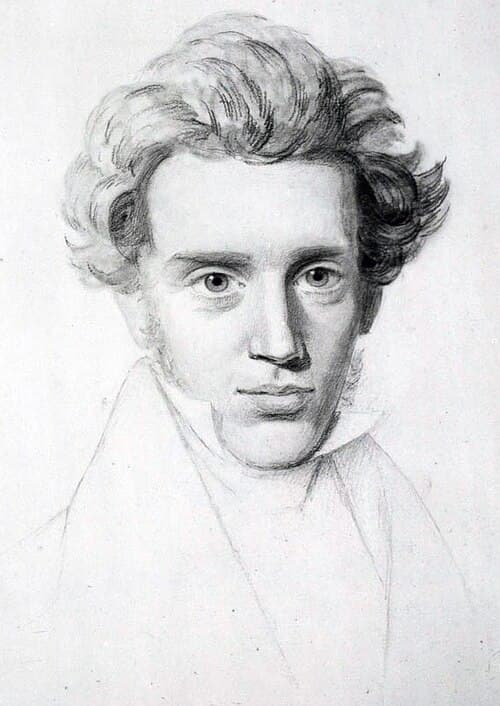
Søren Kierkegaard
Fear and Trembling...stes to him just as good as to one who never knew anything higher, for his continuance in the finite did not bear a trace of the cowed and fearful spirit produced by the process of training; and yet he has this sense of security in enjoying it, as though the finite life were the surest thing of all. And yet, and yet the whole earthly form he exhibits is a new creation by virtue of the absurd. He resigned everything infinitely, and then he grasped everything again by virtue of the absurd.
He constantly makes the movements of infinity, but he does this with such correctness and assurance that he constantly gets the finite out of it, and there is not a second when one has a notion of anything else. It is supposed to be the most difficult task for a dancer to leap into a definite posture in such a way that there is not a second when he is grasping after the posture, but by the leap itself he stands fixed in that posture. Perhaps no dancer can do it–that is what this knight does. Most people live dejectedly in worldly sorrow and joy; they are the ones who sit along the wall and do not join in the dance. The knights of infinity are…
They make the movements upward, and fall down again; and this too is no mean pastime, nor ungraceful to behold. But whenever they fall down they are not able at once to assume the posture, they vacillate an instant, and this vacillation shows that after all they are strangers in the world. This is more or less strikingly evident in proportion to the art they possess, but even the most artistic knights cannot altogether conceal this vacillation. One need not look at them when they are up...
Continue reading →
2
⚖Faith's Highest Passion

Søren Kierkegaard
Fear and TremblingThe author identifies faith as the highest human passion and admits his own personal struggle to reach it, refusing to belittle faith just because he finds it difficult to attain.
...n a holiday have already got through playing all their games before the clock strikes twelve and say impatiently, "Is there nobody can think of a new game?" does this prove that these children are more developed and more advanced than the children of the same generation or of a previous one who could stretch out the familiar games, to last the whole day long? Or does it not prove rather that these children lack what I would call the lovable seriousness which belongs essentially to play?
Faith is the highest passion in a man. There are perhaps many in every generation who do not even reach it, but no one gets further. Whether there be many in our age who do not discover it, I will not decide, I dare only appeal to myself as a witness who makes no secret that the prospects for him are not the best, without for all that wanting to delude himself and to betray the great thing which is faith by reducing it to an insignificance, to an ailment of childhood which one must wish to get over as soon as possible.
But for the man also who does not so much as reach faith life has tasks enough, and if one loves them sincerely, life will by no means be wasted, even though it never is comparable to the life of those who sensed and grasped the highest. But he who reached faith (it makes no difference whether he be a man of distinguished talents or a simple man) does not remain standing at faith, yea, he would be offended if anyone were to say this of him, just as the lover would be indignant if one said...
2
⚖Faith's Unreasonable Journey

Søren Kierkegaard
Fear and TremblingThe author depicts Abraham's journey as a poetic sacrifice of earthly understanding, portraying him as a lonely sojourner who finds favor with God through the abandonment of reason.
...but he who believed God was greater than all. There was one who was great by reason of his power, and one who was great by reason of his wisdom, and one who was great by reason of his hope, and one who was great by reason of his love; but Abraham was greater than all, great by reason of his power whose strength is impotence, great by reason of his wisdom whose secret is foolishness, great by reason of his hope whose form is madness, great by reason of the love which is hatred of oneself.
By faith Abraham went out from the land of his fathers and became a sojourner in the land of promise. He left one thing behind, took one thing with him: he left his earthly understanding behind and took faith with him– otherwise he would not have wandered forth but would have thought this unreasonable. By faith he was a stranger in the land of promise, and there was nothing to recall what was dear to him, but by its novelty everything tempted his soul to melancholy yearning–and yet he was God's elect, in whom the Lord was well pleased!
Yea, if he had been disowned, cast off from God's grace, he could have comprehended it better; but now it was like a mockery of him and of his faith. There was in the world one too who lived in banishment from the fatherland he loved. He is not forgotten, nor his Lamentations when he sorrowfully sought and found what he had lost. There is no song of Lamentations by Abraham. It is human to lament, human to weep with them that weep, but it is greater to believe, more blessed to contemplate...
1
⚖The Docent's Arrogance

Søren Kierkegaard
Fear and TremblingThe author critiques the 'Docents' of his age who judge greatness by results, warning that such a detached perspective lacks any kinship with the actual experience of the great.
...o the paradox, it is likely to be to the following effect: "It is to be judged by the result." A hero who has become a skándalon to his contemporaries because they are conscious that he is a paradox who cannot make himself intelligible, will cry out defiantly to his generation, "The result will surely prove that I am justified." In our age we hear this cry rather seldom, for as our age, to its disadvantage, does not produce heroes, it has also the advantage of producing few caricatures.
When in our age one hears this saying, "It is to be judged according to the result," a man is at once clear as to who it is he has the honor of talking with. Those who talk thus are a numerous tribe, whom I will denominate by the common name of Docents. In their thoughts they live secure in existence, they have a solid position and sure prospects in a well-ordered state, they have centuries and even millenniums between them and the concussions of existence, they do not fear that such things could recur–for what would the police say to that! and the newspapers! Their lifework is to judge the great, and to judge them according to the…
Surely a man who possesses even a little erectioris ingenii [of the higher way of thinking] has not become entirely a cold and clammy mollusk, and when he approaches what is great it can never escape his mind that from the creation of the world it has been customary for the result to come last, and that, if one would truly learn anything from great actions, one must pay attention precisely to the beginning. In case he who should act were to judge himself according to the result, he w...
Continue reading →
3
⚖Faith's First Movement

Søren Kierkegaard
Fear and TremblingThe author admits an inability to truly understand Abraham, expressing astonishment at his faith and critiquing those who try to bypass the 'infinite resignation' required to reach it.
...n times before his name and seventy times before his deed. For this indeed he did not do, as I can prove by the fact that he was glad at receiving Isaac, heartily glad, that he needed no preparation, no time to concentrate upon the finite and its joy. If this had not been the case with Abraham, then perhaps he might have loved God but not believed; for he who loves God without faith reflects upon himself, he who loves God believingly reflects upon God. Upon this pinnacle stands Abraham.
The last stage he loses sight of is the infinite resignation. He really goes further, and reaches faith; for all these caricatures of faith, the miserable lukewarm indolence which thinks, "There surely is no instant need, it is not worth while sorrowing before the time," the pitiful hope which says, "One cannot know what is going to happen … it might possibly be after all"–these caricatures of faith are part and parcel of life's wretchedness, and the infinite resignation has already consigned them to infinite contempt. Abraham I cannot understand, in a certain sense there is nothing I can learn from him but astonishment. If people fancy that…
They would suck worldly wisdom out of the paradox. Perhaps one or another may succeed in that, for our age is not willing to stop with faith, with its miracle of turning water into wine, it goes further, it turns wine into water. Would it not be better to stop with faith, and is it not revolting that everybody wants to go further? When in our age (as indeed is proclaimed in various ways) they will not stop with love, where then are they going? To earthy wisdom, to petty calculation, to p...
Continue reading →
2