Using the Virgin Mary as a metaphor, the author illustrates that divine favor is not a simple privilege but a state defined by profound distress and existential paradox.
Favor's Hidden Distress
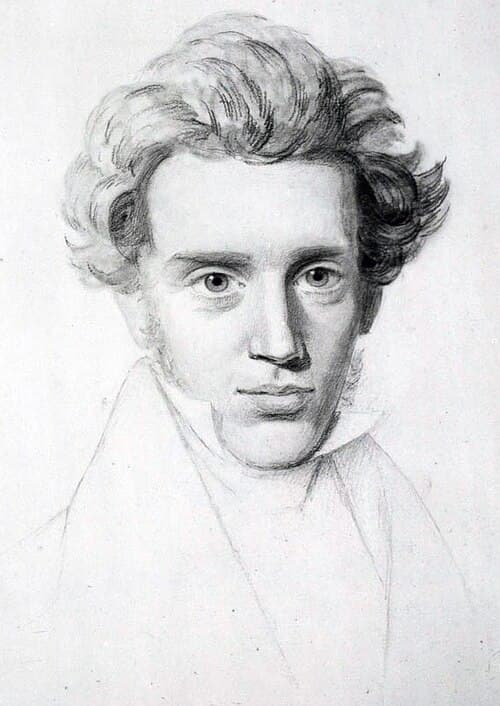
Søren Kierkegaard
Fear and Trembling...ssful every time he bows before them, but he should be frank and confident and always be something more than a charwoman, for if he will not be more, he will never gain entrance. And what will help him is precisely the dread and distress by which the great are tried, for otherwise, if he has a bit of pith in him, they will merely arouse his justified envy. And what distance alone makes great, what people would make great by empty and hollow phrases, that they themselves reduce to naught.
Who was ever so great as that blessed woman, the Mother of God, the Virgin Mary? And yet how do we speak of her? We say that she was highly favored among women. And if it did not happen strangely that those who hear are able to think as inhumanly as those who talk, every young girl might well ask, "Why was not I too the highly favored?" And if I had nothing else to say, I would not dismiss such a question as stupid, for when it is a matter of favor, abstractly considered, everyone is equally entitled to it. What they leave out is the distress, the dread, the paradox.
My thought is as pure as that of anyone, and the thought of the man who is able to think such things will surely become pure–and if this be not so, he may expect the dreadful; for he who once has evoked these images cannot be rid of them again, and if he sins against them, they avenge themselves with quiet wrath, more terrible than the vociferousness of ten ferocious reviewers. To be sure, Mary bore the child miraculously, but it came to pass with her after the manner of women, and that...
2
⚖Pity's Strange Dialectic

Søren Kierkegaard
Fear and TremblingThe author expresses deep personal empathy for the character of Sarah, observing the spiritual cruelty of being an innocent object of pity.
...ring deed! What humility before the face of another personl What faith in God to believe that the next instant she would not hate the husband to whom she owed everything! Let Sarah be a man, and with that the demoniacal is close at hand. The proud and noble nature can endure everything, but one thing it cannot endure, it cannot endure pity. In that there is implied an indignity which can only be inflicted upon one by a higher power, for by oneself one can never become an object of pity.
If a man has sinned, he can bear the punishment for it without despairing; but without blame to be singled out from his mother's womb as a sacrifice to pity, as a sweet-smelling savor in its nostrils, that he cannot put up with. Pity has a strange dialectic, at one moment it requires guilt, the next moment it will not have it, and so it is that to be predestinated to pity is more and more dreadful the more the individual's misfortune is in the direction of the spiritual. But Sarah had no blame attaching to her, she is cast forth as a prey to every suffering and in addition to this has to endure the torture of pity–for even I who admire her…
Put a man in Sarah's place, let him know that in case he were to love a girl a spirit of hell would come and murder his loved one–it might well be possible that he would choose the demoniacal part, that he would shut himself up within himself and say in the way a demoniacal nature talks in secret, "Many thanks, I am no friend of courteous and prolix phrases, I do not absolutely need the pleasure of love, I can become a Blue Beard, finding my delight in seeing maidens perish during the n...
Continue reading →
2
⚖Dread's Misunderstood Lesson

Søren Kierkegaard
Fear and TremblingThe author illustrates the danger of superficial preaching through a scenario where a literal-minded listener attempts to mimic Abraham's sacrifice.
...ags on, Isaac and "the best" are confidently identified, and he who meditates can very well smoke his pipe during the meditation, and the auditor can very well stretch out his legs in comfort. In case that rich young man whom Christ encountered on the road had sold all his goods and given to the poor, we should extol him, as we do all that is great, though without labor we would not understand him–and yet he would not have become an Abraham, in spite of the fact that he offered his best.
What they leave out of Abraham's history is dread; for to money I have no ethical obligation, but to the son the father has the highest and most sacred obligation. Dread, however, is a perilous thing for effeminate natures, hence they forget it, and in spite of that they want to talk about Abraham. So they talk–in the course of the oration they use indifferently the two terms, Isaac and "the best." All goes famously. However, if it chanced that among the auditors there was one who suffered from insomnia–then the most dreadful, the profoundest tragic and comic misunderstanding lies very close. He went home, he would do as Abraham did, for the…
He was delighted with himself, for he had never spoken with such verve and unction. He said to himself and to his wife, "I am an orator. What I lacked was the occasion. When I talked about Abraham on Sunday I did not feel moved in the least." In case the same orator had a little superabundance of reason which might be lost, I think he would have lost it if the sinner were to say calmly and with dignity, "That in fact is what you yourself preached on Sunday." How could the parson be able...
Continue reading →
1
⚖Murder vs Sacrifice

Søren Kierkegaard
Fear and TremblingThe author highlights the contradiction between the ethical view of Abraham as a murderer and the religious view of him as a sacrificer, noting that faith is what creates this dread.
...d is great, and when another does the same it is sin, a heinous sin? In that case I do not wish to participate in such thoughtless eulogy. If faith does not make it a holy act to be willing to murder one's son, then let the same condemnation be pronounced upon Abraham as upon every other man. If a man perhaps lacks courage to carry his thought through, and to say that Abraham was a murderer, then it is surely better to acquire this courage, rather than waste time upon undeserved eulogies.
The ethical expression for what Abraham did is, that he would murder Isaac; the religious expression is, that he would sacrifice Isaac; but precisely in this contradiction consists the dread which can well make a man sleepless, and yet Abraham is not what he is without this dread. Or perhaps he did not do at all what is related, but something altogether different, which is accounted for by the circumstances of his times–then let us forget him, for it is not worth while to remember that past which cannot become a present. Or had perhaps that orator forgotten something which corresponds to the ethical forgetfulness of the fact that Isaac was…
For my part I do not lack the courage to think a thought whole. Hitherto there has been no thought I have been afraid of; if I should run across such a thought, I hope that I have at least the sincerity to say, "I am afraid of this thought, it stirs up something else in me, and therefore I will not think it. If in this I do wrong, the punishment will not fail to follow." If I had recognized that it was the verdict of truth that Abraham was a murderer, I do not know whether I would have b...
Continue reading →
2
⚖The Temptation Beyond

Søren Kierkegaard
Fear and TremblingThe author uses the metaphor of the tragic hero to explore the terrifying uncertainty and potential for self-delusion when an individual renounces the universal for a higher calling.
...ot do so, no one can understand me. Therefore if Abraham would express himself in terms of the universal, he must say that his situation is a temptation (Anfechtung), for he has no higher expression for that universal which stands above the universal which he transgresses. Therefore, though Abraham arouses my admiration, he at the same time appalls me. He who denies himself and sacrifices himself for duty gives up the finite in order to grasp the infinite, and that man is secure enough.
The tragic hero gives up the certain for the still more certain, and the eye of the beholder rests upon him confidently. But he who gives up the universal in order to grasp something still higher which is not the universal–what is he doing? Is it possible that this can be anything else but a temptation (Anfechtung)? And if it be possible … but the individual was mistaken–what can save him? He suffers all the pain of the tragic hero, he brings to naught his joy in the world, he renounces everything … and perhaps at the same instant debars himself from the sublime joy which to him was so precious that he would purchase it at any price.
Him the beholder cannot understand nor let his eye rest confidently upon him. Perhaps it is not possible to do what the believer proposes, since it is indeed unthinkable. Or if it could be done, but if the individual had misunderstood the deity– what can save him? The tragic hero has need of tears and claims them, and where is the envious eye which would be so barren that it could not weep with Agamemnon; but where is the man with a soul so bewildered that he would have the presumption to...
2