Paradox Beyond Mediation
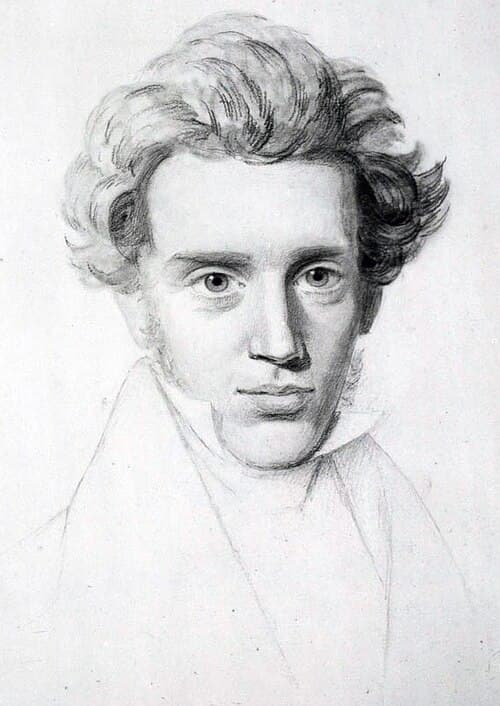
Søren Kierkegaard
Fear and Trembling

The author categorizes Abraham as a paradox that cannot be mediated, asserting that he is either a murderer or a believer because he lacks the 'middle term' of the tragic hero.

...a temptation (Anfechtung). Now the story of Abraham contains such a teleological suspension of the ethical. There have not been lacking clever pates and profound investigators who have found analogies to it. Their wisdom is derived from the pretty proposition that at bottom everything is the same. If one will look a little more closely, I have not much doubt that in the whole world one will not find a single analogy (except a later instance which proves nothing), if it stands fast that
Abraham is the representative of faith, and that faith is normally expressed in him whose life is not merely the most paradoxical that can be thought but so paradoxical that it cannot be thought at all. He acts by virtue of the absurd, for it is precisely absurd that he as the particular is higher than the universal. This paradox cannot be mediated; for as soon as he begins to do this he has to admit that he was in temptation (Anfechtung), and if such was the case, he never gets to the point of sacrificing Isaac, or, if he has sacrificed Isaac, he must turn back repentantly to the universal. By virtue of the absurd he gets Isaac again.…
Hence it is that I can understand the tragic hero but cannot understand Abraham, though in a certain crazy sense I admire him more than all other men. Abraham's relation to Isaac, ethically speaking, is quite simply expressed by saying that a father shall love his son more dearly than himself. Yet within its own compass the ethical has various gradations. Let us see whether in this story there is to be found any higher expression for the ethical such as would ethically explain his conduc...
Continue reading →
2
The Terrible Individual
Søren Kierkegaard
Fear and Trembling

The author challenges the idea that existing as an individual is easy, suggesting it requires more strict self-supervision than living under universal rules.

...in the Church–not even his father and mother etc.–who fails to understand him. On the other hand, he is not a knight of faith, and he has also a different answer from that of Abraham: he does not say that it is a trial or a temptation in which he is tested. People commonly refrain from quoting such a text as this in Luke. They are afraid of giving men a free rein, are afraid that the worst will happen as soon as the individual takes it into his head to comport himself as the individual.
Moreover, they think that to exist as the individual is the easiest thing of all, and that therefore people have to be compelled to become the universal. I cannot share either this fear or this opinion, and both for the same reason. He who has learned that to exist as the individual is the most terrible thing of all will not be fearful of saying that it is great, but then too he will say this in such a way that his words will scarcely be a snare for the bewildered man, but rather will help him into the universal, even though his words do to some extent make room for the great. The man who does not dare to mention such texts will not dare to…
That there may be some who need compulsion, some who, if they were free-footed, would riot in selfish pleasures like unruly beasts, is doubtless true; but a man must prove precisely that he is not of this number by the fact that he knows how to speak with dread and trembling; and out of reverence for the great one is bound to speak, lest it be forgotten for fear of the ill effect, which surely will fail to eventuate when a man talks in such a way that one knows it for the great, knows it...
Continue reading →
4
Individual vs Universal
Søren Kierkegaard
Fear and Trembling

The author distinguishes the tragic hero, who acts for the universal good, from Abraham, who exists in a paradox where the individual is higher than the universal.

...hetics, for aesthetics can well understand that I sacrifice myself, but not that I sacrifice another for my own sake. The aesthetic hero was silent. Ethics condemned him, however, because he was silent by virtue of his accidental particularity. His human foreknowledge was what determined him to keep silent. This ethics cannot forgive, every such human knowledge is only an illusion, ethics requires an infinite movement, it requires revelation. So the aesthetic hero can speak but will not.
The genuine tragic hero sacrifices himself and all that is his for the universal, his deed and every emotion with him belong to the universal, he is revealed, and in this self-revelation he is the beloved son of ethics. This does not fit the case of Abraham: he does nothing for the universal, and he is concealed. Now we reach the paradox. Either the individual as the individual is able to stand in an absolute relation to the absolute (and then the ethical is not the highest)/or Abraham is lost–he is neither a tragic hero, nor an aesthetic hero.
Here again it may seem as if the paradox were the easiest and most convenient thing of all. However, I must repeat that he who counts himself convinced of this is not a knight of faith, for distress and anguish are the only legitimations that can be thought of, and they cannot be thought in general terms, for with that the paradox is annulled. Abraham keeps silent–but he cannot speak. Therein lies the distress and anguish. For if I when I speak am unable to make myself intelligible, th...
2
Faith's Hardest Task
Søren Kierkegaard
Fear and Trembling

The author commands that while infinite resignation is a duty for all, no one has the right to misrepresent faith as something easy or lowly.

...infinite resignation, their elasticity is due to the fact that the individual is incommensurable with reality. The last movement, the paradoxical movement of faith, I cannot make (be that a duty or whatever it may be), in spite of the fact that I would do it more than gladly. Whether a man has a right to make this affirmation, must be left to him, it is a question between him and the Eternal Being who is the object of faith whether in this respect he can hit upon an amicable compromise.
What every man can do is to make the movement of infinite resignation, and I for my part would not hesitate to pronounce everyone cowardly who wishes to make himself believe he can not do it. With faith it is a different matter. But what every man has not a right to do, is to make others believe that faith is something lowly, or that it is an easy thing, whereas it is the greatest and the hardest.
People construe the story of Abraham in another way. They extol God's grace in bestowing Isaac upon him again–the whole thing was only a trial. A trial–that word may say much or little, and yet the whole thing is over as quickly as it is said. One mounts a winged horse, the same instant one is at Mount Moriah, the same instant one sees the ram; one forgets that Abraham rode only upon an ass, which walks slowly along the road, that he had a journey of three days, that he needed some time...
2
Murder vs Sacrifice
Søren Kierkegaard
Fear and Trembling

The author highlights the contradiction between the ethical view of Abraham as a murderer and the religious view of him as a sacrificer, noting that faith is what creates this dread.

...d is great, and when another does the same it is sin, a heinous sin? In that case I do not wish to participate in such thoughtless eulogy. If faith does not make it a holy act to be willing to murder one's son, then let the same condemnation be pronounced upon Abraham as upon every other man. If a man perhaps lacks courage to carry his thought through, and to say that Abraham was a murderer, then it is surely better to acquire this courage, rather than waste time upon undeserved eulogies.
The ethical expression for what Abraham did is, that he would murder Isaac; the religious expression is, that he would sacrifice Isaac; but precisely in this contradiction consists the dread which can well make a man sleepless, and yet Abraham is not what he is without this dread. Or perhaps he did not do at all what is related, but something altogether different, which is accounted for by the circumstances of his times–then let us forget him, for it is not worth while to remember that past which cannot become a present. Or had perhaps that orator forgotten something which corresponds to the ethical forgetfulness of the fact that Isaac was…
For my part I do not lack the courage to think a thought whole. Hitherto there has been no thought I have been afraid of; if I should run across such a thought, I hope that I have at least the sincerity to say, "I am afraid of this thought, it stirs up something else in me, and therefore I will not think it. If in this I do wrong, the punishment will not fail to follow." If I had recognized that it was the verdict of truth that Abraham was a murderer, I do not know whether I would have b...
Continue reading →
2