The author uses a comedic example of a man in a periwig to illustrate how concealment and revelation function within aesthetics and the relation to the idea.
The Comedy of Concealment
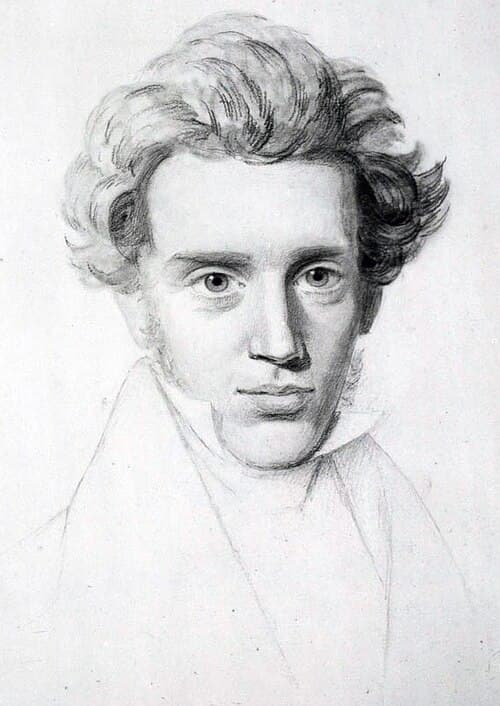
Søren Kierkegaard
Fear and Trembling...age, which is so aesthetically wanton, so potent and so enflamed that the act of conception comes as easy to it as to the partridge hen, which, according to Aristotle's affirmation, needs only to hear the voice of the cock or the sound of its flight overhead–I assume that everyone, merely upon hearing the word "concealment" will be able to shake half a score of romances and comedies out of his sleeve. Wherefore I express myself briefly and so will throw out at once a general observation.
In case one who plays hide and seek (and thereby introduces into the play the dramatic ferment) hides something nonsensical, we get a comedy; if on the other hand he stands in relation to the idea, he may come near being a tragic hero. I give here merely an example of the comic. A man rouges his face and wears a periwig. The same man is eager to try his fortune with the fair sex, he is perfectly sure of conquering by the aid of the rouge and the periwig which make him absolutely irresistible. He captures a girl and is at the acme of happiness. Now comes the gist of the matter: if he is able to admit this embellishment, he does not lose all of…
This science is no friend of bald hypocrites, it abandons him to the mercy of laughter. This must suffice as a mere hint of what I mean–the comical cannot be a subject of interest for this investigation. It is incumbent upon me to examine dialectically the part played by concealment in aesthetics and ethics, for the point is to show the absolute difference between the aesthetic concealment and the paradox. A couple of examples. A girl is secretly in love with a man, although they have n...
Continue reading →
6
⚖Weep for Yourself

Søren Kierkegaard
Fear and TremblingThe author contrasts the tragic hero who deserves public tears with the knight of faith who commands others to weep for themselves rather than for him.
...tate and plays with an infant god. Nevertheless, when she says, "Behold the handmaid of the Lord"–then she is great, and I think it will not be found difficult to explain why she became the Mother of God. She has no need of worldly admiration, any more than Abraham has need of tears, for she was not a heroine, and he was not a hero, but both of them became greater than such, not at all because they were exempted from distress and torment and paradox, but they became great through these.
It is great when the poet, presenting his tragic hero before the admiration of men, dares to say, "Weep for him, for he deserves it." For it is great to deserve the tears of those who are worthy to shed tears. It is great that the poet dares to hold the crowd in check, dares to castigate men, requiring that every man examine himself whether he be worthy to weep for the hero. For the waste-water of blubberers is a degradation of the holy.–But greater than all this it is that the knight of faith dares to say even to the noble man who would weep for him, "Weep not for me, but weep for thyself."
One is deeply moved, one longs to be back in those beautiful times, a sweet yearning conducts one to the desired goal, to see Christ wandering in the promised land. One forgets the dread, the distress, the paradox. Was it so easy a matter not to be mistaken? Was it not dreadful that this man who walks among the others–was it not dreadful that He was God? Was it not dreadful to sit at table with Him? Was it so easy a matter to become an Apostle? But the result, eighteen hundred years–tha...
4
⚖Heroism's Hidden Cost

Søren Kierkegaard
Fear and TremblingThe author argues that true ethical heroism requires a genuine sacrifice of something one actually possesses, rather than a fraudulent leap that bypasses necessary intermediate steps.
...ortune is to fall only upon him. So the two lovers do not find like Axel and Valborg a common expression for their suffering, inasmuch as heaven levels its decree equally against Axel and Valborg because they are equally near of kin to one another. If this were the case here, a way out would be thinkable. For since heaven does not employ any visible power to separate them but leaves this to them, it is thinkable that they might resolve between them to defy heaven and its misfortune too.
Ethics, however, will require him to speak. His heroism then is essentially to be found in the fact that he gives up aesthetic magnanimity, which in this case, however, could not easily be thought to have any admixture of the vanity which consists in being hidden, for it must indeed be clear to him that he makes the girl unhappy. The reality of this heroism depends, however, upon the fact that he had had his opportunity [for a genuine love] and annulled it; for if such heroism could be acquired without this, we should have plenty of heroes in our age, in our age which has attained an unparalleled proficiency in forgery and does the highest…
But then why this sketch, since I get no further after all than the tragic hero? Well, because it is at least possible that it might throw light upon the paradox. Everything depends upon how this man stands related to the utterance of the augurs which is in one way or another decisive for his life. Is this utterance publici juris, or is it a privatissimum? The scene is laid in Greece, the utterance of the augur is intelligible to all. I do not mean merely that the ordinary man is a...
Continue reading →
5
⚖Modern Drama's Emancipation

Søren Kierkegaard
Fear and TremblingThe text contrasts the 'blind' fate of Greek tragedy with the reflective nature of modern drama, where concealment and revelation are the hero's free, responsible acts.
...s to say in the same chapter about the merits of tragedy which are variously appraised in proportion as peripéteia and a'nagnw'risiv impinge upon one another, and also what he says about the "individual" and the "double recognition," I cannot take into consideration here, although by its inwardness and quiet concentration what he says is peculiarly tempting to one who is weary of the superficial omniscience of encyclopedic scholars. A more general observation may be appropriate here.
In Greek tragedy concealment (and consequently recognition) is an epic survival grounded upon a fate in which the dramatic action disappears from view and from which it derives its obscure and enigmatic origin. Hence it is that the effect produced by a Greek tragedy is like the impression of a marble statue which lacks the power of the eye. Greek tragedy is blind. Hence a certain abstraction is necessary in order to appreciate it properly. A son murders his father, but only afterwards does he learn that it was his father. A sister wants to sacrifice her brother, but at the decisive moment she learns who he is. This dramatic motive is not so…
Recognition and concealment are also present as an essential element in modern drama. To adduce examples of this would be too prolix. I am courteous enough to assume that everybody in our age, which is so aesthetically wanton, so potent and so enflamed that the act of conception comes as easy to it as to the partridge hen, which, according to Aristotle's affirmation, needs only to hear the voice of the cock or the sound of its flight overhead–I assume that everyone, merely upon hearing t...
Continue reading →
6
⚖The Interesting Category

Søren Kierkegaard
Fear and TremblingThe author analyzes 'the interesting' as a category of historical turning points and spiritual privilege that is inevitably accompanied by deep pain.
...iacy is the aesthetical, and about this the Hegelian philosophy may be in the right. But faith is not the aesthetical–or else faith has never existed because it has always existed. It will be best to regard the whole matter from a purely aesthetical point of view, and with that intent to embark upon an aesthetic deliberation, to which I beg the reader to abandon himself completely for the moment, while I, to contribute my share, will modify my presentation in conformity with the subject.
The category I would consider a little more closely is the interesting, a category which especially in our age (precisely because our age lives in discrimine rerum) [at a turning point in history] has acquired great importance, for it is properly the category of the turning-point. Therefore we, after having loved this category pro virili [with all our power], should not scorn it as some do because we have outgrown it, but neither should we be too greedy to attain it, for certain it is that to be interesting or to have an interesting life is not a task for industrial art but a fateful privilege, which like every privilege in the…
To take such a life in vain does not beseem a man who takes life seriously, and yet it is not rare to see in our age examples of such an endeavor. Moreover the interesting is a border-category, a boundary between aesthetics and ethics. For this reason our deliberation must constantly glance over into the field of ethics, while in order to be able to acquire significance it must grasp the problem with aesthetic intensity and concupiscence. With such matters ethics seldom deals in our age....
Continue reading →
6