Solitary Faith's Terror
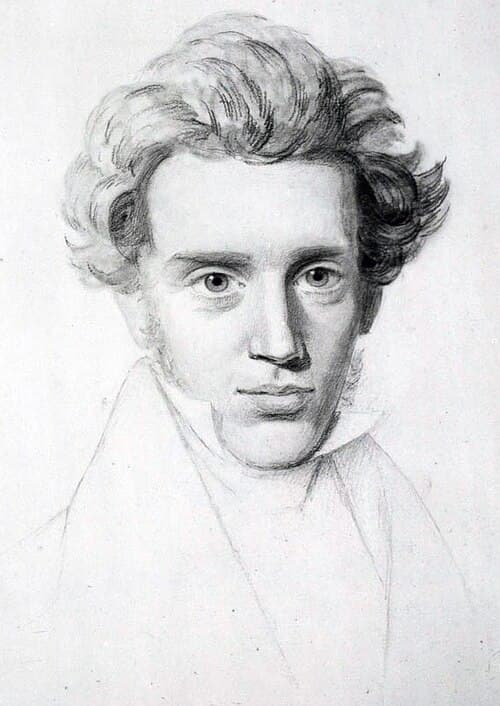
Søren Kierkegaard
Fear and Trembling

The author explores the internal struggle and loneliness of the knight of faith, who must treat the desire for universal understanding as a temptation to be resisted.

...is there winds a solitary path, narrow and steep; he knows that it is terrible to be born outside the universal, to walk without meeting a single traveller. He knows very well where he is and how he is related to men. Humanly speaking, he is crazy and cannot make himself intelligible to anyone. And yet it is the mildest expression, to say that he is crazy. If he is not supposed to be that, then he is a hypocrite, and the higher he climbs on this path, the more dreadful a hypocrite he is.
The knight of faith knows that to give up oneself for the universal inspires enthusiasm, and that it requires courage, but he also knows that security is to be found in this, precisely because it is for the universal. He knows that it is glorious to be understood by every noble mind, so glorious that the beholder is ennobled by it, and he feels as if he were bound; he could wish it were this task that had been allotted to him. Thus Abraham could surely have wished now and then that the task were to love Isaac as becomes a father, in a way intelligible to all, memorable throughout all ages; he could wish that the task were to sacrifice Isaac…
Or what did Abraham accomplish for the universal? Let me speak humanly about it, quite humanly. He spent seventy years in getting a son of his old age. What other men get quickly enough and enjoy for a long time he spent seventy years in accomplishing. And why? Because he was tried and put to the test. Is not that crazy? But Abraham believed, and Sarah wavered and got him to take Hagar as a concubine–but therefore he also had to drive her away. He gets Isaac, then he has to be tried again...
Continue reading →
2
Faith's Tremendous Paradox
Søren Kierkegaard
Fear and Trembling

The author urges the reader to either ignore Abraham or confront the terrifying paradox of his faith to determine if they possess the courage for such a spiritual trial.

...No miracle occurs. The whole of life is a trial." In proportion as the orator proceeds with his outpouring, he would get more and more excited, would become more and more delighted with himself, and whereas he had noticed no congestion of the blood while he talked about Abraham, he now felt how the vein swelled in his forehead. Perhaps he would have lost his breath as well as his tongue if the sinner had answered calmly and with dignity, "But it was about this you preached last Sunday.
"Let us then either consign Abraham to oblivion, or let us learn to be dismayed by the tremendous paradox which constitutes the significance of Abraham's life, that we may understand that our age, like every age, can be joyful if it has faith. In case Abraham is not a nullity, a phantom, a show one employs for a pastime, then the fault can never consist in the fact that the sinner wants to do likewise, but the point is to see how great a thing it was that Abraham did, in order that man may judge for himself whether he has the call and the courage to be subjected to such a test.
The comic contradiction in the behavior of the orator is that he reduced Abraham to an insignificance, and yet would admonish the other to behave in the same way. Should not one dare then to talk about Abraham? I think one should. If I were to talk about him, I would first depict the pain of his trial. To that end I would like a leech suck all the dread and distress and torture out of a father's sufferings, so that I might describe what Abraham suffered, whereas all the while he neverth...
2
Faith by Absurdity
Søren Kierkegaard
Fear and Trembling

The author analyzes Abraham's 'double-movement,' where he resigns Isaac to God while simultaneously believing by virtue of the absurd that he will receive him back.

...ed. That I was resolute in making the movement might prove my courage, humanly speaking; that I loved him with all my soul is the presumption apart from which the whole thing becomes a crime, but yet I did not love like Abraham, for in that case I would have held back even at the last minute, though not for this would I have arrived too late at Mount Moriah. Besides, by my behavior I would have spoiled the whole story; for if I had got Isaac back again, I would have been in embarrassment.
What Abraham found easiest, I would have found hard, namely to be joyful again with Isaac; for he who with all the infinity of his soul, propio motu et propiis auspiciis [by his own power and on his own responsibility], has performed the infinite movement [of resignation] and cannot do more, only retains Isaac with pain. But what did Abraham do? He arrived neither too soon nor too late. He mounted the ass, he rode slowly along the way. All that time he believed– he believed that God would not require Isaac of him, whereas he was willing nevertheless to sacrifice him if it was required. He believed by virtue of the absurd; for there…
Let us go further. We let Isaac be really sacrificed. Abraham believed. He did not believe that some day he would be blessed in the beyond, but that he would be happy here in the world. God could give him a new Isaac, could recall to life him who had been sacrificed. He believed by virtue of the absurd; for all human reckoning had long since ceased to function. That sorrow can derange a man's mind, that we see, and it is sad enough. That there is such a thing as strength of will which is...
Continue reading →
2
Faith's First Movement
Søren Kierkegaard
Fear and Trembling

The author admits his inability to rationally understand Abraham, warning others that they cannot skip the pain of resignation to reach the comfort of faith.

...is the infinite resignation. He really goes further, and reaches faith; for all these caricatures of faith, the miserable lukewarm indolence which thinks, "There surely is no instant need, it is not worth while sorrowing before the time," the pitiful hope which says, "One cannot know what is going to happen … it might possibly be after all"–these caricatures of faith are part and parcel of life's wretchedness, and the infinite resignation has already consigned them to infinite contempt.
Abraham I cannot understand, in a certain sense there is nothing I can learn from him but astonishment. If people fancy that by considering the outcome of this story they might let themselves be moved to believe, they deceive themselves and want to swindle God out of the first movement of faith, the infinite resignation. They would suck worldly wisdom out of the paradox.
Perhaps one or another may succeed in that, for our age is not willing to stop with faith, with its miracle of turning water into wine, it goes further, it turns wine into water. Would it not be better to stop with faith, and is it not revolting that everybody wants to go further? When in our age (as indeed is proclaimed in various ways) they will not stop with love, where then are they going? To earthy wisdom, to petty calculation, to paltriness and wretchedness, to everything which can...
1
Abraham's Procrastination Trial
Søren Kierkegaard
Fear and Trembling

The author portrays Abraham's long life of waiting and his ultimate trial as a unique form of 'procrastination' that transcends the social duties of a tragic hero.

...what did Abraham accomplish for the universal? Let me speak humanly about it, quite humanly. He spent seventy years in getting a son of his old age. What other men get quickly enough and enjoy for a long time he spent seventy years in accomplishing. And why? Because he was tried and put to the test. Is not that crazy? But Abraham believed, and Sarah wavered and got him to take Hagar as a concubine–but therefore he also had to drive her away. He gets Isaac, then he has to be tried again.
He knew that it is glorious to express the universal, glorious to live with Isaac. But this is not the task. He knew that it is a kingly thing to sacrifice such a son for the universal, he himself would have found repose in that, and all would have reposed in the commendation of his deed, as a vowel reposes in its consonant, but that is not the task–he is tried. That Roman general who is celebrated by his name of Cunctator checked the foe by procrastination–but what a procrastinator Abraham is in comparison with him! … yet he did not save the state. This is the content of one hundred and thirty years.
Who can bear it? Would not his contemporary age, if we can speak of such a thing, have said of him, "Abraham is eternally procrastinating. Finally he gets a son. That took long enough. Now he wants to sacrifice him. So is he not mad? And if at least he could explain why he wants to do it–but he always says that it is a trial." Nor could Abraham explain more, for his life is like a book placed under a divine attachment and which never becomes publici juris. This is the terrible thing....
1