Repentance's Double Grip
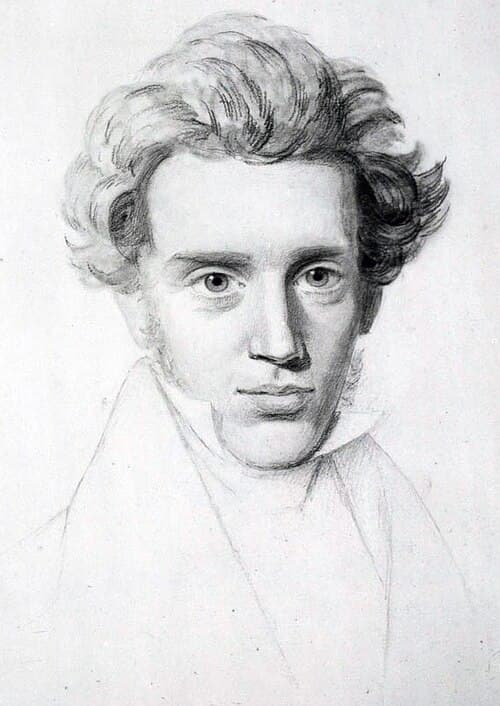
Søren Kierkegaard
Fear and Trembling

The author uses the mythological figure of the merman to metaphorically explore the psychological tension between hidden guilt and the revelation of love.

...ce is more righteous and fair: there is only one protection, and that is innocence. We will now bestow upon the merman a human consciousness and suppose that the fact of his being a merman indicates a human pre- existence in the consequences of which his life is entangled. There is nothing to prevent him from becoming a hero, for the step he now takes is one of reconciliation. He is saved by Agnes, the seducer is crushed, he has bowed to the power of innocence, he can never seduce again.
But at the same instant two powers are striving for possession of him: repentance; and Agnes and repentance. If repentance alone takes possession of him, then he is hidden; if Agnes and repentance take possession of him, then he is revealed. Now in case repentance grips the merman and he remains concealed, he has clearly made Agnes unhappy, for Agnes loved him in all her innocence, she believed that at the instant when even to her he seemed changed, however well he hid it, he was telling the truth in saying that he only wanted to show her the beautiful calmness of the sea. However, with respect to passion the merman himself becomes still more…
The demoniacal element in repentance will now explain to him that this is precisely his punishment [for the faults of his pre-existent state], and that the more it tortures him the better. If he abandons himself to this demoniacal influence, he then perhaps makes still another attempt to save Agnes, in such a way as one can, in a certain sense, save a person by means of the evil. He knows that Agnes loves him. If he could wrest from Agnes this love, then in a way she is saved. But how? T...
Continue reading →
2
Courage Without Faith
Søren Kierkegaard
Fear and Trembling

The author admits his own inability to perform the 'movements of faith,' acknowledging that while he can face the dreadful, he lacks the courage to embrace the absurd.

...something lowly, but on the contrary that it is the highest thing, and that it is dishonest of philosophy to give something else instead of it and to make light of faith. Philosophy cannot and should not give faith, but it should understand itself and know what it has to offer and take nothing away, and least of all should fool people out of something as if it were nothing. I am not unacquainted with the perplexities and dangers of life, I do not fear them, and I encounter them buoyantly.
I am not unacquainted with the dreadful, my memory is a faithful wife, and my imagination is (as I myself am not) a diligent little maiden who all day sits quietly at her work, and in the evening knows how to chat to me about it so prettily that I must look at it, though not always, I must say, is it landscapes, or flowers, or pastoral idyls she paints. I have seen the dreadful before my own eyes, I do not flee from it timorously, but I know very well that, although I advance to meet it, my courage is not the courage of faith, nor anything comparable to it. I am unable to make the movements of faith, I cannot shut my eyes and plunge…
I am convinced that God is love, this thought has for me a primitive lyrical validity. When it is present to me, I am unspeakably blissful, when it is absent, I long for it more vehemently than does the lover for his object; but I do not believe, this courage I lack. For me the love of God is, both in a direct and in an inverse sense, incommensurable with the whole of reality. I am not cowardly enough to whimper and complain, but neither am I deceitful enough to deny that faith is someth...
Continue reading →
2
Movement Beyond Renunciation
Søren Kierkegaard
Fear and Trembling

The knight of faith is defined by a second movement beyond resignation: the belief that the impossible remains possible through God, a concept the understanding cannot grasp.

...lum one had to run through in order to catch up with oneself, and he who will not pass through this curriculum is helped very little by the fact that he was born in the most enlightened age. The infinite resignation is the last stage prior to faith, so that one who has not made this movement has not faith; for only in the infinite resignation do I become clear to myself with respect to my eternal validity, and only then can there be any question of grasping existence by virtue of faith.
Now we will let the knight of faith appear in the role just described. He makes exactly the same movements as the other knight, infinitely renounces claim to the love which is the content of his life, he is reconciled in pain; but then occurs the prodigy, he makes still another movement more wonderful than all, for he says, "I believe nevertheless that I shall get her, in virtue, that is, of the absurd, in virtue of the fact that with God all things are possible." The absurd is not one of the factors which can be discriminated within the proper compass of the understanding: it is not identical with the improbable, the unexpected, the unforeseen.
At the moment when the knight made the act of resignation he was convinced, humanly speaking, of the impossibility. This was the result reached by the understanding, and he had sufficient energy to think it. On the other hand, in an infinite sense it was possible, namely, by renouncing it; but this sort of possessing is at the same time a relinquishing, and yet there is no absurdity in this for the understanding, for the understanding continued to be in the right in affirming that in the...
2
The Knight's Vacillation
Søren Kierkegaard
Fear and Trembling

The author observes that 'knights of infinity' often appear as strangers in the world because they lack the seamless grace of the knight of faith when returning to earthly reality.

...nite out of it, and there is not a second when one has a notion of anything else. It is supposed to be the most difficult task for a dancer to leap into a definite posture in such a way that there is not a second when he is grasping after the posture, but by the leap itself he stands fixed in that posture. Perhaps no dancer can do it–that is what this knight does. Most people live dejectedly in worldly sorrow and joy; they are the ones who sit along the wall and do not join in the dance.
The knights of infinity are dancers and possess elevation. They make the movements upward, and fall down again; and this too is no mean pastime, nor ungraceful to behold. But whenever they fall down they are not able at once to assume the posture, they vacillate an instant, and this vacillation shows that after all they are strangers in the world. This is more or less strikingly evident in proportion to the art they possess, but even the most artistic knights cannot altogether conceal this vacillation. One need not look at them when they are up in the air, but only the instant they touch or have touched the ground–then one recognizes them.
But to be able to fall down in such a way that the same second it looks as if one were standing and walking, to transform the leap of life into a walk, absolutely to express the sublime in the pedestrian–that only the knight of faith can do–and this is the one and only prodigy. But since the prodigy is so likely to be delusive, I will describe the movements in a definite instance which will serve to illustrate their relation to reality, for upon this everything turns. A young swain falls...
2
The Demon's Turning Point
Søren Kierkegaard
Fear and Trembling

The author outlines the dialectical choices for the 'merman' figure: either remaining in religious concealment or finding salvation through the revelation of truth.

...make in conclusion only one psychological observation. The more selfishly Agnes has been developed, the more dazzling will the self-deception be, indeed it is not inconceivable that in reality it might come to pass that a merman by his demoniac shrewdness has, humanly speaking, not only saved an Agnes but brought something extraordinary out of her; for a demon knows how to torture powers out of even the weakest person, and in his way he may have the best intentions toward a human being.
The merman stands at the dialectical turning-point. If he is delivered out of the demoniacal into repentance there are two paths open to him. He may hold back, remain in his concealment, but not rely upon his shrewdness. He does not come as the individual into an absolute relationship with the demoniacal but finds repose in the counter-paradox that the deity will save Agnes. (So it is the Middle Ages would perform the movement, for according to its conception the merman is absolutely dedicated to the cloister.) Or else he may be saved along with Agnes. Now this is not to be understood to mean that by the love of Agnes for him he might be…
Then he marries Agnes. But still he must have recourse to the paradox. For when the individual by his guilt has gone outside the universal he can return to it only by virtue of having come as the individual into an absolute relationship with the absolute. Here I will make an observation by which I say more than was said at any point in the foregoing discussion.* Sin is not the first immediacy, sin is a later immediacy. By sin the individual is already higher (in the direction of the dem...
Continue reading →
3