The author identifies a dual-layered truth in communism: an immutable 'esoteric' revolutionary dogma and a 'realistic' tactical truth used to deceive the bourgeois world. He argues that any compromises with nationalism or private property are merely temporary instruments serving the primary revolutionary goal.
Two Truths of Communism
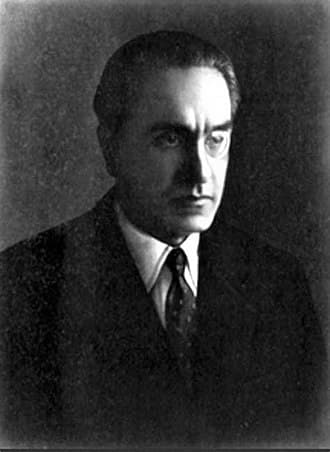
Julius Evola
Revolt Against the Modern World...of the revolution there were never relevant crises or oscillations. This is indeed a characteristic as well as sinister trait; it foreshadows an era in which the forces of darkness will no longer work behind the scenes but come out into the open, having found their most suitable incarnation in beings in whom daemonism teams up with a lucid intellect, a method, and a strong will to power. A phenomenon of this kind is one of the most salient characteristics of the terminal point of every cycle.
As far as the communist idea is concerned, anybody who forgets that there are two truths in communism is likely to be deceived. The first "esoteric" truth has a dogmatic and immutable character; it corresponds to the basic tenets of the revolution and is formulated in the writings and in the directives of the early Bolshevik period. The second is a changeable and "realistic" truth, which is forged case by case, often in apparent contrast with the first truth, and characterized by eventual compromises with the ideas of the "bourgeois" world (e.g., the patriotic idea, mitigation in the collectivization of private property, the Slavic myth, and…
Therefore, those who would fall into this trap and believe that Bolshevism is a thing of the past, that it has evolved and that it is going to take on normal forms of government and international relations, are indeed extremely naive. However, one should not be deceived about the first truth either; the Marxist economic myth is not its primary element. The primary element is the disavowal of every spiritual and transcendent value; the philosophy and the sociology of historical materialism are...
Continue reading →
6
⚖Virtue's Unmoved Center

Julius Evola
Revolt Against the Modern WorldThe author describes the traditional concept of royalty as an 'unmoved mover' or 'pole,' serving as a stable center around which the motion of the state revolves without subversion.
...mbolizes sarhsara or the stream of becoming (the Hellenes called it κύκλος τής γενὲσεως , the "wheel of generation," or κύκλος ανάγκης , "the wheel of Fate"). Its motionless center signifies the spiritual stability inherent in those who are not affected by this stream and who can organize and subject to a higher principle the energies and the activities connected to the inferior nature. Then the cakravartin appears as the dharmarāja, the "Lord of the Law," or the "Lord of the Wheel of the Law."
According to Confucius: "The practice of government by means of virtue may be compared to the polestar, which the multitudinous stars pay homage to while it stays in its place." Hence the meaning of the concept of "revolution," which is the motion occurring around an "unmoved mover," though in our modern day and age it has become synonymous with subversion. In this sense royalty assumes the value of a "pole," by referring to a general traditional symbolism. We may recall here, besides Midgard (the heavenly "middle abode" described in Nordic traditions), Plato's reference to the place where Zeus holds counsel with the gods in order to reach a…
The abovementioned notion of cakravartin is also connected to a cycle of enigmatic traditions concerning the real existence of a "center of the world" that exercises this supreme function here on earth. Some fundamental symbols of regality had originally a close relationship with these ideas. One of these symbols was the scepter, the main function of which is analogically related to the "axis of the world." Another symbol is the throne, an "elevated" place; sitting still on the throne evokes,...
Continue reading →
2
⚖Revolution as Disease

Julius Evola
Revolt Against the Modern WorldA summary of Metternich's view that revolutions are artificial, international diseases provoked by subversive forces, with nationalism serving as a mere mask for global upheaval.
...to spread into the remaining states of traditional and aristocratic Europe as a result of the upheavals brought about by his victorious campaigns. Through the Holy Alliance it would have been possible to create a dam against the fate of the last times. Metternich may rightly be considered the last great European. Nobody was able to see like him with the same far-sighted lucidity and the same overall view the interplay of subversive forces as well as the only way immediately to neutralize them.
Metternich saw all the most essential points: that revolutions are not spontaneous outbursts or mass phenomena, but rather artificial phenomena that are provoked by forces that have the same function in the healthy body of people and states that bacteria have in the generation of diseases in the human body; that nationalism, as it emerged in his own day and age, was only the mask of revolution; that revolution was essentially an international event and that the individual revolutionary phenomena are only localized and partial manifestations of the same subversive current of global proportions.
Metternich also saw very clearly the concatenation of the various degrees of revolution; liberalism and constitutionalism unavoidably pave the way for democracy, which in turn paves the way for socialism, which in turn paves the way for radicalism and finally for communism—the entire liberal revolution of the Third Estate only being instrumental in preparing the way for the revolution of the Fourth Estate, which is destined to inexorably remove the representatives of the former and their world...
5
⚖Rome's Sacred Virility

Julius Evola
Revolt Against the Modern WorldA vision of Rome as the embodiment of 'conquering virility,' where the state and the right to command were rooted in an initiatory, Olympian mystery inaccessible to the masses.
...events befell Rome, the haruspexes were charged with betrayal and after confessing, were executed. Thus, Rome departed from the background of the Italic populations of its origins that were still connected to the spirit of the ancient Southern civilizations, thereby manifesting a new influence that can hardly be traced to its background. This influence, however, could only be exercised through a harsh struggle, both inner and outer, and a series of reactions, adaptations, and transformations.
The ideal of conquering virility was embodied in Rome. This virility was manifested in the doctrine of the state and in the notions of auctoritas and imperium. The state was under the aegis of the Olympian deities (particularly the Capitoline Jupiter, who was detached, sovereign, ungenerated, and exempt from any naturalistic myths and generations) and originally it was not separated from the initiatory "mystery" of regality (adytum et initia regis) that had been declared inaccessible to ordinary people. The imperium (not in the hegemonical and territorial sense of the word) was understood in terms of power and the mystical and dreadful force…
The Roman symbol of fire reflected a similar spirituality, as did the strict paternal right and the articulations of a law that Vico did not hesitate to call "heroic law," since it informed the Roman ethic of honor and faithfulness. This ethic was felt so strongly that, according to Livy, it eventually became a trademark of the Roman people; whereas lacking a fides and following the contingencies of fate characterized by those whom the Romans referred to as "barbarians." The early Romans charac...
Continue reading →
1
⚖The King's Heavenly Mandate

Julius Evola
Revolt Against the Modern WorldThe author describes the traditional Far Eastern concept of kingship as a supernatural force that governs through 'non-action,' exerting an ineluctable influence over common men.
...and "golden" sequence in the divine lineage, which is legitimately appointed to the task of regere. Interestingly enough, the theme of "glory" as a divine attribute is found even in Christianity, and according to mystical theology the beatific vision takes place within the "glory of God." Christian iconography used to portray this glory as a halo around the person's head, thus visibly representing the meaning of the Egyptian uraeus and of the glowing crown of the Persian and Roman solar kings.
According to a Far Eastern tradition, the king, as a "son of heaven" who is believed to have nonhuman origins, enjoys the "mandate of heaven" (tien ming), which implies the idea of a real and supernatural force. This force that comes "from heaven," according to Lao-tzu, acts without acting (wei wu wei) through an immaterial presence, or by virtue of just being present. It is as invisible as the wind, and yet its actions are as ineluctable as the forces of nature. When this power is unleashed, the forces of common men, according to Meng-tzu, bend under it as blades of grass under the wind.
Concerning wu wei, a text says: By its thickness and substantiality, sincerity equals earth; and by its height and splendor it equals heaven. Its extent and duration are without limit. He who possesses this sincerity, without showing himself, he will shine forth, without moving he will renovate others; without acting, he will perfect them. Only such a man, "is able to harmonize the opposing strands of human society, to establish and to maintain moral order in the country." Established in thi...
3