The text distinguishes between a person's desire for an outcome and a legitimate right, defining a right as a claim that society is specifically obligated to protect or provide.
Society's Arbitrary Rights
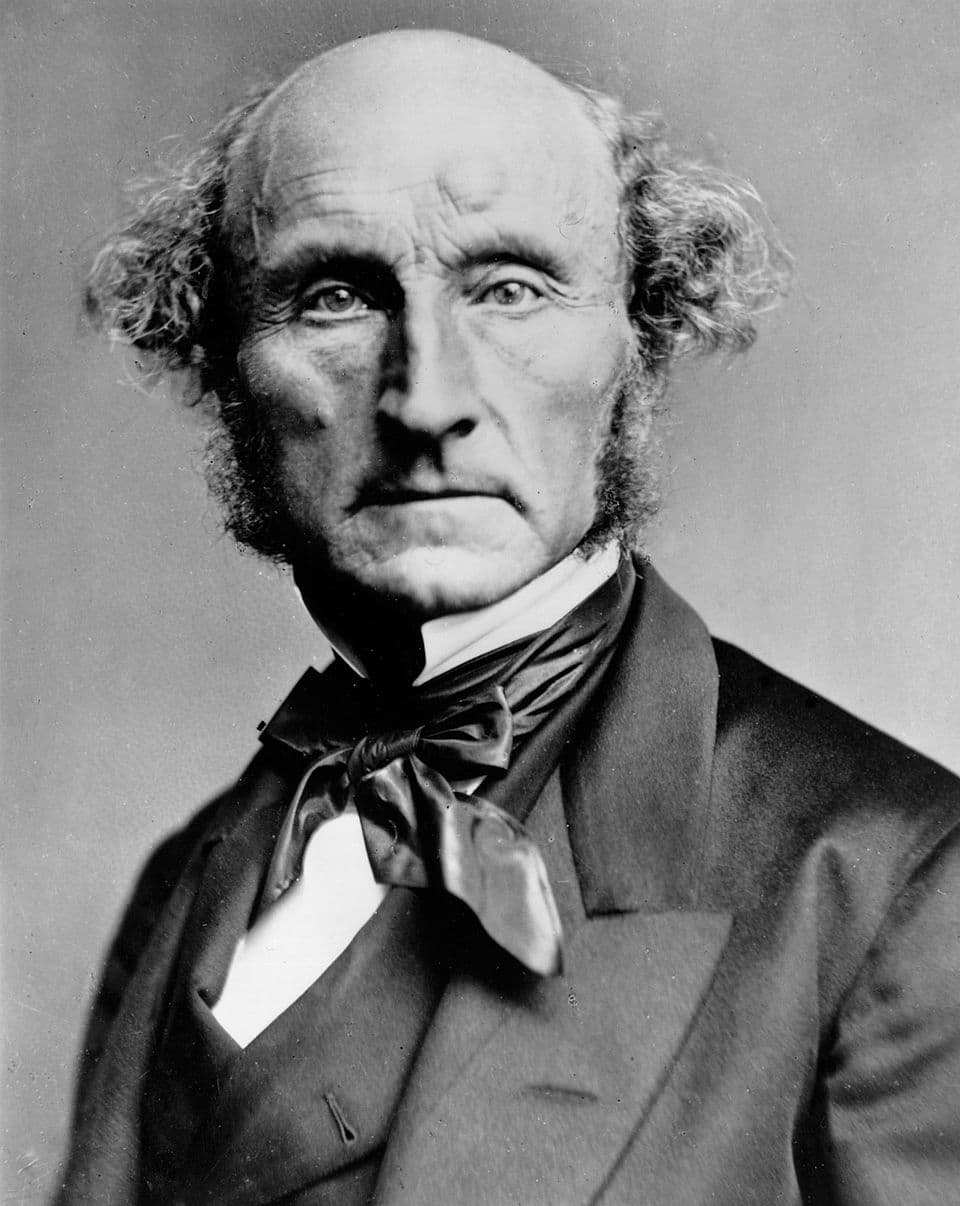
John Stewart Mill
Utilitarianism...on society to protect him in the possession of it, either by the force of law, or by that of education and opinion. If he has what we consider a sufficient claim, on whatever account, to have something guaranteed to him by society, we say that he has a right to it. If we desire to prove that anything does not belong to him by right, we think this done as soon as it is admitted that society ought not to take measures for securing it to him, but should leave it to chance, or to his own exertions.
Thus, a person is said to have a right to what he can earn in fair professional competition; because society ought not to allow any other person to hinder him from endeavouring to earn in that manner as much as he can. But he has not a right to three hundred a-year, though he may happen to be earning it; because society is not called on to provide that he shall earn that sum. On the contrary, if he owns ten thousand pounds three per cent. stock, he has a right to three hundred a-year; because society has come under an obligation to provide him with an income of that amount.
To have a right, then, is, I conceive, to have something which society ought to defend me in the possession of. If the objector goes on to ask why it ought, I can give him no other reason than general utility. If that expression does not seem to convey a sufficient feeling of the strength of the obligation, nor to account for the peculiar energy of the feeling, it is because there goes to the composition of the sentiment, not a rational only but also an animal element, the thirst for retaliati...
6
⚖Right as Social Guarantee

John Stewart Mill
UtilitarianismA right is defined as a valid claim that an individual has upon society to protect their possession of something through law, education, or public opinion.
...treated the idea of a right residing in the injured person, and violated by the injury, not as a separate element in the composition of the idea and sentiment, but as one of the forms in which the other two elements clothe themselves. These elements are, a hurt to some assignable person or persons on the one hand, and a demand for punishment on the other. An examination of our own minds, I think, will show, that these two things include all that we mean when we speak of violation of a right.
When we call anything a person's right, we mean that he has a valid claim on society to protect him in the possession of it, either by the force of law, or by that of education and opinion. If he has what we consider a sufficient claim, on whatever account, to have something guaranteed to him by society, we say that he has a right to it. If we desire to prove that anything does not belong to him by right, we think this done as soon as it is admitted that society ought not to take measures for securing it to him, but should leave it to chance, or to his own exertions.
Thus, a person is said to have a right to what he can earn in fair professional competition; because society ought not to allow any other person to hinder him from endeavouring to earn in that manner as much as he can. But he has not a right to three hundred a-year, though he may happen to be earning it; because society is not called on to provide that he shall earn that sum. On the contrary, if he owns ten thousand pounds three per cent. stock, he has a right to three hundred a-year; because...
6
⚖Right as Social Defense

John Stewart Mill
UtilitarianismThe author defines a right as a claim that society ought to protect based on general utility, specifically the vital interest of security, which is fueled by both rational calculation and the animal instinct for retaliation.
...etition; because society ought not to allow any other person to hinder him from endeavouring to earn in that manner as much as he can. But he has not a right to three hundred a-year, though he may happen to be earning it; because society is not called on to provide that he shall earn that sum. On the contrary, if he owns ten thousand pounds three per cent. stock, he has a right to three hundred a-year; because society has come under an obligation to provide him with an income of that amount.
To have a right, then, is, I conceive, to have something which society ought to defend me in the possession of. If the objector goes on to ask why it ought, I can give him no other reason than general utility. If that expression does not seem to convey a sufficient feeling of the strength of the obligation, nor to account for the peculiar energy of the feeling, it is because there goes to the composition of the sentiment, not a rational only but also an animal element, the thirst for retaliation; and this thirst derives its intensity, as well as its moral justification, from the extraordinarily important and impressive kind of utility which…
Nearly all other earthly benefits are needed by one person, not needed by another; and many of them can, if necessary, be cheerfully foregone, or replaced by something else; but security no human being can possibly do without; on it we depend for all our immunity from evil, and for the whole value of all and every good, beyond the passing moment; since nothing but the gratification of the instant could be of any worth to us, if we could be deprived of everything the next instant by whoever was...
Continue reading →
5
⚖The Absolute Claim

John Stewart Mill
UtilitarianismThe text explains that the intense feeling of justice arises from the essential need for security, making it feel absolute and distinct from ordinary expediency.
...an possibly do without; on it we depend for all our immunity from evil, and for the whole value of all and every good, beyond the passing moment; since nothing but the gratification of the instant could be of any worth to us, if we could be deprived of everything the next instant by whoever was momentarily stronger than ourselves. Now this most indispensable of all necessaries, after physical nutriment, cannot be had, unless the machinery for providing it is kept unintermittedly in active play.
Our notion, therefore, of the claim we have on our fellow creatures to join in making safe for us the very groundwork of our existence, gathers feelings round it so much more intense than those concerned in any of the more common cases of utility, that the difference in degree (as is often the case in psychology) becomes a real difference in kind. The claim assumes that character of absoluteness, that apparent infinity, and incommensurability with all other considerations, which constitute the distinction between the feeling of right and wrong and that of ordinary expediency and inexpediency.
The feelings concerned are so powerful, and we count so positively on finding a responsive feeling in others (all being alike interested), that ought and should grow into must, and recognized indispensability becomes a moral necessity, analogous to physical, and often not inferior to it in binding force. If the preceding analysis, or something resembling it, be not the correct account of the notion of justice; if justice be totally independent of utility, and be a standard per se, whic...
6