Hume acknowledges 'Custom' as an ultimate principle of human nature beyond which inquiry cannot go, urging acceptance of the limits of our faculties.
Custom's Ultimate Principle
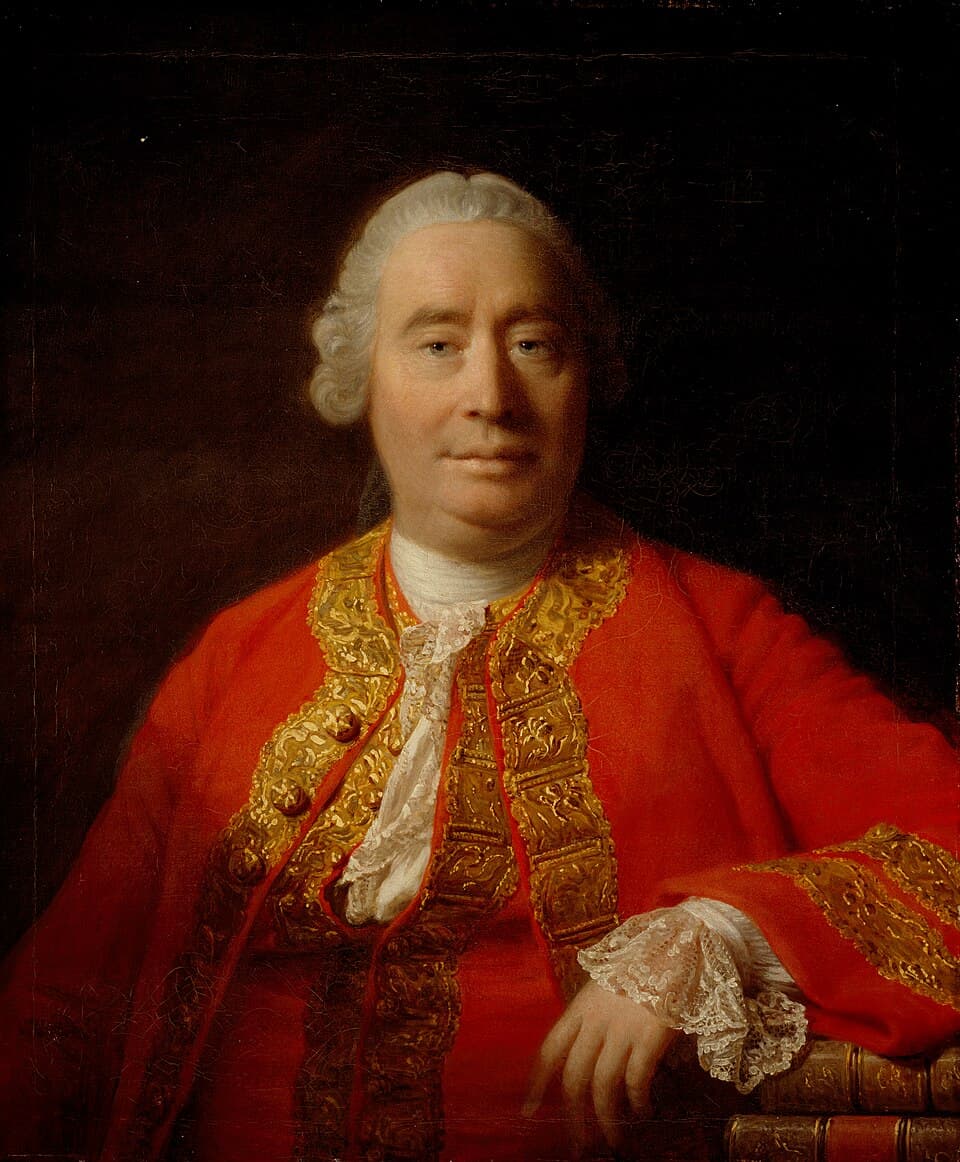
David Hume
An Enquiry Concerning Human Understanding...erience, acquired any idea or knowledge of the secret power by which the one object produces the other; nor is it, by any process of reasoning, he is engaged to draw this inference. But still he finds himself determined to draw it: And though he should be convinced that his understanding has no part in the operation, he would nevertheless continue in the same course of thinking. There is some other principle which determines him to form such a conclusion. 36. This principle is Custom or Habit.
For wherever the repetition of any particular act or operation produces a propensity to renew the same act or operation, without being impelled by any reasoning or process of the understanding, we always say, that this propensity is the effect of Custom. By employing that word, we pretend not to have given the ultimate reason of such a propensity. We only point out a principle of human nature, which is universally acknowledged, and which is well known by its effects. Perhaps we can push our enquiries no farther, or pretend to give the cause of this cause; but must rest contented with it as the ultimate principle, which we can assign, of all…
And it is certain we here advance a very intelligible proposition at least, if not a true one, when we assert that, after the constant conjunction of two objects--heat and flame, for instance, weight and solidity--we are determined by custom alone to expect the one from the appearance of the other. This hypothesis seems even the only one which explains the difficulty, why we draw, from a thousand instances, an inference which we are not able to draw from one instance, that is, in no respect, di...
Continue reading →
4
⚖Philosophy's Blindness

David Hume
An Enquiry Concerning Human UnderstandingHume reflects on the inherent limitations of human reason, observing that the ultimate goal of philosophy is merely to discover the depth of our own blindness and the incomprehensibility of nature's ultimate causes.
...always many other effects, which, to reason, must seem fully as consistent and natural. In vain, therefore, should we pretend to determine any single event, or infer any cause or effect, without the assistance of observation and experience. 26. Hence we may discover the reason why no philosopher, who is rational and modest, has ever pretended to assign the ultimate cause of any natural operation, or to show distinctly the action of that power, which produces any single effect in the universe.
It is confessed, that the utmost effort of human reason is to reduce the principles, productive of natural phenomena, to a greater simplicity, and to resolve the many particular effects into a few general causes, by means of reasonings from analogy, experience, and observation. But as to the causes of these general causes, we should in vain attempt their discovery; nor shall we ever be able to satisfy ourselves, by any particular explication of them. These ultimate springs and principles are totally shut up from human curiosity and enquiry. Elasticity, gravity, cohesion of parts, communication of motion by impulse; these are probably the…
27. Nor is geometry, when taken into the assistance of natural philosophy, ever able to remedy this defect, or lead us into the knowledge of ultimate causes, by all that accuracy of reasoning for which it is so justly celebrated. Every part of mixed mathematics proceeds upon the supposition that certain laws are established by nature in her operations; and abstract reasonings are employed, either to assist experience in the discovery of these laws, or to determine their influence in particular...
Continue reading →
2
⚖Belief Proportioned to Evidence

David Hume
An Enquiry Concerning Human UnderstandingHume advises that a wise person should always proportion their belief to the available evidence, weighing probabilities based on the frequency of past experiences.
...ontrariety of events, which we may learn from a diligent observation. All effects follow not with like certainty from their supposed causes. Some events are found, in all countries and all ages, to have been constantly conjoined together: Others are found to have been more variable, and sometimes to disappoint our expectations; so that, in our reasonings concerning matter of fact, there are all imaginable degrees of assurance, from the highest certainty to the lowest species of moral evidence.
A wise man, therefore, proportions his belief to the evidence. In such conclusions as are founded on an infallible experience, he expects the event with the last degree of assurance, and regards his past experience as a full proof of the future existence of that event. In other cases, he proceeds with more caution: He weighs the opposite experiments: He considers which side is supported by the greater number of experiments: to that side he inclines, with doubt and hesitation; and when at last he fixes his judgement, the evidence exceeds not what we properly call probability. All probability, then, supposes an opposition of experiments and…
A hundred instances or experiments on one side, and fifty on another, afford a doubtful expectation of any event; though a hundred uniform experiments, with only one that is contradictory, reasonably beget a pretty strong degree of assurance. In all cases, we must balance the opposite experiments, where they are opposite, and deduct the smaller number from the greater, in order to know the exact force of the superior evidence. 88. To apply these principles to a particular instance; we may obse...
Continue reading →
2
⚖Cause and Effect's Arbitrary Link

David Hume
An Enquiry Concerning Human UnderstandingThe author asserts that effects are distinct from causes and cannot be discovered a priori, making observation and experience the only valid tools for inferring their connection.
...ay I not conceive, that a hundred different events might as well follow from that cause? May not both these balls remain at absolute rest? May not the first ball return in a straight line, or leap off from the second in any line or direction? All these suppositions are consistent and conceivable. Why then should we give the preference to one, which is no more consistent or conceivable than the rest? All our reasonings a priori will never be able to show us any foundation for this preference.
In a word, then, every effect is a distinct event from its cause. It could not, therefore, be discovered in the cause, and the first invention or conception of it, a priori, must be entirely arbitrary. And even after it is suggested, the conjunction of it with the cause must appear equally arbitrary; since there are always many other effects, which, to reason, must seem fully as consistent and natural. In vain, therefore, should we pretend to determine any single event, or infer any cause or effect, without the assistance of observation and experience.
26. Hence we may discover the reason why no philosopher, who is rational and modest, has ever pretended to assign the ultimate cause of any natural operation, or to show distinctly the action of that power, which produces any single effect in the universe. It is confessed, that the utmost effort of human reason is to reduce the principles, productive of natural phenomena, to a greater simplicity, and to resolve the many particular effects into a few general causes, by means of reasonings from...
4
⚖Habit's Predictive Leap

David Hume
An Enquiry Concerning Human UnderstandingThe author explains how humans develop a habit of transferring past experiences to unknown future events, forming the basis of all empirical reasoning.
...and observation [19]. [19] Since all reasonings concerning facts or causes is derived merely from custom, it may be asked how it happens, that men so much surpass animals in reasoning, and one man so much surpasses another? Has not the same custom the same influence on all? We shall here endeavour briefly to explain the great difference in human understandings: After which the reason of the difference between men and animals will easily be comprehended. 1.
When we have lived any time, and have been accustomed to the uniformity of nature, we acquire a general habit, by which we always transfer the known to the unknown, and conceive the latter to resemble the former. By means of this general habitual principle, we regard even one experiment as the foundation of reasoning, and expect a similar event with some degree of certainty, where the experiment has been made accurately, and free from all foreign circumstances. It is therefore considered as a matter of great importance to observe the consequences of things; and as one man may very much surpass another in attention and memory and observation, this will make a very great difference in their reasoning.
2. Where there is a complication of causes to produce any effect, one mind may be much larger than another, and better able to comprehend the whole system of objects, and to infer justly their consequences. 3. One man is able to carry on a chain of consequences to a greater length than another. 4. Few men can think long without running into a confusion of ideas, and mistaking one for another; and there are various degrees of this infirmity. 5. The cir...
2