Hume suggests that human experimental reasoning is actually a form of instinct similar to that of animals, acting as a mechanical power rather than a purely intellectual faculty.
Reasoning as Instinct
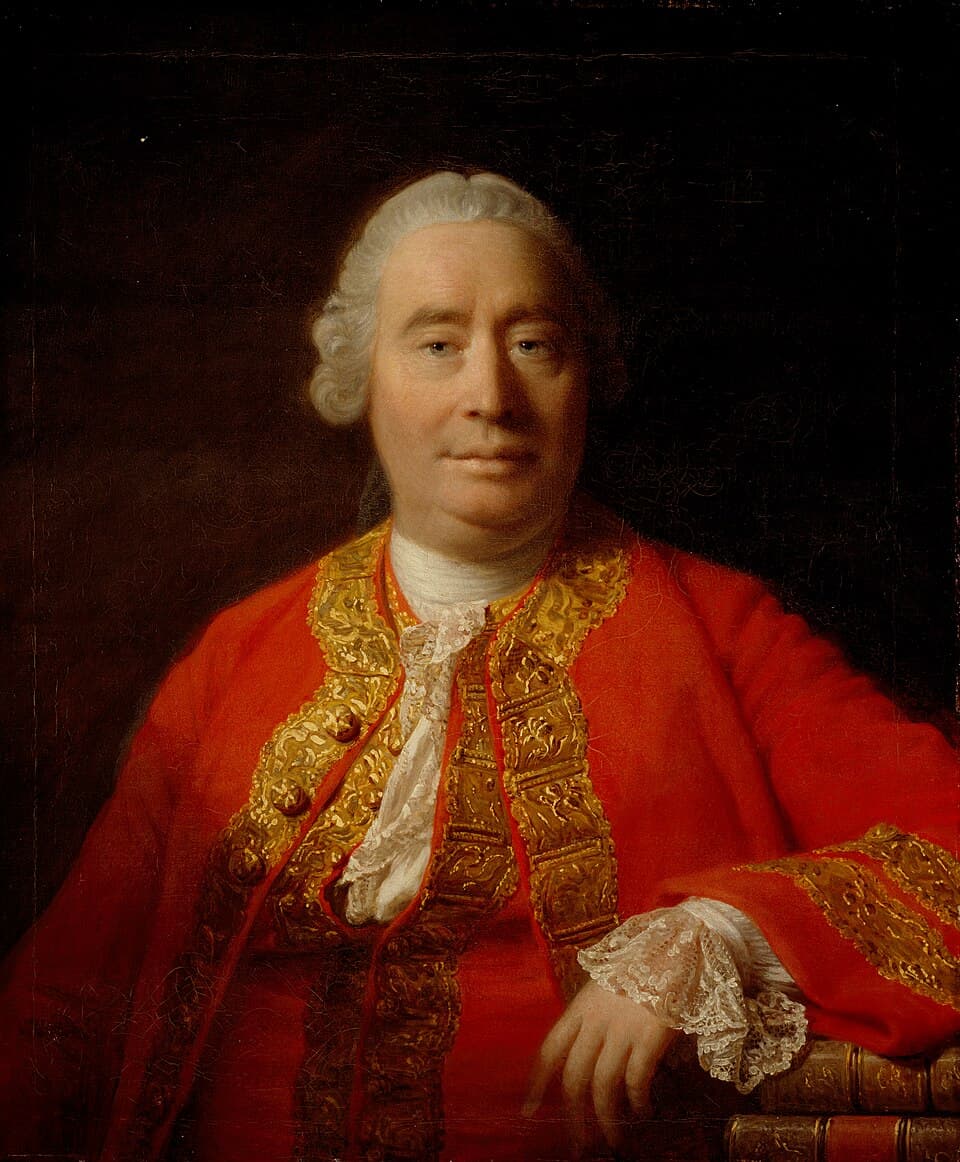
David Hume
An Enquiry Concerning Human Understanding...ience or the greater promptitude of suggesting analogies, will be the better reasoner. 8. Byasses from prejudice, education, passion, party, &c. hang more upon one mind than another. 9. After we have acquired a confidence in human testimony, books and conversation enlarge much more the sphere of one man's experience and thought than those of another. It would be easy to discover many other circumstances that make a difference in the understandings of men. 85.
But though animals learn many parts of their knowledge from observation, there are also many parts of it, which they derive from the original hand of nature; which much exceed the share of capacity they possess on ordinary occasions; and in which they improve, little or nothing, by the longest practice and experience. These we denominate Instincts, and are so apt to admire as something very extraordinary, and inexplicable by all the disquisitions of human understanding. But our wonder will, perhaps, cease or diminish, when we consider, that the experimental reasoning itself, which we possess in common with beasts, and on which the whole…
SECTION X. OF MIRACLES. PART I. 86. There is, in Dr. Tillotson's writings, an argument against the real presence, which is as concise, and elegant, and strong as any argument can possibly be supposed against a doctrine, so little worthy of a serious refutation. It is acknowledged on all hands, says that learned prelate, that the authority, either of the scripture or of tradition, is founded merely in the testimony of the apostles, who were eye-witnesses to those miracles of our Saviou...
Continue reading →
4
⚖Reason's Rash Curiosity

David Hume
An Enquiry Concerning Human UnderstandingThe author critiques religious philosophers for their rash curiosity in trying to prove faith through reason, which often results in more doubt than certainty.
...But so far as in me lies, I will prevent this abuse. We shall not here dispute concerning the origin and government of worlds. We shall only enquire how far such questions concern the public interest. And if I can persuade you, that they are entirely indifferent to the peace of society and security of government, I hope that you will presently send us back to our schools, there to examine, at leisure, the question the most sublime, but at the same time, the most speculative of all philosophy.
The religious philosophers, not satisfied with the tradition of your forefathers, and doctrine of your priests (in which I willingly acquiesce), indulge a rash curiosity, in trying how far they can establish religion upon the principles of reason; and they thereby excite, instead of satisfying, the doubts, which naturally arise from a diligent and scrutinous enquiry. They paint, in the most magnificent colours, the order, beauty, and wise arrangement of the universe; and then ask, if such a glorious display of intelligence could proceed from the fortuitous concourse of atoms, or if chance could produce what the greatest genius can never sufficiently admire.
I shall not examine the justness of this argument. I shall allow it to be as solid as my antagonists and accusers can desire. It is sufficient, if I can prove, from this very reasoning, that the question is entirely speculative, and that, when, in my philosophical disquisitions, I deny a providence and a future state, I undermine not the foundations of society, but advance principles, which they themselves, upon their own topics, if they argue consistently, must allow to be solid and satisfacto...
2
⚖Space and Time's Absurdity

David Hume
An Enquiry Concerning Human UnderstandingThe author discusses the paradox of abstract reasonings regarding space and time, which lead to logically sound but common-sense-defying conclusions like infinite divisibility.
...it, and leave only a certain unknown, inexplicable something, as the cause of our perceptions; a notion so imperfect, that no sceptic will think it worth while to contend against it. PART II. 124. It may seem a very extravagant attempt of the sceptics to destroy reason by argument and ratiocination; yet is this the grand scope of all their enquiries and disputes. They endeavour to find objections, both to our abstract reasonings, and to those which regard matter of fact and existence.
The chief objection against all abstract reasonings is derived from the ideas of space and time; ideas, which, in common life and to a careless view, are very clear and intelligible, but when they pass through the scrutiny of the profound sciences (and they are the chief object of these sciences) afford principles, which seem full of absurdity and contradiction. No priestly dogmas, invented on purpose to tame and subdue the rebellious reason of mankind, ever shocked common sense more than the doctrine of the infinitive divisibility of extension, with its consequences; as they are pompously displayed by all geometricians and…
nor is it possible for us to allow the premises without admitting the consequences. Nothing can be more convincing and satisfactory than all the conclusions concerning the properties of circles and triangles; and yet, when these are once received, how can we deny, that the angle of contact between a circle and its tangent is infinitely less than any rectilineal angle, that as you may increase the diameter of the circle in infinitum, this angle of contact becomes still less, even _in infinitum...
Continue reading →
5
⚖The Naive Observer

David Hume
An Enquiry Concerning Human UnderstandingThe author imagines a person suddenly brought into the world to illustrate that reason alone, without experience, cannot discover the relation of cause and effect.
...en by the mind which is not supported by any argument or process of the understanding; there is no danger that these reasonings, on which almost all knowledge depends, will ever be affected by such a discovery. If the mind be not engaged by argument to make this step, it must be induced by some other principle of equal weight and authority; and that principle will preserve its influence as long as human nature remains the same. What that principle is may well be worth the pains of enquiry. 35.
Suppose a person, though endowed with the strongest faculties of reason and reflection, to be brought on a sudden into this world; he would, indeed, immediately observe a continual succession of objects, and one event following another; but he would not be able to discover anything farther. He would not, at first, by any reasoning, be able to reach the idea of cause and effect; since the particular powers, by which all natural operations are performed, never appear to the senses; nor is it reasonable to conclude, merely because one event, in one instance, precedes another, that therefore the one is the cause, the other the effect. Their…
Suppose, again, that he has acquired more experience, and has lived so long in the world as to have observed familiar objects or events to be constantly conjoined together; what is the consequence of this experience? He immediately infers the existence of one object from the appearance of the other. Yet he has not, by all his experience, acquired any idea or knowledge of the secret power by which the one object produces the other; nor is it, by any process of reasoning, he is engaged to draw t...
Continue reading →
1
⚖Perception's Illusion

David Hume
An Enquiry Concerning Human UnderstandingThe author argues that reason reveals we never perceive external objects directly, but only fleeting mental images or representations of those objects.
...e the external objects, and never entertain any suspicion, that the one are nothing but representations of the other. This very table, which we see white, and which we feel hard, is believed to exist, independent of our perception, and to be something external to our mind, which perceives it. Our presence bestows not being on it: our absence does not annihilate it. It preserves its existence uniform and entire, independent of the situation of intelligent beings, who perceive or contemplate it.
But this universal and primary opinion of all men is soon destroyed by the slightest philosophy, which teaches us, that nothing can ever be present to the mind but an image or perception, and that the senses are only the inlets, through which these images are conveyed, without being able to produce any immediate intercourse between the mind and the object. The table, which we see, seems to diminish, as we remove farther from it: but the real table, which exists independent of us, suffers no alteration: it was, therefore, nothing but its image, which was present to the mind. These are the obvious dictates of reason; and no man, who reflects,…
119. So far, then, are we necessitated by reasoning to contradict or depart from the primary instincts of nature, and to embrace a new system with regard to the evidence of our senses. But here philosophy finds herself extremely embarrassed, when she would justify this new system, and obviate the cavils and objections of the sceptics. She can no longer plead the infallible and irresistible instinct of nature: for that led us to a quite different system, which is acknowledged fallible and even...
Continue reading →
5