The text identifies a psychological principle where the very absurdity of a miracle increases its believability because the resulting emotion of wonder is agreeable to the human mind.
Wonder's Persuasive Power
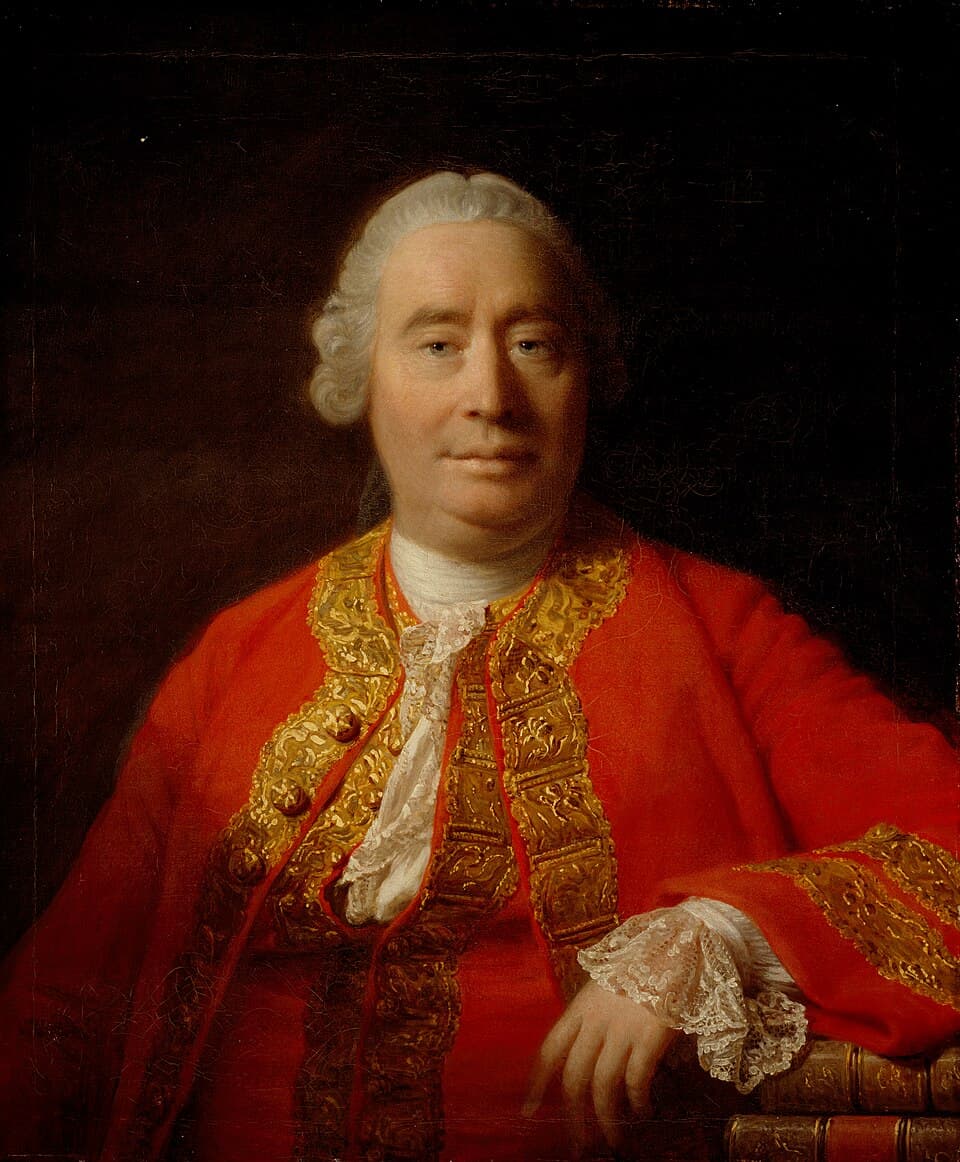
David Hume
An Enquiry Concerning Human Understanding...; of such undoubted integrity, as to place them beyond all suspicion of any design to deceive others; of such credit and reputation in the eyes of mankind, as to have a great deal to lose in case of their being detected in any falsehood; and at the same time, attesting facts performed in such a public manner and in so celebrated a part of the world, as to render the detection unavoidable: All which circumstances are requisite to give us a full assurance in the testimony of men. 93. Secondly.
We may observe in human nature a principle which, if strictly examined, will be found to diminish extremely the assurance, which we might, from human testimony, have, in any kind of prodigy. The maxim, by which we commonly conduct ourselves in our reasonings, is, that the objects, of which we have no experience, resembles those, of which we have; that what we have found to be most usual is always most probable; and that where there is an opposition of arguments, we ought to give the preference to such as are founded on the greatest number of past observations. But though, in proceeding by this rule, we readily reject any fact which is unusual…
And this goes so far, that even those who cannot enjoy this pleasure immediately, nor can believe those miraculous events, of which they are informed, yet love to partake of the satisfaction at second-hand or by rebound, and place a pride and delight in exciting the admiration of others. With what greediness are the miraculous accounts of travellers received, their descriptions of sea and land monsters, their relations of wonderful adventures, strange men, and uncouth manners? But if the spiri...
Continue reading →
3
⚖The Prophet's Delusion

David Hume
An Enquiry Concerning Human UnderstandingThe author provides a cynical insight into the psychological motivations of those who claim divine authority, suggesting vanity and self-delusion drive 'pious frauds'.
...s of testimony must, in all cases, have equal force and authority? Suppose that the Caesarean and Pompeian factions had, each of them, claimed the victory in these battles, and that the historians of each party had uniformly ascribed the advantage to their own side; how could mankind, at this distance, have been able to determine between them? The contrariety is equally strong between the miracles related by Herodotus or Plutarch, and those delivered by Mariana, Bede, or any monkish historian.
The wise lend a very academic faith to every report which favours the passion of the reporter; whether it magnifies his country, his family, or himself, or in any other way strikes in with his natural inclinations and propensities. But what greater temptation than to appear a missionary, a prophet, an ambassador from heaven? Who would not encounter many dangers and difficulties, in order to attain so sublime a character? Or if, by the help of vanity and a heated imagination, a man has first made a convert of himself, and entered seriously into the delusion; who ever scruples to make use of pious frauds, in support of so holy and meritorious a cause?
The smallest spark may here kindle into the greatest flame; because the materials are always prepared for it. The avidum genus auricularum[25], the gazing populace, receive greedily, without examination, whatever sooths superstition, and promotes wonder. [25] Lucret. How many stories of this nature have, in all ages, been detected and exploded in their infancy? How many more have been celebrated for a time, and have afterwards sunk into neglect and oblivion? Where such reports, therefo...
2
⚖Dogmatism's Impatient Certainty

David Hume
An Enquiry Concerning Human UnderstandingThe author observes the human tendency toward dogmatism and the psychological discomfort people feel when faced with hesitation or balanced arguments.
...gh they are not able, by their most diligent enquiry, to satisfy themselves concerning the foundation of these operations, or to remove the objections, which may be raised against them. PART III. 129. There is, indeed, a more mitigated scepticism or academical philosophy, which may be both durable and useful, and which may, in part, be the result of this Pyrrhonism, or excessive scepticism, when its undistinguished doubts are, in some measure, corrected by common sense and reflection.
The greater part of mankind are naturally apt to be affirmative and dogmatical in their opinions; and while they see objects only on one side, and have no idea of any counterpoising argument, they throw themselves precipitately into the principles, to which they are inclined; nor have they any indulgence for those who entertain opposite sentiments. To hesitate or balance perplexes their understanding, checks their passion, and suspends their action. They are, therefore, impatient till they escape from a state, which to them is so uneasy: and they think, that they could never remove themselves far enough from it, by the violence of their affirmations and obstinacy of their belief.
But could such dogmatical reasoners become sensible of the strange infirmities of human understanding, even in its most perfect state, and when most accurate and cautious in its determinations; such a reflection would naturally inspire them with more modesty and reserve, and diminish their fond opinion of themselves, and their prejudice against antagonists. The illiterate may reflect on the disposition of the learned, who, amidst all the advantages of study and reflection, are commonly still di...
2
⚖Custom's Invisible Force

David Hume
An Enquiry Concerning Human UnderstandingHume identifies 'Custom or Habit' as the non-rational principle that determines the mind to infer one object from another after repeated experience.
...reasonable to conclude, merely because one event, in one instance, precedes another, that therefore the one is the cause, the other the effect. Their conjunction may be arbitrary and casual. There may be no reason to infer the existence of one from the appearance of the other. And in a word, such a person, without more experience, could never employ his conjecture or reasoning concerning any matter of fact, or be assured of anything beyond what was immediately present to his memory and senses.
Suppose, again, that he has acquired more experience, and has lived so long in the world as to have observed familiar objects or events to be constantly conjoined together; what is the consequence of this experience? He immediately infers the existence of one object from the appearance of the other. Yet he has not, by all his experience, acquired any idea or knowledge of the secret power by which the one object produces the other; nor is it, by any process of reasoning, he is engaged to draw this inference. But still he finds himself determined to draw it: And though he should be convinced that his understanding has no part in the operation,…
For wherever the repetition of any particular act or operation produces a propensity to renew the same act or operation, without being impelled by any reasoning or process of the understanding, we always say, that this propensity is the effect of Custom. By employing that word, we pretend not to have given the ultimate reason of such a propensity. We only point out a principle of human nature, which is universally acknowledged, and which is well known by its effects. Perhaps we can push our e...
Continue reading →
2
⚖Faith's Miraculous Override

David Hume
An Enquiry Concerning Human UnderstandingThe author observes that religious faith is an internal experience that defies rational understanding, describing it as a personal miracle that subverts one's own logical principles.
...o prophecies; and indeed, all prophecies are real miracles, and as such only, can be admitted as proofs of any revelation. If it did not exceed the capacity of human nature to foretell future events, it would be absurd to employ any prophecy as an argument for a divine mission or authority from heaven. So that, upon the whole, we may conclude, that the Christian Religion not only was at first attended with miracles, but even at this day cannot be believed by any reasonable person without one.
Mere reason is insufficient to convince us of its veracity: And whoever is moved by Faith to assent to it, is conscious of a continued miracle in his own person, which subverts all the principles of his understanding, and gives him a determination to believe what is most contrary to custom and experience.
SECTION XI. OF A PARTICULAR PROVIDENCE AND OF A FUTURE STATE. 102. I was lately engaged in conversation with a friend who loves sceptical paradoxes; where, though he advanced many principles, of which I can by no means approve, yet as they seem to be curious, and to bear some relation to the chain of reasoning carried on throughout this enquiry, I shall here copy them from my memory as accurately as I can, in order to submit them to the judgement of the reader. Our conversation began wit...
2