Hume argues that the sciences of history, politics, and morals are only possible if we assume a necessary and uniform connection between human motives and actions.
Necessity's Practical Foundation
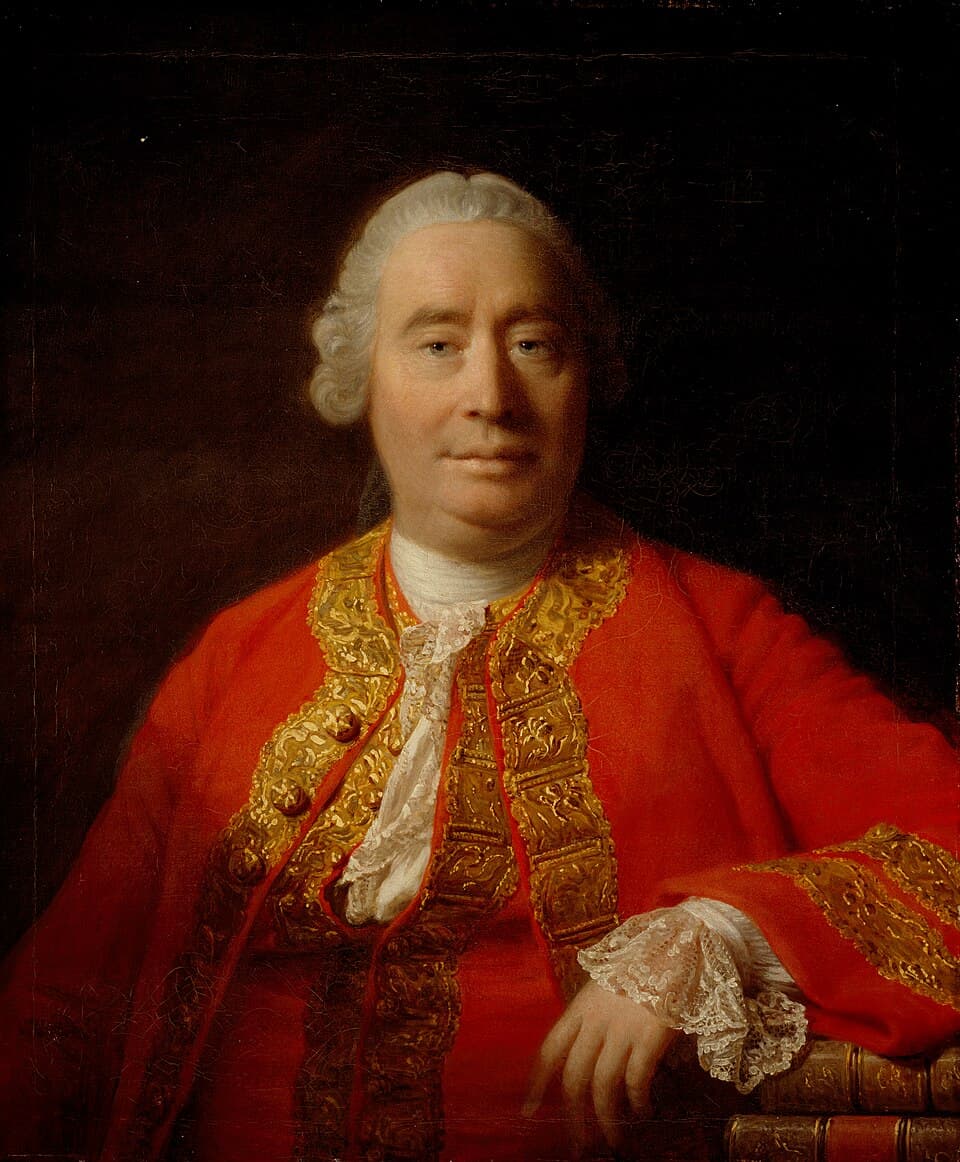
David Hume
An Enquiry Concerning Human Understanding...that no man, while awake, is ever a moment without employing it. Have we not reason, therefore, to affirm that all mankind have always agreed in the doctrine of necessity according to the foregoing definition and explication of it? 70. Nor have philosophers ever entertained a different opinion from the people in this particular. For, not to mention that almost every action of their life supposes that opinion, there are even few of the speculative parts of learning to which it is not essential.
What would become of history, had we not a dependence on the veracity of the historian according to the experience which we have had of mankind? How could politics be a science, if laws and forms of goverment had not a uniform influence upon society? Where would be the foundation of morals, if particular characters had no certain or determinate power to produce particular sentiments, and if these sentiments had no constant operation on actions? And with what pretence could we employ our criticism upon any poet or polite author, if we could not pronounce the conduct and sentiments of his actors either natural or unnatural to such…
And indeed, when we consider how aptly natural and moral evidence link together, and form only one chain of argument, we shall make no scruple to allow that they are of the same nature, and derived from the same principles. A prisoner who has neither money nor interest, discovers the impossibility of his escape, as well when he considers the obstinacy of the gaoler, as the walls and bars with which he is surrounded; and, in all attempts for his freedom, chooses rather to work upon the ston...
Continue reading →
2
⚖The Flames Test

David Hume
An Enquiry Concerning Human UnderstandingThe author issues a provocative command to discard any books that contain neither mathematical reasoning nor experimental facts, labeling them as mere illusion.
...tion in reason, so far as it is supported by experience. But its best and most solid foundation is faith and divine revelation. Morals and criticism are not so properly objects of the understanding as of taste and sentiment. Beauty, whether moral or natural, is felt, more properly than perceived. Or if we reason concerning it, and endeavour to fix its standard, we regard a new fact, to wit, the general tastes of mankind, or some such fact, which may be the object of reasoning and enquiry.
When we run over libraries, persuaded of these principles, what havoc must we make? If we take in our hand any volume; of divinity or school metaphysics, for instance; let us ask, Does it contain any abstract reasoning concerning quantity or number? No. Does it contain any experimental reasoning concerning matter of fact and existence? No. Commit it then to the flames: for it can contain nothing but sophistry and illusion.
4
⚖The Future-Past Problem

David Hume
An Enquiry Concerning Human UnderstandingHume challenges the logical basis of induction, arguing that the assumption that the future will resemble the past is neither intuitive nor demonstratively provable.
...only shows us a number of uniform effects, resulting from certain objects, and teaches us that those particular objects, at that particular time, were endowed with such powers and forces. When a new object, endowed with similar sensible qualities, is produced, we expect similar powers and forces, and look for a like effect. From a body of like colour and consistence with bread we expect like nourishment and support. But this surely is a step or progress of the mind, which wants to be explained.
When a man says, I have found, in all past instances, such sensible qualities conjoined with such secret powers: And when he says, Similar sensible qualities will always be conjoined with similar secret powers, he is not guilty of a tautology, nor are these propositions in any respect the same. You say that the one proposition is an inference from the other. But you must confess that the inference is not intuitive; neither is it demonstrative: Of what nature is it, then? To say it is experimental, is begging the question. For all inferences from experience suppose, as their foundation, that the future will resemble the past, and that…
It is impossible, therefore, that any arguments from experience can prove this resemblance of the past to the future; since all these arguments are founded on the supposition of that resemblance. Let the course of things be allowed hitherto ever so regular; that alone, without some new argument or inference, proves not that, for the future, it will continue so. In vain do you pretend to have learned the nature of bodies from your past experience. Their secret nature, and consequently all their...
Continue reading →
2
⚖History's Constant Principles

David Hume
An Enquiry Concerning Human UnderstandingHume claims that human nature is universal across time and place, and that history serves as a collection of experiments for the moral philosopher to discover constant principles.
...sions, mixed in various degrees, and distributed through society, have been, from the beginning of the world, and still are, the source of all the actions and enterprises, which have ever been observed among mankind. Would you know the sentiments, inclinations, and course of life of the Greeks and Romans? Study well the temper and actions of the French and English: You cannot be much mistaken in transferring to the former most of the observations which you have made with regard to the latter.
Mankind are so much the same, in all times and places, that history informs us of nothing new or strange in this particular. Its chief use is only to discover the constant and universal principles of human nature, by showing men in all varieties of circumstances and situations, and furnishing us with materials from which we may form our observations and become acquainted with the regular springs of human action and behaviour. These records of wars, intrigues, factions, and revolutions, are so many collections of experiments, by which the politician or moral philosopher fixes the principles of his science, in the same manner as the physician…
Nor are the earth, water, and other elements, examined by Aristotle, and Hippocrates, more like to those which at present lie under our observation than the men described by Polybius and Tacitus are to those who now govern the world. Should a traveller, returning from a far country, bring us an account of men, wholly different from any with whom we were ever acquainted; men, who were entirely divested of avarice, ambition, or revenge; who knew no pleasure but friendship, generosity, and public...
Continue reading →
5
⚖The Illusion of Causation

David Hume
An Enquiry Concerning Human UnderstandingHume argues that while common people assume a necessary connection between cause and effect through habit, philosophers recognize that we only ever perceive the constant conjunction of objects.
...on all sides. Do you find anything in it like this creative power, by which it raises from nothing a new idea, and with a kind of Fiat, imitates the omnipotence of its Maker, if I may be allowed so to speak, who called forth into existence all the various scenes of nature? So far from being conscious of this energy in the will, it requires as certain experience as that of which we are possessed, to convince us that such extraordinary effects do ever result from a simple act of volition. 54.
The generality of mankind never find any difficulty in accounting for the more common and familiar operations of nature--such as the descent of heavy bodies, the growth of plants, the generation of animals, or the nourishment of bodies by food: But suppose that, in all these cases, they perceive the very force or energy of the cause, by which it is connected with its effect, and is for ever infallible in its operation. They acquire, by long habit, such a turn of mind, that, upon the appearance of the cause, they immediately expect with assurance its usual attendant, and hardly conceive it possible that any other event could result from it. It…
[13] [Greek: theos apo maechanaes.] 55. Here, then, many philosophers think themselves obliged by reason to have recourse, on all occasions, to the same principle, which the vulgar never appeal to but in cases that appear miraculous and supernatural. They acknowledge mind and intelligence to be, not only the ultimate and original cause of all things, but the immediate and sole cause of every event which appears in nature. They pretend that those objects which are commonly denominated _cau...
Continue reading →
2