The author reiterates that our senses only observe the succession of events, never the underlying power or 'tie' that supposedly connects a cause to its effect.
Causality's Hidden Mechanism
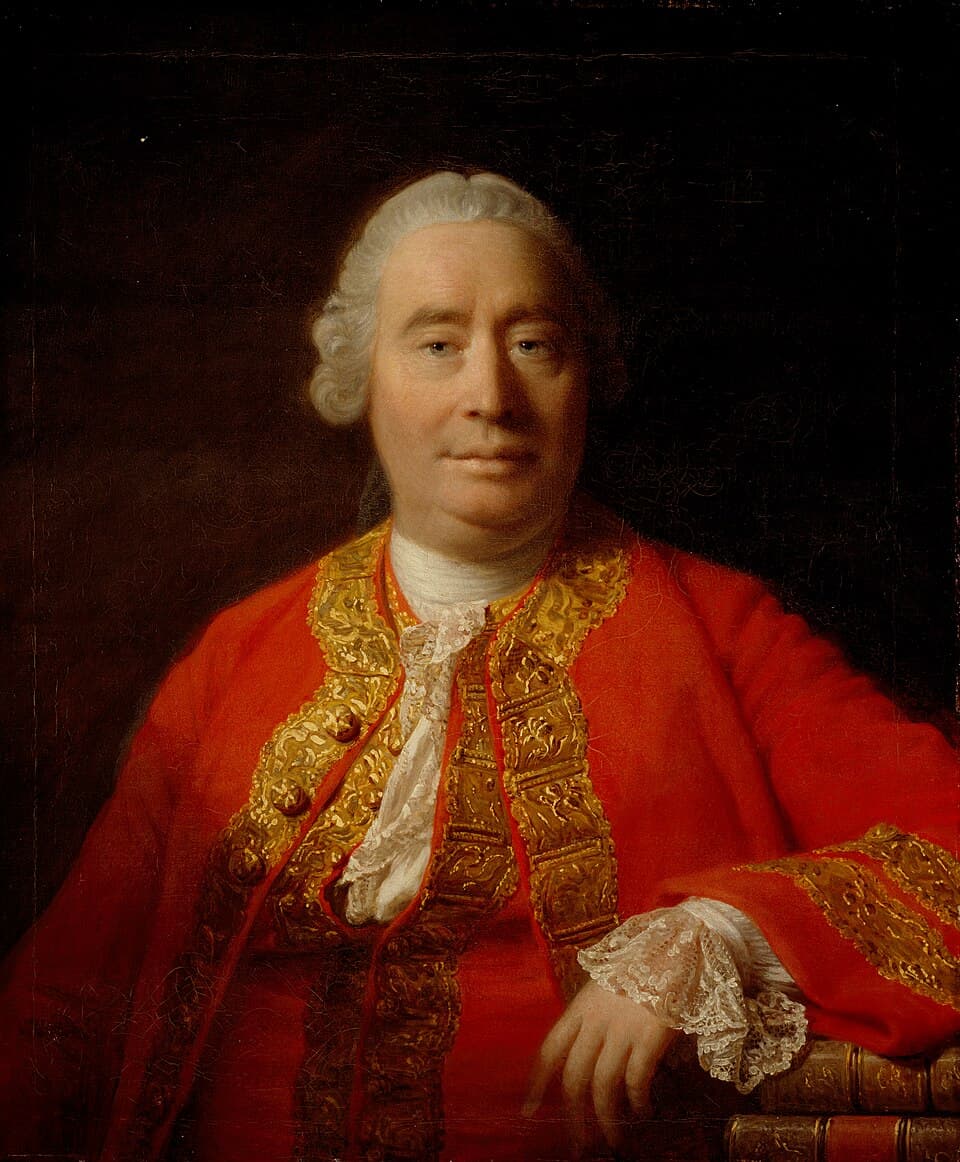
David Hume
An Enquiry Concerning Human Understanding...oral sciences, the most minute, and most simple ideas may be so enlarged as to fall readily under our apprehension, and be equally known with the grossest and most sensible ideas, that can be the object of our enquiry. [10] Section II. 50. To be fully acquainted, therefore, with the idea of power or necessary connexion, let us examine its impression; and in order to find the impression with greater certainty, let us search for it in all the sources, from which it may possibly be derived.
When we look about us towards external objects, and consider the operation of causes, we are never able, in a single instance, to discover any power or necessary connexion; any quality, which binds the effect to the cause, and renders the one an infallible consequence of the other. We only find, that the one does actually, in fact, follow the other. The impulse of one billiard-ball is attended with motion in the second. This is the whole that appears to the outward senses. The mind feels no sentiment or inward impression from this succession of objects: Consequently, there is not, in any single, particular instance of cause and effect,…
From the first appearance of an object, we never can conjecture what effect will result from it. But were the power or energy of any cause discoverable by the mind, we could foresee the effect, even without experience; and might, at first, pronounce with certainty concerning it, by mere dint of thought and reasoning. In reality, there is no part of matter, that does ever, by its sensible qualities, discover any power or energy, or give us ground to imagine, that it could produce any thing, or...
Continue reading →
2
⚖Philosophy's Blindness

David Hume
An Enquiry Concerning Human UnderstandingHume reflects on the inherent limitations of human reason, observing that the ultimate goal of philosophy is merely to discover the depth of our own blindness and the incomprehensibility of nature's ultimate causes.
...always many other effects, which, to reason, must seem fully as consistent and natural. In vain, therefore, should we pretend to determine any single event, or infer any cause or effect, without the assistance of observation and experience. 26. Hence we may discover the reason why no philosopher, who is rational and modest, has ever pretended to assign the ultimate cause of any natural operation, or to show distinctly the action of that power, which produces any single effect in the universe.
It is confessed, that the utmost effort of human reason is to reduce the principles, productive of natural phenomena, to a greater simplicity, and to resolve the many particular effects into a few general causes, by means of reasonings from analogy, experience, and observation. But as to the causes of these general causes, we should in vain attempt their discovery; nor shall we ever be able to satisfy ourselves, by any particular explication of them. These ultimate springs and principles are totally shut up from human curiosity and enquiry. Elasticity, gravity, cohesion of parts, communication of motion by impulse; these are probably the…
27. Nor is geometry, when taken into the assistance of natural philosophy, ever able to remedy this defect, or lead us into the knowledge of ultimate causes, by all that accuracy of reasoning for which it is so justly celebrated. Every part of mixed mathematics proceeds upon the supposition that certain laws are established by nature in her operations; and abstract reasonings are employed, either to assist experience in the discovery of these laws, or to determine their influence in particular...
Continue reading →
2
⚖Reason's Profound Darkness

David Hume
An Enquiry Concerning Human UnderstandingThe author personifies Reason as being in a state of amazement and suspense, caught between the light of certainty and the darkness of the unknown.
...circle in infinitum, this angle of contact becomes still less, even in infinitum, and that the angle of contact between other curves and their tangents may be infinitely less than those between any circle and its tangent, and so on, in infinitum? The demonstration of these principles seems as unexceptionable as that which proves the three angles of a triangle to be equal to two right ones, though the latter opinion be natural and easy, and the former big with contradiction and absurdity.
Reason here seems to be thrown into a kind of amazement and suspence, which, without the suggestions of any sceptic, gives her a diffidence of herself, and of the ground on which she treads. She sees a full light, which illuminates certain places; but that light borders upon the most profound darkness. And between these she is so dazzled and confounded, that she scarcely can pronounce with certainty and assurance concerning any one object. Whatever disputes there may be about mathematical points, we must allow that there are physical points; that is, parts of extension, which cannot be divided or lessened, either by the eye or imagination.
These images, then, which are present to the fancy or senses, are absolutely indivisible, and consequently must be allowed by mathematicians to be infinitely less than any real part of extension; and yet nothing appears more certain to reason, than that an infinite number of them composes an infinite extension. How much more an infinite number of those infinitely small parts of extension, which are still supposed infinitely divisible. 125. The absurdity of these bol...
2
⚖The Chain of Necessity

David Hume
An Enquiry Concerning Human UnderstandingThe passage explores the logical consequences of determinism, noting that if all actions are pre-ordained by a Creator, then human moral guilt must either be non-existent or shared by that Creator.
...ions are objects of our moral sentiment, so far only as they are indications of the internal character, passions, and affections; it is impossible that they can give rise either to praise or blame, where they proceed not from these principles, but are derived altogether from external violence. 78. I pretend not to have obviated or removed all objections to this theory, with regard to necessity and liberty. I can foresee other objections, derived from topics which have not here been treated of.
It may be said, for instance, that, if voluntary actions be subjected to the same laws of necessity with the operations of matter, there is a continued chain of necessary causes, pre-ordained and pre-determined, reaching from the original cause of all to every single volition of every human creature. No contingency anywhere in the universe; no indifference; no liberty. While we act, we are, at the same time, acted upon. The ultimate Author of all our volitions is the Creator of the world, who first bestowed motion on this immense machine, and placed all beings in that particular position, whence every subsequent event, by an inevitable…
For as a man, who fired a mine, is answerable for all the consequences whether the train he employed be long or short; so wherever a continued chain of necessary causes is fixed, that Being, either finite or infinite, who produces the first, is likewise the author of all the rest, and must both bear the blame and acquire the praise which belong to them. Our clear and unalterable ideas of morality establish this rule, upon unquestionable reasons, when we examine the consequences of any human act...
Continue reading →
6
⚖Nature's Hidden Mechanism

David Hume
An Enquiry Concerning Human UnderstandingThe author compares human cognitive instincts to the use of limbs, suggesting that nature guides our thoughts through hidden forces we do not fully understand.
...in its operations; appears not, in any degree, during the first years of infancy; and at best is, in every age and period of human life, extremely liable to error and mistake. It is more conformable to the ordinary wisdom of nature to secure so necessary an act of the mind, by some instinct or mechanical tendency, which may be infallible in its operations, may discover itself at the first appearance of life and thought, and may be independent of all the laboured deductions of the understanding.
As nature has taught us the use of our limbs, without giving us the knowledge of the muscles and nerves, by which they are actuated; so has she implanted in us an instinct, which carries forward the thought in a correspondent course to that which she has established among external objects; though we are ignorant of those powers and forces, on which this regular course and succession of objects totally depends.
SECTION VI. OF PROBABILITY[9]. [9] Mr. Locke divides all arguments into demonstrative and probable. In this view, we must say, that it is only probable all men must die, or that the sun will rise to-morrow. But to conform our language more to common use, we ought to divide arguments into demonstrations, proofs, and probabilities. By proofs meaning such arguments from experience as leave no room for doubt or opposition. 46. Though there be no such thing a...
2