The author reflects on the inherent limitations of human inquiry, noting how quickly nature forces us to acknowledge our ignorance regarding ultimate causes.
Nature's Bar to Inquiry
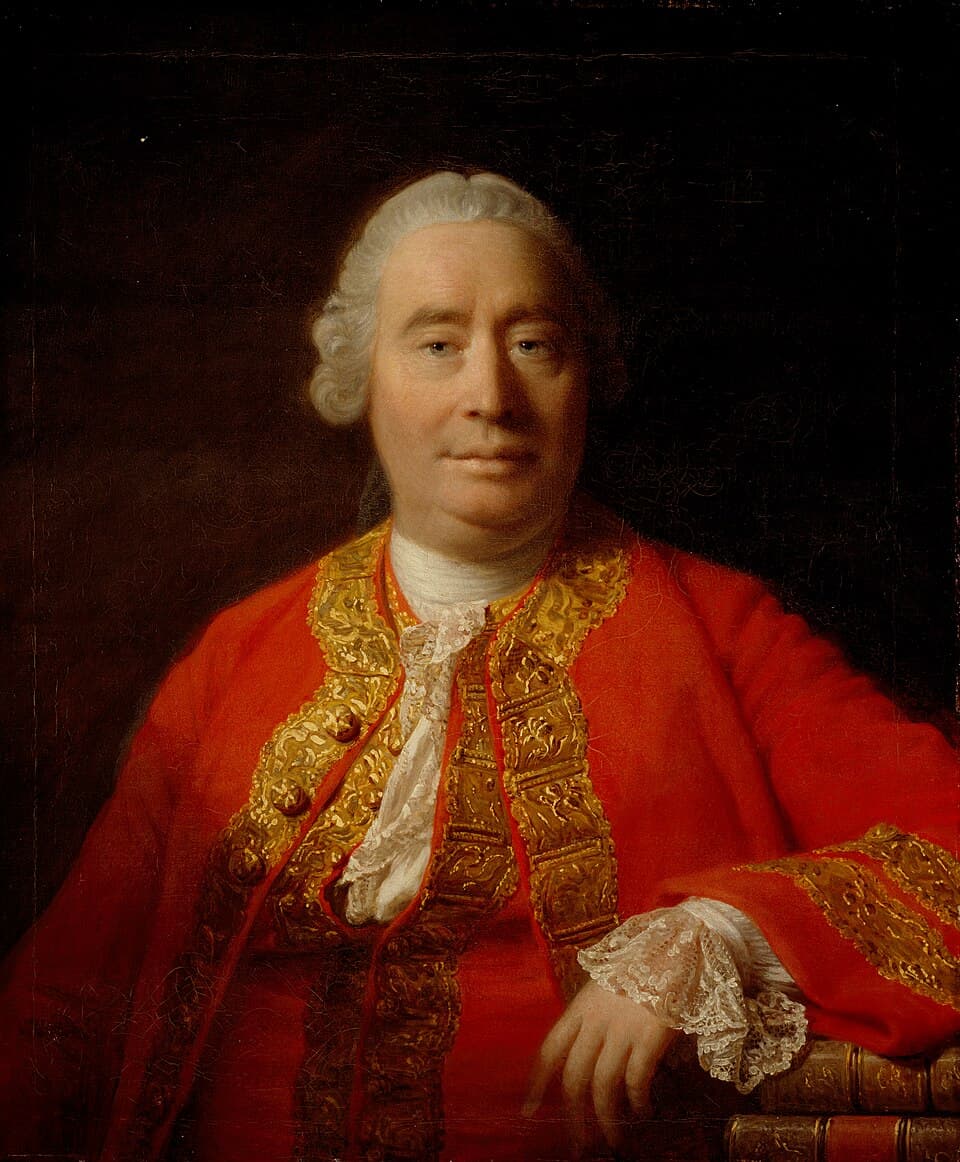
David Hume
An Enquiry Concerning Human Understanding...y reflection; nor is it in our power to recal the original object, as often as we have occasion to contemplate it. Ambiguity, by this means, is gradually introduced into our reasonings: Similar objects are readily taken to be the same: And the conclusion becomes at last very wide of the premises. One may safely, however, affirm, that, if we consider these sciences in a proper light, their advantages and disadvantages nearly compensate each other, and reduce both of them to a state of equality.
If the mind, with greater facility, retains the ideas of geometry clear and determinate, it must carry on a much longer and more intricate chain of reasoning, and compare ideas much wider of each other, in order to reach the abstruser truths of that science. And if moral ideas are apt, without extreme care, to fall into obscurity and confusion, the inferences are always much shorter in these disquisitions, and the intermediate steps, which lead to the conclusion, much fewer than in the sciences which treat of quantity and number. In reality, there is scarcely a proposition in Euclid so simple, as not to consist of more parts, than are to be…
The chief obstacle, therefore, to our improvement in the moral or metaphysical sciences is the obscurity of the ideas, and ambiguity of the terms. The principal difficulty in the mathematics is the length of inferences and compass of thought, requisite to the forming of any conclusion. And, perhaps, our progress in natural philosophy is chiefly retarded by the want of proper experiments and phaenomena, which are often discovered by chance, and cannot always be found, when requisite, even by the...
Continue reading →
2
⚖Fact vs Necessity

David Hume
An Enquiry Concerning Human UnderstandingThe author argues that matters of fact are incapable of logical demonstration because their negation is always conceivable and never involves a formal contradiction.
...at where there is no property, there can be no injustice_, it is only necessary to define the terms, and explain injustice to be a violation of property. This proposition is, indeed, nothing but a more imperfect definition. It is the same case with all those pretended syllogistical reasonings, which may be found in every other branch of learning, except the sciences of quantity and number; and these may safely, I think, be pronounced the only proper objects of knowledge and demonstration. 132.
All other enquiries of men regard only matter of fact and existence; and these are evidently incapable of demonstration. Whatever is may not be. No negation of a fact can involve a contradiction. The non-existence of any being, without exception, is as clear and distinct an idea as its existence. The proposition, which affirms it not to be, however false, is no less conceivable and intelligible, than that which affirms it to be. The case is different with the sciences, properly so called. Every proposition, which is not true, is there confused and unintelligible.
That the cube root of 64 is equal to the half of 10, is a false proposition, and can never be distinctly conceived. But that Caesar, or the angel Gabriel, or any being never existed, may be a false proposition, but still is perfectly conceivable, and implies no contradiction. The existence, therefore, of any being can only be proved by arguments from its cause or its effect; and these arguments are founded entirely on experience. If we reason a priori, anything may appear able to produce any...
6
⚖Miracles' Diminished Authority

David Hume
An Enquiry Concerning Human UnderstandingThe author recommends a general resolution to distrust testimony regarding miracles, as the commonality of human falsehood outweighs the probability of a violation of natural law.
...henomena, that I should rather believe the most extraordinary events to arise from their concurrence, than admit of so signal a violation of the laws of nature. But should this miracle be ascribed to any new system of religion; men, in all ages, have been so much imposed on by ridiculous stories of that kind, that this very circumstance would be a full proof of a cheat, and sufficient, with all men of sense, not only to make them reject the fact, but even reject it without farther examination.
Though the Being to whom the miracle is ascribed, be, in this case, Almighty, it does not, upon that account, become a whit more probable; since it is impossible for us to know the attributes or actions of such a Being, otherwise than from the experience which we have of his productions, in the usual course of nature. This still reduces us to past observation, and obliges us to compare the instances of the violation of truth in the testimony of men, with those of the violation of the laws of nature by miracles, in order to judge which of them is most likely and probable. As the violations of truth are more common in the testimony concerning…
Lord Bacon seems to have embraced the same principles of reasoning. 'We ought,' says he, 'to make a collection or particular history of all monsters and prodigious births or productions, and in a word of every thing new, rare, and extraordinary in nature. But this must be done with the most severe scrutiny, lest we depart from truth. Above all, every relation must be considered as suspicious, which depends in any degree upon religion, as the prodigies of Livy: And no less so, every thing that...
Continue reading →
4
⚖Chain of Certainty

David Hume
An Enquiry Concerning Human UnderstandingThrough the metaphor of a prisoner facing both iron bars and human guards, the author illustrates that the mind perceives no difference between physical and moral necessity.
...al to such characters, and in such circumstances? It seems almost impossible, therefore, to engage either in science or action of any kind without acknowledging the doctrine of necessity, and this inference from motive to voluntary actions, from characters to conduct. And indeed, when we consider how aptly natural and moral evidence link together, and form only one chain of argument, we shall make no scruple to allow that they are of the same nature, and derived from the same principles.
A prisoner who has neither money nor interest, discovers the impossibility of his escape, as well when he considers the obstinacy of the gaoler, as the walls and bars with which he is surrounded; and, in all attempts for his freedom, chooses rather to work upon the stone and iron of the one, than upon the inflexible nature of the other. The same prisoner, when conducted to the scaffold, foresees his death as certainly from the constancy and fidelity of his guards, as from the operation of the axe or wheel. His mind runs along a certain train of ideas: The refusal of the soldiers to consent to his escape; the action of the executioner; the…
The same experienced union has the same effect on the mind, whether the united objects be motives, volition, and actions; or figure and motion. We may change the name of things; but their nature and their operation on the understanding never change. Were a man, whom I know to be honest and opulent, and with whom I live in intimate friendship, to come into my house, where I am surrounded with my servants, I rest assured that he is not to stab me before he leaves it in order to rob me of my silv...
Continue reading →
2
⚖Witnesses vs Impossibility

David Hume
An Enquiry Concerning Human UnderstandingThe author asserts that reasonable individuals should reject testimony regarding miracles, as the inherent impossibility of the event outweighs any amount of human evidence.
...roved upon the spot, before judges of unquestioned integrity, attested by witnesses of credit and distinction, in a learned age, and on the most eminent theatre that is now in the world. Nor is this all: a relation of them was published and dispersed every where; nor were the Jesuits, though a learned body, supported by the civil magistrate, and determined enemies to those opinions, in whose favour the miracles were said to have been wrought, ever able distinctly to refute or detect them[24].
Where shall we find such a number of circumstances, agreeing to the corroboration of one fact? And what have we to oppose to such a cloud of witnesses, but the absolute impossibility or miraculous nature of the events, which they relate? And this surely, in the eyes of all reasonable people, will alone be regarded as a sufficient refutation.
[24] This book was writ by Mons. Montgeron, counsellor or judge of the parliament of Paris, a man of figure and character, who was also a martyr to the cause, and is now said to be somewhere in a dungeon on account of his book. There is another book in three volumes (called Recueil des Miracles de l'Abbé Paris) giving an account of many of these miracles, and accompanied with prefatory discourses, which are very well written. There runs, however, through the...
4