The author explains how humans develop a habit of transferring past experiences to unknown future events, forming the basis of all empirical reasoning.
Habit's Predictive Leap
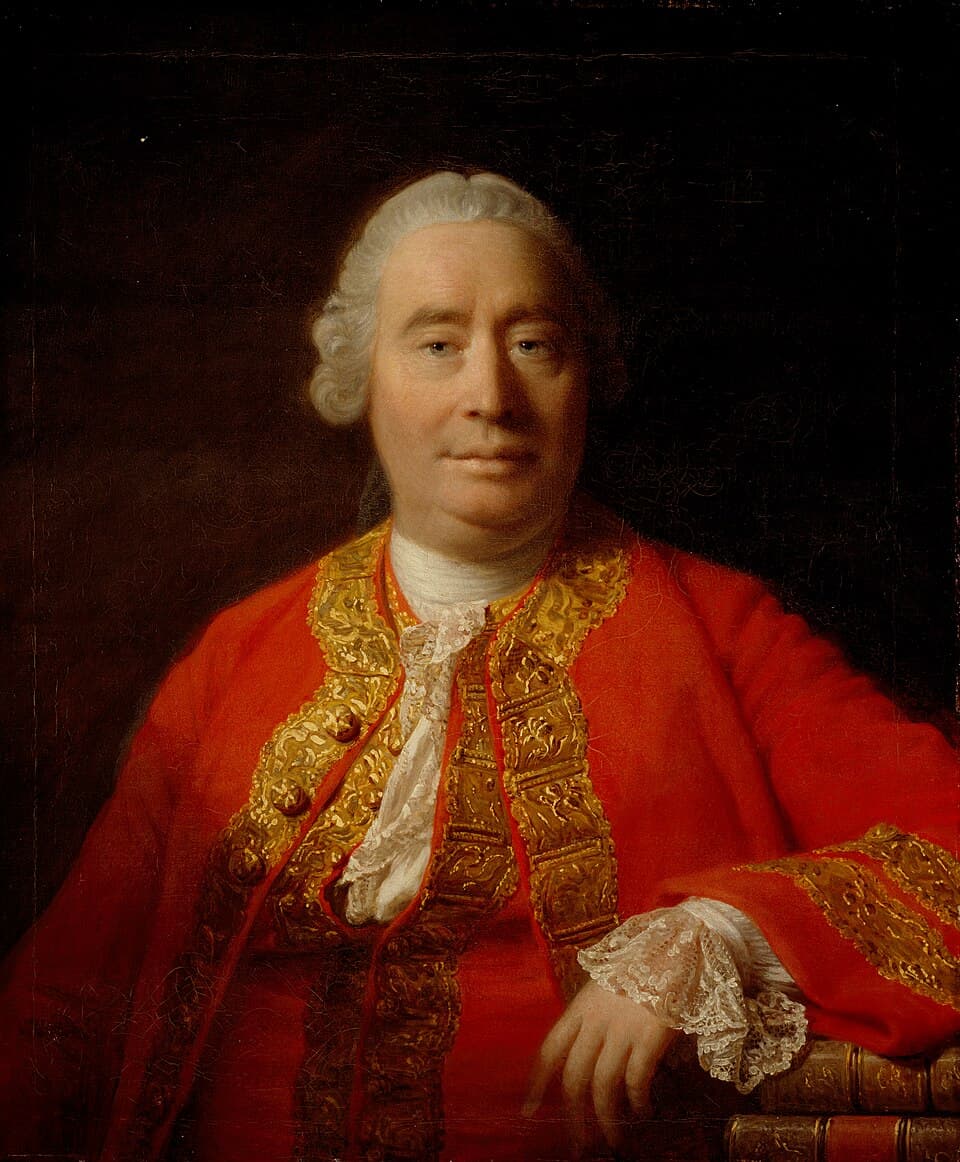
David Hume
An Enquiry Concerning Human Understanding...and observation [19]. [19] Since all reasonings concerning facts or causes is derived merely from custom, it may be asked how it happens, that men so much surpass animals in reasoning, and one man so much surpasses another? Has not the same custom the same influence on all? We shall here endeavour briefly to explain the great difference in human understandings: After which the reason of the difference between men and animals will easily be comprehended. 1.
When we have lived any time, and have been accustomed to the uniformity of nature, we acquire a general habit, by which we always transfer the known to the unknown, and conceive the latter to resemble the former. By means of this general habitual principle, we regard even one experiment as the foundation of reasoning, and expect a similar event with some degree of certainty, where the experiment has been made accurately, and free from all foreign circumstances. It is therefore considered as a matter of great importance to observe the consequences of things; and as one man may very much surpass another in attention and memory and observation, this will make a very great difference in their reasoning.
2. Where there is a complication of causes to produce any effect, one mind may be much larger than another, and better able to comprehend the whole system of objects, and to infer justly their consequences. 3. One man is able to carry on a chain of consequences to a greater length than another. 4. Few men can think long without running into a confusion of ideas, and mistaking one for another; and there are various degrees of this infirmity. 5. The cir...
2
⚖The Necessity of Similarity

David Hume
An Enquiry Concerning Human UnderstandingThe author argues that the concept of cause and effect is entirely dependent on the observed regularity of events, without which we would have no idea of necessity.
...se that no other effect, in such particular circumstances, could possibly have resulted from it. The degree and direction of every motion is, by the laws of nature, prescribed with such exactness that a living creature may as soon arise from the shock of two bodies as motion in any other degree or direction than what is actually produced by it. Would we, therefore, form a just and precise idea of necessity, we must consider whence that idea arises when we apply it to the operation of bodies.
It seems evident that, if all the scenes of nature were continually shifted in such a manner that no two events bore any resemblance to each other, but every object was entirely new, without any similitude to whatever had been seen before, we should never, in that case, have attained the least idea of necessity, or of a connexion among these objects. We might say, upon such a supposition, that one object or event has followed another; not that one was produced by the other. The relation of cause and effect must be utterly unknown to mankind. Inference and reasoning concerning the operations of nature would, from that moment, be at an end; and…
Our idea, therefore, of necessity and causation arises entirely from the uniformity observable in the operations of nature, where similar objects are constantly conjoined together, and the mind is determined by custom to infer the one from the appearance of the other. These two circumstances form the whole of that necessity, which we ascribe to matter. Beyond the constant conjunction of similar objects, and the consequent inference from one to the other, we have no notion of any necessity o...
Continue reading →
2
⚖Nature's Concealed Secrets

David Hume
An Enquiry Concerning Human UnderstandingThe text observes that while nature hides its secret powers from us, humans instinctively presume that similar sensible qualities will produce similar effects.
...lves before it is objected to us. By this means, we may make a kind of merit of our very ignorance. I shall content myself, in this section, with an easy task, and shall pretend only to give a negative answer to the question here proposed. I say then, that, even after we have experience of the operations of cause and effect, our conclusions from that experience are not founded on reasoning, or any process of the understanding. This answer we must endeavour both to explain and to defend. 29.
It must certainly be allowed, that nature has kept us at a great distance from all her secrets, and has afforded us only the knowledge of a few superficial qualities of objects; while she conceals from us those powers and principles on which the influence of those objects entirely depends. Our senses inform us of the colour, weight, and consistence of bread; but neither sense nor reason can ever inform us of those qualities which fit it for the nourishment and support of a human body. Sight or feeling conveys an idea of the actual motion of bodies; but as to that wonderful force or power, which would carry on a moving body for ever in a…
If a body of like colour and consistence with that bread, which we have formerly eat, be presented to us, we make no scruple of repeating the experiment, and foresee, with certainty, like nourishment and support. Now this is a process of the mind or thought, of which I would willingly know the foundation. It is allowed on all hands that there is no known connexion between the sensible qualities and the secret powers; and consequently, that the mind is not led to form such a conclusion concernin...
Continue reading →
2
⚖Cause and Effect's Arbitrary Link

David Hume
An Enquiry Concerning Human UnderstandingThe author asserts that effects are distinct from causes and cannot be discovered a priori, making observation and experience the only valid tools for inferring their connection.
...ay I not conceive, that a hundred different events might as well follow from that cause? May not both these balls remain at absolute rest? May not the first ball return in a straight line, or leap off from the second in any line or direction? All these suppositions are consistent and conceivable. Why then should we give the preference to one, which is no more consistent or conceivable than the rest? All our reasonings a priori will never be able to show us any foundation for this preference.
In a word, then, every effect is a distinct event from its cause. It could not, therefore, be discovered in the cause, and the first invention or conception of it, a priori, must be entirely arbitrary. And even after it is suggested, the conjunction of it with the cause must appear equally arbitrary; since there are always many other effects, which, to reason, must seem fully as consistent and natural. In vain, therefore, should we pretend to determine any single event, or infer any cause or effect, without the assistance of observation and experience.
26. Hence we may discover the reason why no philosopher, who is rational and modest, has ever pretended to assign the ultimate cause of any natural operation, or to show distinctly the action of that power, which produces any single effect in the universe. It is confessed, that the utmost effort of human reason is to reduce the principles, productive of natural phenomena, to a greater simplicity, and to resolve the many particular effects into a few general causes, by means of reasonings from...
4
⚖The Future-Past Problem

David Hume
An Enquiry Concerning Human UnderstandingHume challenges the logical basis of induction, arguing that the assumption that the future will resemble the past is neither intuitive nor demonstratively provable.
...only shows us a number of uniform effects, resulting from certain objects, and teaches us that those particular objects, at that particular time, were endowed with such powers and forces. When a new object, endowed with similar sensible qualities, is produced, we expect similar powers and forces, and look for a like effect. From a body of like colour and consistence with bread we expect like nourishment and support. But this surely is a step or progress of the mind, which wants to be explained.
When a man says, I have found, in all past instances, such sensible qualities conjoined with such secret powers: And when he says, Similar sensible qualities will always be conjoined with similar secret powers, he is not guilty of a tautology, nor are these propositions in any respect the same. You say that the one proposition is an inference from the other. But you must confess that the inference is not intuitive; neither is it demonstrative: Of what nature is it, then? To say it is experimental, is begging the question. For all inferences from experience suppose, as their foundation, that the future will resemble the past, and that…
It is impossible, therefore, that any arguments from experience can prove this resemblance of the past to the future; since all these arguments are founded on the supposition of that resemblance. Let the course of things be allowed hitherto ever so regular; that alone, without some new argument or inference, proves not that, for the future, it will continue so. In vain do you pretend to have learned the nature of bodies from your past experience. Their secret nature, and consequently all their...
Continue reading →
2