Connection in Thought
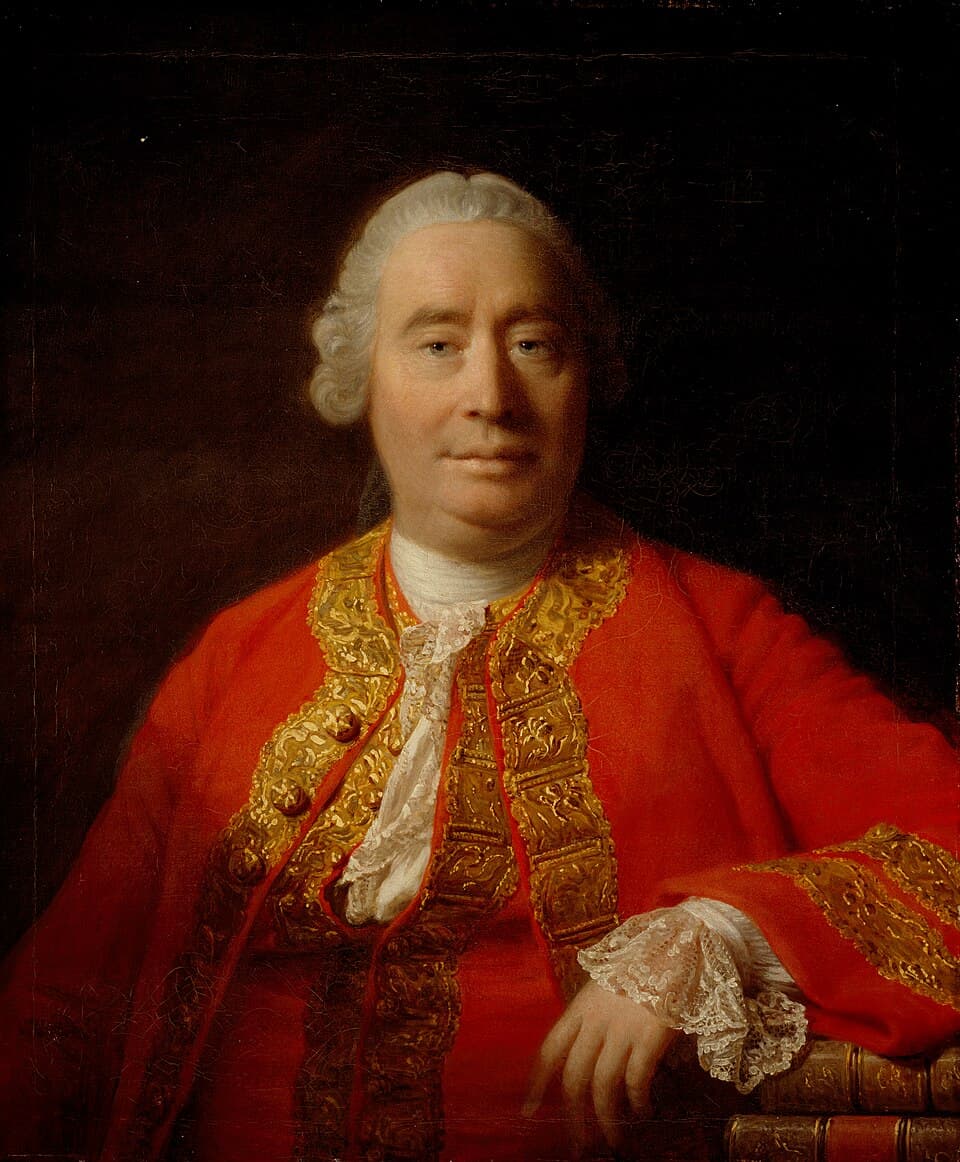
David Hume
An Enquiry Concerning Human Understanding

The author concludes that 'connection' between objects exists only in our thoughts and that acknowledging the limits of reason is consistent with skepticism.

...otion by impulse, as by the shock of two billiard balls, he could not pronounce that the one event was connected: but only that it was conjoined with the other. After he has observed several instances of this nature, he then pronounces them to be connected. What alteration has happened to give rise to this new idea of connexion? Nothing but that he now feels these events to be connected in his imagination, and can readily foretell the existence of one from the appearance of the other.
When we say, therefore, that one object is connected with another, we mean only that they have acquired a connexion in our thought, and give rise to this inference, by which they become proofs of each other's existence: A conclusion which is somewhat extraordinary, but which seems founded on sufficient evidence. Nor will its evidence be weakened by any general diffidence of the understanding, or sceptical suspicion concerning every conclusion which is new and extraordinary. No conclusions can be more agreeable to scepticism than such as make discoveries concerning the weakness and narrow limits of human reason and capacity.
60. And what stronger instance can be produced of the surprising ignorance and weakness of the understanding than the present? For surely, if there be any relation among objects which it imports to us to know perfectly, it is that of cause and effect. On this are founded all our reasonings concerning matter of fact or existence. By means of it alone we attain any assurance concerning objects which are removed from the present testimony of our memory and senses. The only immediate utility of al...
2
Philosophy's Selfish Refinement
David Hume
An Enquiry Concerning Human Understanding

Hume observes that a devotion to philosophy can sometimes be a mask for natural indolence or a refined form of selfishness that detaches a person from social virtues.

...he future, and to expect similar effects from causes which are, to appearance, similar. This is the proposition which I intended to enforce in the present section. If I be right, I pretend not to have made any mighty discovery. And if I be wrong, I must acknowledge myself to be indeed a very backward scholar; since I cannot now discover an argument which, it seems, was perfectly familiar to me long before I was out of my cradle. SECTION V. SCEPTICAL SOLUTION OF THESE DOUBTS. PART I. 34.
The passion for philosophy, like that for religion, seems liable to this inconvenience, that, though it aims at the correction of our manners, and extirpation of our vices, it may only serve, by imprudent management, to foster a predominant inclination, and push the mind, with more determined resolution, towards that side which already draws too much, by the bias and propensity of the natural temper. It is certain that, while we aspire to the magnanimous firmness of the philosophic sage, and endeavour to confine our pleasures altogether within our own minds, we may, at last, render our philosophy like that of Epictetus, and other Stoics,…
There is, however, one species of philosophy which seems little liable to this inconvenience, and that because it strikes in with no disorderly passion of the human mind, nor can mingle itself with any natural affection or propensity; and that is the Academic or Sceptical philosophy. The academics always talk of doubt and suspense of judgement, of danger in hasty determinations, of confining to very narrow bounds the enquiries of the understanding, and of renouncing all speculations which lie n...
Continue reading →
2
Language's Universal Thread
David Hume
An Enquiry Concerning Human Understanding

The author posits that the cross-linguistic similarity of complex ideas serves as evidence for a universal principle of mental association shared by all humanity.

...ltogether at adventures, but that there was still a connexion upheld among the different ideas, which succeeded each other. Were the loosest and freest conversation to be transcribed, there would immediately be observed something which connected it in all its transitions. Or where this is wanting, the person who broke the thread of discourse might still inform you, that there had secretly revolved in his mind a succession of thought, which had gradually led him from the subject of conversation.
Among different languages, even where we cannot suspect the least connexion or communication, it is found, that the words, expressive of ideas, the most compounded, do yet nearly correspond to each other: a certain proof that the simple ideas, comprehended in the compound ones, were bound together by some universal principle, which had an equal influence on all mankind.
19. Though it be too obvious to escape observation, that different ideas are connected together; I do not find that any philosopher has attempted to enumerate or class all the principles of association; a subject, however, that seems worthy of curiosity. To me, there appear to be only three principles of connexion among ideas, namely, Resemblance, Contiguity in time or place, and Cause or Effect. That these principles serve to connect ideas will not, I believe, be much doubted. A pictur...
5
Miracles' Diminished Authority
David Hume
An Enquiry Concerning Human Understanding

The author recommends a general resolution to distrust testimony regarding miracles, as the commonality of human falsehood outweighs the probability of a violation of natural law.

...henomena, that I should rather believe the most extraordinary events to arise from their concurrence, than admit of so signal a violation of the laws of nature. But should this miracle be ascribed to any new system of religion; men, in all ages, have been so much imposed on by ridiculous stories of that kind, that this very circumstance would be a full proof of a cheat, and sufficient, with all men of sense, not only to make them reject the fact, but even reject it without farther examination.
Though the Being to whom the miracle is ascribed, be, in this case, Almighty, it does not, upon that account, become a whit more probable; since it is impossible for us to know the attributes or actions of such a Being, otherwise than from the experience which we have of his productions, in the usual course of nature. This still reduces us to past observation, and obliges us to compare the instances of the violation of truth in the testimony of men, with those of the violation of the laws of nature by miracles, in order to judge which of them is most likely and probable. As the violations of truth are more common in the testimony concerning…
Lord Bacon seems to have embraced the same principles of reasoning. 'We ought,' says he, 'to make a collection or particular history of all monsters and prodigious births or productions, and in a word of every thing new, rare, and extraordinary in nature. But this must be done with the most severe scrutiny, lest we depart from truth. Above all, every relation must be considered as suspicious, which depends in any degree upon religion, as the prodigies of Livy: And no less so, every thing that...
Continue reading →
4
Sensation's Idea Limit
David Hume
An Enquiry Concerning Human Understanding

The author posits that a lack of sensory organs or personal experience with a sentiment results in a corresponding inability to form the associated ideas.

...length we please; where we shall always find, that every idea which we examine is copied from a similar impression. Those who would assert that this position is not universally true nor without exception, have only one, and that an easy method of refuting it; by producing that idea, which, in their opinion, is not derived from this source. It will then be incumbent on us, if we would maintain our doctrine, to produce the impression, or lively perception, which corresponds to it. 15. Secondly.
If it happen, from a defect of the organ, that a man is not susceptible of any species of sensation, we always find that he is as little susceptible of the correspondent ideas. A blind man can form no notion of colours; a deaf man of sounds. Restore either of them that sense in which he is deficient; by opening this new inlet for his sensations, you also open an inlet for the ideas; and he finds no difficulty in conceiving these objects. The case is the same, if the object, proper for exciting any sensation, has never been applied to the organ. A Laplander or Negro has no notion of the relish of wine. And though there are few or no instances…
It is readily allowed, that other beings may possess many senses of which we can have no conception; because the ideas of them have never been introduced to us in the only manner by which an idea can have access to the mind, to wit, by the actual feeling and sensation. 16. There is, however, one contradictory phenomenon, which may prove that it is not absolutely impossible for ideas to arise, independent of their correspondent impressions. I believe it will readily be allowed, that the several...
Continue reading →
4