The text describes two approaches to moral philosophy: one that treats man as an active being influenced by sentiment and virtue, and another that seeks to understand him through reason.
Virtue's Amiable Colors
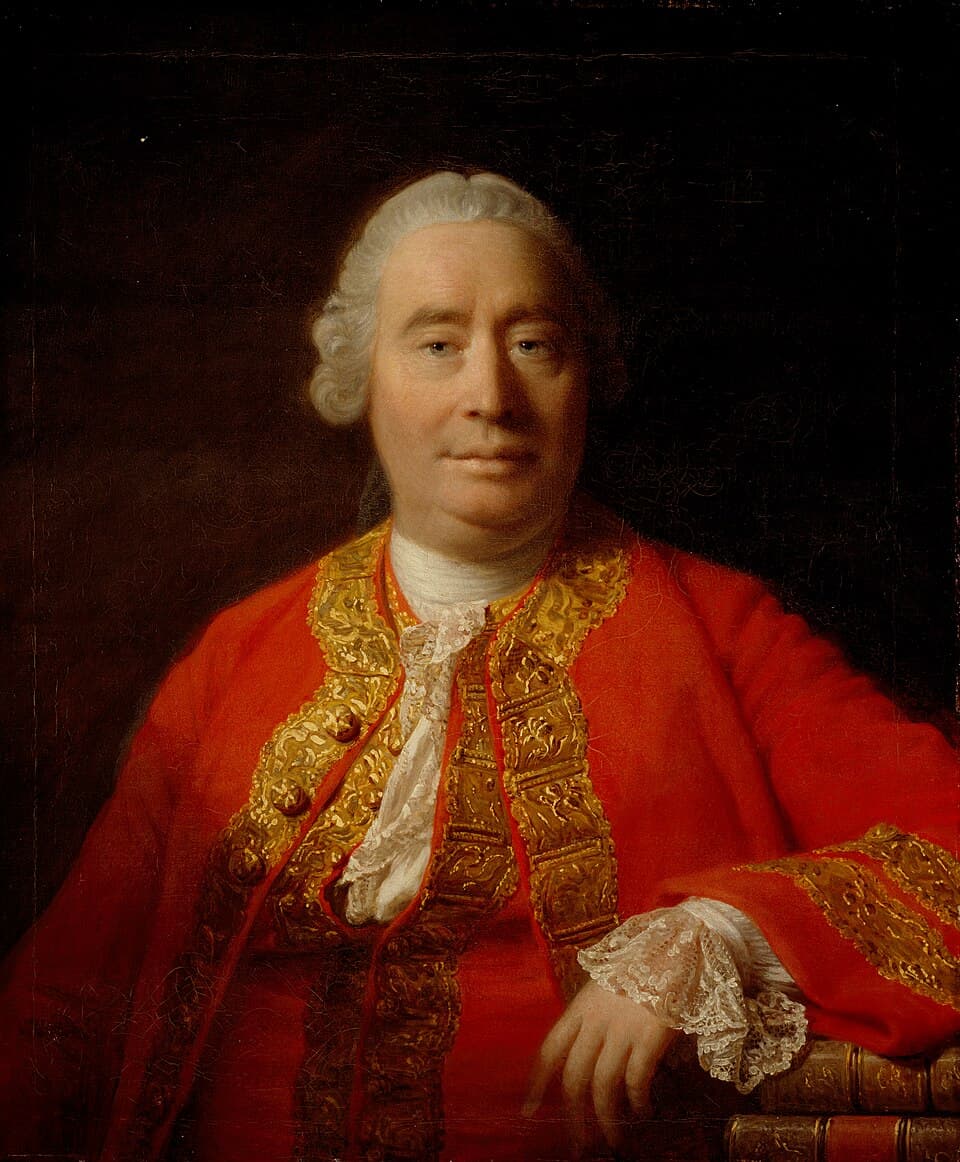
David Hume
An Enquiry Concerning Human Understanding...SECTION I. OF THE DIFFERENT SPECIES OF PHILOSOPHY. 1.
Moral philosophy, or the science of human nature, may be treated after two different manners; each of which has its peculiar merit, and may contribute to the entertainment, instruction, and reformation of mankind. The one considers man chiefly as born for action; and as influenced in his measures by taste and sentiment; pursuing one object, and avoiding another, according to the value which these objects seem to possess, and according to the light in which they present themselves. As virtue, of all objects, is allowed to be the most valuable, this species of philosophers paint her in the most amiable colours; borrowing all helps from poetry…
They select the most striking observations and instances from common life; place opposite characters in a proper contrast; and alluring us into the paths of virtue by the views of glory and happiness, direct our steps in these paths by the soundest precepts and most illustrious examples. They make us feel the difference between vice and virtue; they excite and regulate our sentiments; and so they can but bend our hearts to the love of probity and true honour, they think, that they have fully...
Continue reading →
6
⚖Human Nature's Constancy

David Hume
An Enquiry Concerning Human UnderstandingThe text claims that human nature is uniform across all ages and that the same motives consistently produce the same actions in society.
...herefore, that all mankind have ever allowed, without any doubt or hesitation, that these two circumstances take place in the voluntary actions of men, and in the operations of mind; it must follow, that all mankind have ever agreed in the doctrine of necessity, and that they have hitherto disputed, merely for not understanding each other. 65. As to the first circumstance, the constant and regular conjunction of similar events, we may possibly satisfy ourselves by the following considerations.
It is universally acknowledged that there is a great uniformity among the actions of men, in all nations and ages, and that human nature remains still the same, in its principles and operations. The same motives always produce the same actions. The same events follow from the same causes. Ambition, avarice, self-love, vanity, friendship, generosity, public spirit: these passions, mixed in various degrees, and distributed through society, have been, from the beginning of the world, and still are, the source of all the actions and enterprises, which have ever been observed among mankind.
Would you know the sentiments, inclinations, and course of life of the Greeks and Romans? Study well the temper and actions of the French and English: You cannot be much mistaken in transferring to the former most of the observations which you have made with regard to the latter. Mankind are so much the same, in all times and places, that history informs us of nothing new or strange in this particular. Its chief use is only to discover the constant and universal principles of human nature, by...
5
⚖Affections' Narrow Scope

David Hume
An Enquiry Concerning Human UnderstandingThe author claims that human nature is constitutionally designed to feel immediate sentiments of approval or blame toward certain characters and actions.
...those general laws, which produced the malignant humours in his body, and led them through the proper canals, to the sinews and nerves, where they now excite such acute torments. These enlarged views may, for a moment, please the imagination of a speculative man, who is placed in ease and security; but neither can they dwell with constancy on his mind, even though undisturbed by the emotions of pain or passion; much less can they maintain their ground when attacked by such powerful antagonists.
The affections take a narrower and more natural survey of their object; and by an economy, more suitable to the infirmity of human minds, regard alone the beings around us, and are actuated by such events as appear good or ill to the private system. 80. The case is the same with moral as with physical ill. It cannot reasonably be supposed, that those remote considerations, which are found of so little efficacy with regard to one, will have a more powerful influence with regard to the other. The mind of man is so formed by nature that, upon the appearance of certain characters, dispositions, and actions, it immediately feels the sentiment…
The characters which engage our approbation are chiefly such as contribute to the peace and security of human society; as the characters which excite blame are chiefly such as tend to public detriment and disturbance: Whence it may reasonably be presumed, that the moral sentiments arise, either mediately or immediately, from a reflection of these opposite interests. What though philosophical meditations establish a different opinion or conjecture; that everything is right with regard to the WHO...
Continue reading →
6
⚖Testimony's Human Foundation

David Hume
An Enquiry Concerning Human UnderstandingThe text asserts that our trust in human testimony is not innate but is a learned probability based on our experience of human veracity and memory.
...of human testimony, and of the usual conformity of facts to the reports of witnesses. It being a general maxim, that no objects have any discoverable connexion together, and that all the inferences, which we can draw from one to another, are founded merely on our experience of their constant and regular conjunction; it is evident, that we ought not to make an exception to this maxim in favour of human testimony, whose connexion with any event seems, in itself, as little necessary as any other.
Were not the memory tenacious to a certain degree, had not men commonly an inclination to truth and a principle of probity; were they not sensible to shame, when detected in a falsehood: Were not these, I say, discovered by experience to be qualities, inherent in human nature, we should never repose the least confidence in human testimony. A man delirious, or noted for falsehood and villany, has no manner of authority with us. And as the evidence, derived from witnesses and human testimony, is founded on past experience, so it varies with the experience, and is regarded either as a proof or a probability, according as the conjunction…
There are a number of circumstances to be taken into consideration in all judgements of this kind; and the ultimate standard, by which we determine all disputes, that may arise concerning them, is always derived from experience and observation. Where this experience is not entirely uniform on any side, it is attended with an unavoidable contrariety in our judgements, and with the same opposition and mutual destruction of argument as in every other kind of evidence. We frequently hesitate concer...
Continue reading →
2
⚖Beauty as Feeling

David Hume
An Enquiry Concerning Human UnderstandingThe author claims that morality and aesthetics are rooted in subjective sentiment and taste rather than objective rational perception, though they can be studied as social facts.
...treat of general facts, are politics, natural philosophy, physic, chemistry, &c. where the qualities, causes and effects of a whole species of objects are enquired into. Divinity or Theology, as it proves the existence of a Deity, and the immortality of souls, is composed partly of reasonings concerning particular, partly concerning general facts. It has a foundation in reason, so far as it is supported by experience. But its best and most solid foundation is faith and divine revelation.
Morals and criticism are not so properly objects of the understanding as of taste and sentiment. Beauty, whether moral or natural, is felt, more properly than perceived. Or if we reason concerning it, and endeavour to fix its standard, we regard a new fact, to wit, the general tastes of mankind, or some such fact, which may be the object of reasoning and enquiry.
When we run over libraries, persuaded of these principles, what havoc must we make? If we take in our hand any volume; of divinity or school metaphysics, for instance; let us ask, Does it contain any abstract reasoning concerning quantity or number? No. Does it contain any experimental reasoning concerning matter of fact and existence? No. Commit it then to the flames: for it can contain nothing but sophistry and illusion....
6