The author claims that humans mistakenly believe they perceive a necessary connection in nature, when they actually only observe constant conjunction and feel a customary transition.
Custom vs Necessary Connection
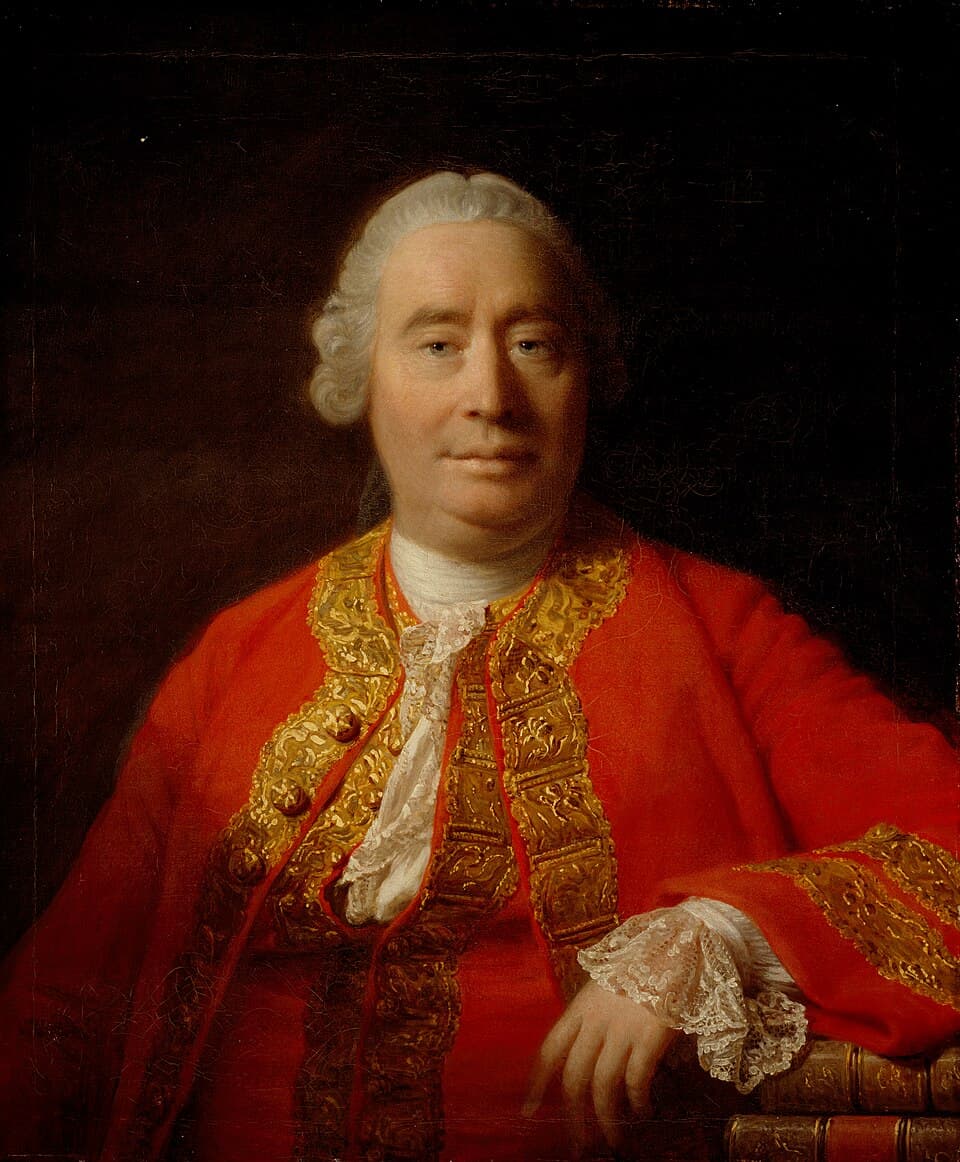
David Hume
An Enquiry Concerning Human Understanding...experience of the usual conduct of mankind in such particular situations. 71. I have frequently considered, what could possibly be the reason why all mankind, though they have ever, without hesitation, acknowledged the doctrine of necessity in their whole practice and reasoning, have yet discovered such a reluctance to acknowledge it in words, and have rather shown a propensity, in all ages, to profess the contrary opinion. The matter, I think, may be accounted for after the following manner.
If we examine the operations of body, and the production of effects from their causes, we shall find that all our faculties can never carry us farther in our knowledge of this relation than barely to observe that particular objects are constantly conjoined together, and that the mind is carried, by a customary transition, from the appearance of one to the belief of the other. But though this conclusion concerning human ignorance be the result of the strictest scrutiny of this subject, men still entertain a strong propensity to believe that they penetrate farther into the powers of nature, and perceive something like a necessary connexion…
But being once convinced that we know nothing farther of causation of any kind than merely the constant conjunction of objects, and the consequent inference of the mind from one to another, and finding that these two circumstances are universally allowed to have place in voluntary actions; we may be more easily led to own the same necessity common to all causes. And though this reasoning may contradict the systems of many philosophers, in ascribing necessity to the determinations of the wil...
Continue reading →
2
⚖Nature's Infallible Instinct

David Hume
An Enquiry Concerning Human UnderstandingThe author suggests it is a wise provision of nature that essential survival inferences are handled by infallible instinct rather than slow, error-prone human reason.
...nce of human life. Had not the presence of an object, instantly excited the idea of those objects, commonly conjoined with it, all our knowledge must have been limited to the narrow sphere of our memory and senses; and we should never have been able to adjust means to ends, or employ our natural powers, either to the producing of good, or avoiding of evil. Those, who delight in the discovery and contemplation of final causes, have here ample subject to employ their wonder and admiration. 45.
I shall add, for a further confirmation of the foregoing theory, that, as this operation of the mind, by which we infer like effects from like causes, and vice versa, is so essential to the subsistence of all human creatures, it is not probable, that it could be trusted to the fallacious deductions of our reason, which is slow in its operations; appears not, in any degree, during the first years of infancy; and at best is, in every age and period of human life, extremely liable to error and mistake. It is more conformable to the ordinary wisdom of nature to secure so necessary an act of the mind, by some instinct or mechanical tendency,…
As nature has taught us the use of our limbs, without giving us the knowledge of the muscles and nerves, by which they are actuated; so has she implanted in us an instinct, which carries forward the thought in a correspondent course to that which she has established among external objects; though we are ignorant of those powers and forces, on which this regular course and succession of objects totally depends. SECTION VI. OF PROBABILITY[9]. [9] Mr. Locke divides all arguments into demo...
Continue reading →
1
⚖The Necessity of Similarity

David Hume
An Enquiry Concerning Human UnderstandingThe author argues that the concept of cause and effect is entirely dependent on the observed regularity of events, without which we would have no idea of necessity.
...se that no other effect, in such particular circumstances, could possibly have resulted from it. The degree and direction of every motion is, by the laws of nature, prescribed with such exactness that a living creature may as soon arise from the shock of two bodies as motion in any other degree or direction than what is actually produced by it. Would we, therefore, form a just and precise idea of necessity, we must consider whence that idea arises when we apply it to the operation of bodies.
It seems evident that, if all the scenes of nature were continually shifted in such a manner that no two events bore any resemblance to each other, but every object was entirely new, without any similitude to whatever had been seen before, we should never, in that case, have attained the least idea of necessity, or of a connexion among these objects. We might say, upon such a supposition, that one object or event has followed another; not that one was produced by the other. The relation of cause and effect must be utterly unknown to mankind. Inference and reasoning concerning the operations of nature would, from that moment, be at an end; and…
Our idea, therefore, of necessity and causation arises entirely from the uniformity observable in the operations of nature, where similar objects are constantly conjoined together, and the mind is determined by custom to infer the one from the appearance of the other. These two circumstances form the whole of that necessity, which we ascribe to matter. Beyond the constant conjunction of similar objects, and the consequent inference from one to the other, we have no notion of any necessity o...
Continue reading →
2
⚖The Illusion of Causation

David Hume
An Enquiry Concerning Human UnderstandingHume argues that while common people assume a necessary connection between cause and effect through habit, philosophers recognize that we only ever perceive the constant conjunction of objects.
...on all sides. Do you find anything in it like this creative power, by which it raises from nothing a new idea, and with a kind of Fiat, imitates the omnipotence of its Maker, if I may be allowed so to speak, who called forth into existence all the various scenes of nature? So far from being conscious of this energy in the will, it requires as certain experience as that of which we are possessed, to convince us that such extraordinary effects do ever result from a simple act of volition. 54.
The generality of mankind never find any difficulty in accounting for the more common and familiar operations of nature--such as the descent of heavy bodies, the growth of plants, the generation of animals, or the nourishment of bodies by food: But suppose that, in all these cases, they perceive the very force or energy of the cause, by which it is connected with its effect, and is for ever infallible in its operation. They acquire, by long habit, such a turn of mind, that, upon the appearance of the cause, they immediately expect with assurance its usual attendant, and hardly conceive it possible that any other event could result from it. It…
[13] [Greek: theos apo maechanaes.] 55. Here, then, many philosophers think themselves obliged by reason to have recourse, on all occasions, to the same principle, which the vulgar never appeal to but in cases that appear miraculous and supernatural. They acknowledge mind and intelligence to be, not only the ultimate and original cause of all things, but the immediate and sole cause of every event which appears in nature. They pretend that those objects which are commonly denominated _cau...
Continue reading →
2
⚖The Necessity of Connection

David Hume
An Enquiry Concerning Human UnderstandingHume argues that the concept of cause and effect is derived solely from the regular conjunction of objects and the resulting inference of the understanding, rather than an inherent 'necessary connection'.
...liberty is universally allowed to belong to every one who is not a prisoner and in chains. Here, then, is no subject of dispute. 74. Whatever definition we may give of liberty, we should be careful to observe two requisite circumstances; first, that it be consistent with plain matter of fact; secondly, that it be consistent with itself. If we observe these circumstances, and render our definition intelligible, I am persuaded that all mankind will be found of one opinion with regard to it.
It is universally allowed that nothing exists without a cause of its existence, and that chance, when strictly examined, is a mere negative word, and means not any real power which has anywhere a being in nature. But it is pretended that some causes are necessary, some not necessary. Here then is the advantage of definitions. Let any one define a cause, without comprehending, as a part of the definition, a necessary connexion with its effect; and let him show distinctly the origin of the idea, expressed by the definition; and I shall readily give up the whole controversy. But if the foregoing explication of the matter be received, this…
Whoever attempts a definition of cause, exclusive of these circumstances, will be obliged either to employ unintelligible terms or such as are synonymous to the term which he endeavours to define.[18] And if the definition above mentioned be admitted; liberty, when opposed to necessity, not to constraint, is the same thing with chance; which is universally allowed to have no existence. [18] Thus, if a cause be defined, that which produces any thing; it is easy to observe, that _produ...
Continue reading →
2