The author contrasts the wandering nature of the imagination with the disciplined method of judgment, which restricts itself to the realm of common life and experience.
Imagination vs Judgment
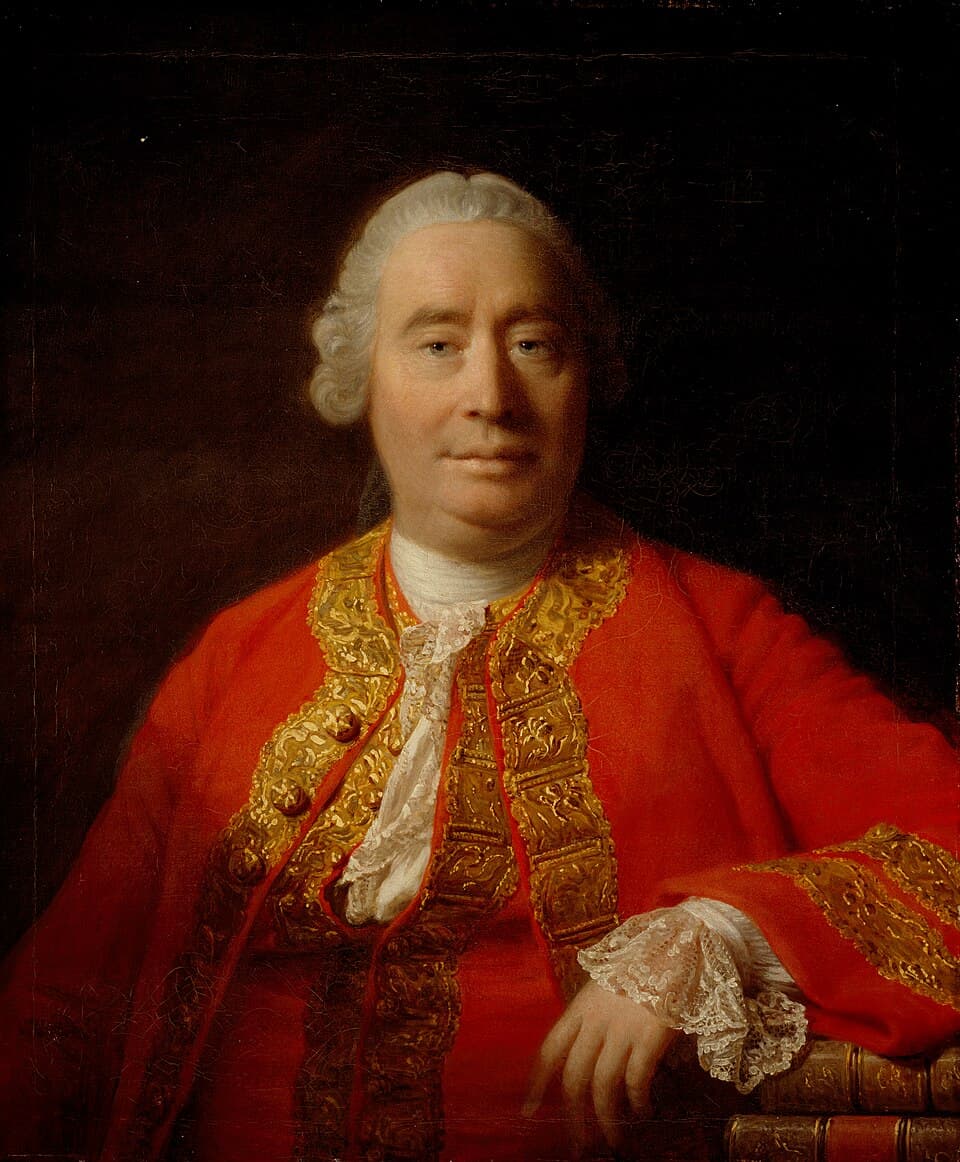
David Hume
An Enquiry Concerning Human Understanding...l perplexity and confusion, which is inherent in human nature. In general, there is a degree of doubt, and caution, and modesty, which, in all kinds of scrutiny and decision, ought for ever to accompany a just reasoner. 130. Another species of mitigated scepticism which may be of advantage to mankind, and which may be the natural result of the Pyrrhonian doubts and scruples, is the limitation of our enquiries to such subjects as are best adapted to the narrow capacity of human understanding.
The imagination of man is naturally sublime, delighted with whatever is remote and extraordinary, and running, without control, into the most distant parts of space and time in order to avoid the objects, which custom has rendered too familiar to it. A correct Judgement observes a contrary method, and avoiding all distant and high enquiries, confines itself to common life, and to such subjects as fall under daily practice and experience; leaving the more sublime topics to the embellishment of poets and orators, or to the arts of priests and politicians.
To bring us to so salutary a determination, nothing can be more serviceable, than to be once thoroughly convinced of the force of the Pyrrhonian doubt, and of the impossibility, that anything, but the strong power of natural instinct, could free us from it. Those who have a propensity to philosophy, will still continue their researches; because they reflect, that, besides the immediate pleasure, attending such an occupation, philosophical decisions are nothing but the reflections of common life...
6
⚖The Naive Observer

David Hume
An Enquiry Concerning Human UnderstandingThe author imagines a person suddenly brought into the world to illustrate that reason alone, without experience, cannot discover the relation of cause and effect.
...en by the mind which is not supported by any argument or process of the understanding; there is no danger that these reasonings, on which almost all knowledge depends, will ever be affected by such a discovery. If the mind be not engaged by argument to make this step, it must be induced by some other principle of equal weight and authority; and that principle will preserve its influence as long as human nature remains the same. What that principle is may well be worth the pains of enquiry. 35.
Suppose a person, though endowed with the strongest faculties of reason and reflection, to be brought on a sudden into this world; he would, indeed, immediately observe a continual succession of objects, and one event following another; but he would not be able to discover anything farther. He would not, at first, by any reasoning, be able to reach the idea of cause and effect; since the particular powers, by which all natural operations are performed, never appear to the senses; nor is it reasonable to conclude, merely because one event, in one instance, precedes another, that therefore the one is the cause, the other the effect. Their…
Suppose, again, that he has acquired more experience, and has lived so long in the world as to have observed familiar objects or events to be constantly conjoined together; what is the consequence of this experience? He immediately infers the existence of one object from the appearance of the other. Yet he has not, by all his experience, acquired any idea or knowledge of the secret power by which the one object produces the other; nor is it, by any process of reasoning, he is engaged to draw t...
Continue reading →
1
⚖History's Constant Principles

David Hume
An Enquiry Concerning Human UnderstandingHume claims that human nature is universal across time and place, and that history serves as a collection of experiments for the moral philosopher to discover constant principles.
...sions, mixed in various degrees, and distributed through society, have been, from the beginning of the world, and still are, the source of all the actions and enterprises, which have ever been observed among mankind. Would you know the sentiments, inclinations, and course of life of the Greeks and Romans? Study well the temper and actions of the French and English: You cannot be much mistaken in transferring to the former most of the observations which you have made with regard to the latter.
Mankind are so much the same, in all times and places, that history informs us of nothing new or strange in this particular. Its chief use is only to discover the constant and universal principles of human nature, by showing men in all varieties of circumstances and situations, and furnishing us with materials from which we may form our observations and become acquainted with the regular springs of human action and behaviour. These records of wars, intrigues, factions, and revolutions, are so many collections of experiments, by which the politician or moral philosopher fixes the principles of his science, in the same manner as the physician…
Nor are the earth, water, and other elements, examined by Aristotle, and Hippocrates, more like to those which at present lie under our observation than the men described by Polybius and Tacitus are to those who now govern the world. Should a traveller, returning from a far country, bring us an account of men, wholly different from any with whom we were ever acquainted; men, who were entirely divested of avarice, ambition, or revenge; who knew no pleasure but friendship, generosity, and public...
Continue reading →
5
⚖Mind's Limited Creativity

David Hume
An Enquiry Concerning Human UnderstandingThe author defines the mind's creative power as merely the ability to compound and transpose materials provided by the senses, asserting that all ideas are copies of impressions.
...le than to conceive the most natural and familiar objects. And while the body is confined to one planet, along which it creeps with pain and difficulty; the thought can in an instant transport us into the most distant regions of the universe; or even beyond the universe, into the unbounded chaos, where nature is supposed to lie in total confusion. What never was seen, or heard of, may yet be conceived; nor is any thing beyond the power of thought, except what implies an absolute contradiction.
But though our thought seems to possess this unbounded liberty, we shall find, upon a nearer examination, that it is really confined within very narrow limits, and that all this creative power of the mind amounts to no more than the faculty of compounding, transposing, augmenting, or diminishing the materials afforded us by the senses and experience. When we think of a golden mountain, we only join two consistent ideas, gold, and mountain, with which we were formerly acquainted. A virtuous horse we can conceive; because, from our own feeling, we can conceive virtue; and this we may unite to the figure and shape of a horse, which is an…
14. To prove this, the two following arguments will, I hope, be sufficient. First, when we analyze our thoughts or ideas, however compounded or sublime, we always find that they resolve themselves into such simple ideas as were copied from a precedent feeling or sentiment. Even those ideas, which, at first view, seem the most wide of this origin, are found, upon a nearer scrutiny, to be derived from it. The idea of God, as meaning an infinitely intelligent, wise, and good Being, arises from re...
Continue reading →
3
⚖Experience's Non-Rational Authority

David Hume
An Enquiry Concerning Human UnderstandingThe author argues that our reliance on similarity to predict effects is not a product of reason, but a principle of human nature derived from experience.
...l arguments concerning existence are founded on the relation of cause and effect; that our knowledge of that relation is derived entirely from experience; and that all our experimental conclusions proceed upon the supposition that the future will be conformable to the past. To endeavour, therefore, the proof of this last supposition by probable arguments, or arguments regarding existence, must be evidently going in a circle, and taking that for granted, which is the very point in question. 31.
In reality, all arguments from experience are founded on the similarity which we discover among natural objects, and by which we are induced to expect effects similar to those which we have found to follow from such objects. And though none but a fool or madman will ever pretend to dispute the authority of experience, or to reject that great guide of human life, it may surely be allowed a philosopher to have so much curiosity at least as to examine the principle of human nature, which gives this mighty authority to experience, and makes us draw advantage from that similarity which nature has placed among different objects. From causes which…
Nothing so like as eggs; yet no one, on account of this appearing similarity, expects the same taste and relish in all of them. It is only after a long course of uniform experiments in any kind, that we attain a firm reliance and security with regard to a particular event. Now where is that process of reasoning which, from one instance, draws a conclusion, so different from that which it infers from a hundred instances that are nowise different from that single one? This question I propose as m...
Continue reading →
2