Custom vs Necessary Connection
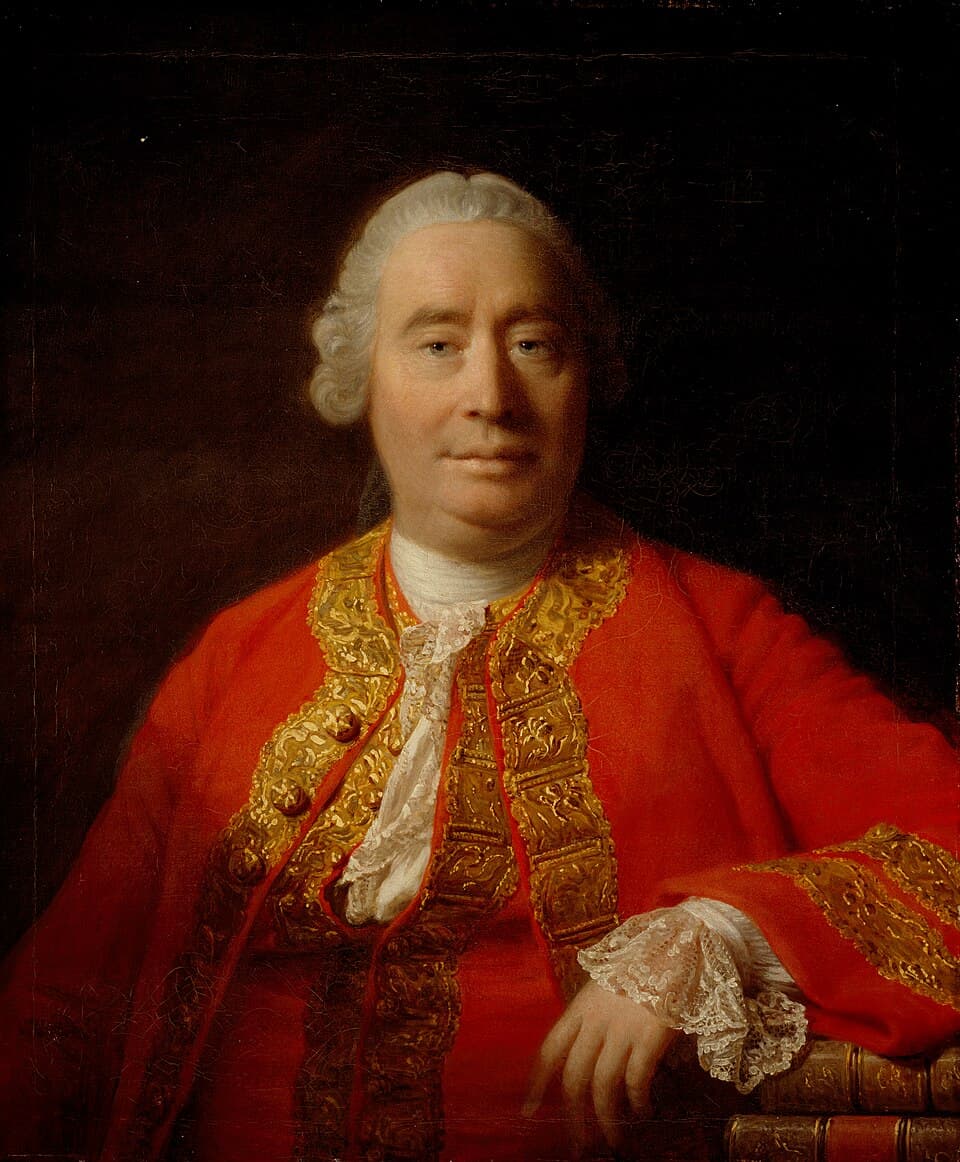
David Hume
An Enquiry Concerning Human Understanding

The author claims that humans mistakenly believe they perceive a necessary connection in nature, when they actually only observe constant conjunction and feel a customary transition.

...experience of the usual conduct of mankind in such particular situations. 71. I have frequently considered, what could possibly be the reason why all mankind, though they have ever, without hesitation, acknowledged the doctrine of necessity in their whole practice and reasoning, have yet discovered such a reluctance to acknowledge it in words, and have rather shown a propensity, in all ages, to profess the contrary opinion. The matter, I think, may be accounted for after the following manner.
If we examine the operations of body, and the production of effects from their causes, we shall find that all our faculties can never carry us farther in our knowledge of this relation than barely to observe that particular objects are constantly conjoined together, and that the mind is carried, by a customary transition, from the appearance of one to the belief of the other. But though this conclusion concerning human ignorance be the result of the strictest scrutiny of this subject, men still entertain a strong propensity to believe that they penetrate farther into the powers of nature, and perceive something like a necessary connexion…
But being once convinced that we know nothing farther of causation of any kind than merely the constant conjunction of objects, and the consequent inference of the mind from one to another, and finding that these two circumstances are universally allowed to have place in voluntary actions; we may be more easily led to own the same necessity common to all causes. And though this reasoning may contradict the systems of many philosophers, in ascribing necessity to the determinations of the wil...
Continue reading →
2
The Future's Uncertainty
David Hume
An Enquiry Concerning Human Understanding

The author challenges the logical basis of induction, arguing that we cannot prove the future will resemble the past because all such arguments already assume that resemblance.

...s not intuitive; neither is it demonstrative: Of what nature is it, then? To say it is experimental, is begging the question. For all inferences from experience suppose, as their foundation, that the future will resemble the past, and that similar powers will be conjoined with similar sensible qualities. If there be any suspicion that the course of nature may change, and that the past may be no rule for the future, all experience becomes useless, and can give rise to no inference or conclusion.
It is impossible, therefore, that any arguments from experience can prove this resemblance of the past to the future; since all these arguments are founded on the supposition of that resemblance. Let the course of things be allowed hitherto ever so regular; that alone, without some new argument or inference, proves not that, for the future, it will continue so. In vain do you pretend to have learned the nature of bodies from your past experience. Their secret nature, and consequently all their effects and influence, may change, without any change in their sensible qualities. This happens sometimes, and with regard to some objects: Why may it…
My practice, you say, refutes my doubts. But you mistake the purport of my question. As an agent, I am quite satisfied in the point; but as a philosopher, who has some share of curiosity, I will not say scepticism, I want to learn the foundation of this inference. No reading, no enquiry has yet been able to remove my difficulty, or give me satisfaction in a matter of such importance. Can I do better than propose the difficulty to the public, even though, perhaps, I have small hopes of obtaining...
Continue reading →
2
Cause's Imperfect Definition
David Hume
An Enquiry Concerning Human Understanding

The author emphasizes the vital importance of the cause-and-effect relation for navigating reality while noting our inability to define it outside of external observations.

...nary, but which seems founded on sufficient evidence. Nor will its evidence be weakened by any general diffidence of the understanding, or sceptical suspicion concerning every conclusion which is new and extraordinary. No conclusions can be more agreeable to scepticism than such as make discoveries concerning the weakness and narrow limits of human reason and capacity. 60. And what stronger instance can be produced of the surprising ignorance and weakness of the understanding than the present?
For surely, if there be any relation among objects which it imports to us to know perfectly, it is that of cause and effect. On this are founded all our reasonings concerning matter of fact or existence. By means of it alone we attain any assurance concerning objects which are removed from the present testimony of our memory and senses. The only immediate utility of all sciences, is to teach us, how to control and regulate future events by their causes. Our thoughts and enquiries are, therefore, every moment, employed about this relation: Yet so imperfect are the ideas which we form concerning it, that it is impossible to give any just…
Similar objects are always conjoined with similar. Of this we have experience. Suitably to this experience, therefore, we may define a cause to be an object, followed by another, and where all the objects similar to the first are followed by objects similar to the second. Or in other words where, if the first object had not been, the second never had existed. The appearance of a cause always conveys the mind, by a customary transition, to the idea of the effect. Of this also we have experie...
Continue reading →
2
Cause and Effect's Bond
David Hume
An Enquiry Concerning Human Understanding

The author asserts that all reasoning about matters of fact beyond immediate memory and sensation is based on the perceived relation of cause and effect.

...e the more excusable; while we march through such difficult paths without any guide or direction. They may even prove useful, by exciting curiosity, and destroying that implicit faith and security, which is the bane of all reasoning and free enquiry. The discovery of defects in the common philosophy, if any such there be, will not, I presume, be a discouragement, but rather an incitement, as is usual, to attempt something more full and satisfactory than has yet been proposed to the public. 22.
All reasonings concerning matter of fact seem to be founded on the relation of Cause and Effect. By means of that relation alone we can go beyond the evidence of our memory and senses. If you were to ask a man, why he believes any matter of fact, which is absent; for instance, that his friend is in the country, or in France; he would give you a reason; and this reason would be some other fact; as a letter received from him, or the knowledge of his former resolutions and promises. A man finding a watch or any other machine in a desert island, would conclude that there had once been men in that island. All our reasonings concerning fact are…
The hearing of an articulate voice and rational discourse in the dark assures us of the presence of some person: Why? because these are the effects of the human make and fabric, and closely connected with it. If we anatomize all the other reasonings of this nature, we shall find that they are founded on the relation of cause and effect, and that this relation is either near or remote, direct or collateral. Heat and light are collateral effects of fire, and the one effect may justly be inferred...
Continue reading →
4
Three Associative Principles
David Hume
An Enquiry Concerning Human Understanding

The author proposes that all human thought is organized by three specific principles of association: resemblance, contiguity, and cause or effect.

...had secretly revolved in his mind a succession of thought, which had gradually led him from the subject of conversation. Among different languages, even where we cannot suspect the least connexion or communication, it is found, that the words, expressive of ideas, the most compounded, do yet nearly correspond to each other: a certain proof that the simple ideas, comprehended in the compound ones, were bound together by some universal principle, which had an equal influence on all mankind. 19.
Though it be too obvious to escape observation, that different ideas are connected together; I do not find that any philosopher has attempted to enumerate or class all the principles of association; a subject, however, that seems worthy of curiosity. To me, there appear to be only three principles of connexion among ideas, namely, Resemblance, Contiguity in time or place, and Cause or Effect. That these principles serve to connect ideas will not, I believe, be much doubted. A picture naturally leads our thoughts to the original: the mention of one apartment in a building naturally introduces an enquiry or discourse concerning the…
But that this enumeration is complete, and that there are no other principles of association except these, may be difficult to prove to the satisfaction of the reader, or even to a man's own satisfaction. All we can do, in such cases, is to run over several instances, and examine carefully the principle which binds the different thoughts to each other, never stopping till we render the principle as general as possible[5]. The more instances we examine, and the more care we employ, the more assu...
Continue reading →
2