Augustine recounts his former struggle to conceptualize God and evil without physical substance, leading to his past difficulties in understanding the Incarnation.
Evil's Imagined Substance
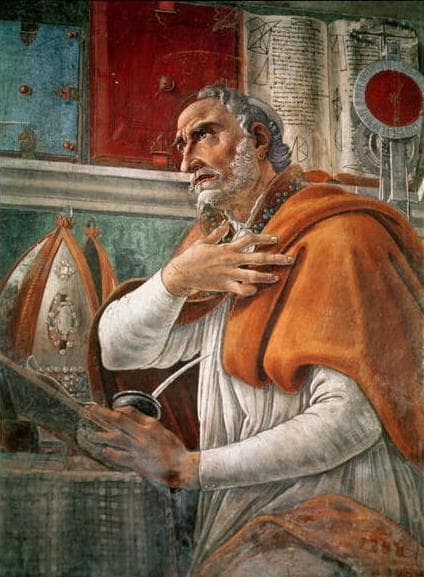
Augustine of Hippo
Confessions...me. For when my mind endeavoured to recur to the Catholic faith, I was driven back, since that was not the Catholic faith which I thought to be so. And I seemed to myself more reverential, if I believed of Thee, my God (to whom Thy mercies confess out of my mouth), as unbounded, at least on other sides, although on that one where the mass of evil was opposed to Thee, I was constrained to confess Thee bounded; than if on all sides I should imagine Thee to be bounded by the form of a human body.
And it seemed to me better to believe Thee to have created no evil (which to me ignorant seemed not some only, but a bodily substance, because I could not conceive of mind unless as a subtile body, and that diffused in definite spaces), than to believe the nature of evil, such as I conceived it, could come from Thee. Yea, and our Saviour Himself, Thy Only Begotten, I believed to have been reached forth (as it were) for our salvation, out of the mass of Thy most lucid substance, so as to believe nothing of Him, but what I could imagine in my vanity. His Nature then, being such, I thought could not be born of the Virgin Mary, without being…
I feared therefore to believe Him born in the flesh, lest I should be forced to believe Him defiled by the flesh. Now will Thy spiritual ones mildly and lovingly smile upon me, if they shall read these my confessions. Yet such was I. Furthermore, what the Manichees had criticised in Thy Scriptures, I thought could not be defended; yet at times verily I had a wish to confer upon these several points with some one very well skilled in those books, and to make trial what he thought thereon; for t...
Continue reading →
2
⚖Memory's Secret Windings

Augustine of Hippo
ConfessionsA poetic description of the memory as a vast, secret harbor where sensory images are stored and can be recalled internally even in darkness and silence.
...m sight, ready to come when I will. All which takes place when I repeat a thing by heart. There are all things preserved distinctly and under general heads, each having entered by its own avenue: as light, and all colours and forms of bodies by the eyes; by the ears all sorts of sounds; all smells by the avenue of the nostrils; all tastes by the mouth; and by the sensation of the whole body, what is hard or soft; hot or cold; or rugged; heavy or light; either outwardly or inwardly to the body.
All these doth that great harbour of the memory receive in her numberless secret and inexpressible windings, to be forthcoming, and brought out at need; each entering in by his own gate, and there laid up. Nor yet do the things themselves enter in; only the images of the things perceived are there in readiness, for thought to recall. Which images, how they are formed, who can tell, though it doth plainly appear by which sense each hath been brought in and stored up? For even while I dwell in darkness and silence, in my memory I can produce colours, if I will, and discern betwixt black and white, and what others I will: nor yet do sounds break…
For these too I call for, and forthwith they appear. And though my tongue be still, and my throat mute, so can I sing as much as I will; nor do those images of colours, which notwithstanding be there, intrude themselves and interrupt, when another store is called for, which flowed in by the ears. So the other things, piled in and up by the other senses, I recall at my pleasure. Yea, I discern the breath of lilies from violets, though smelling nothing; and I prefer honey to sweet wine, smooth be...
Continue reading →
2
⚖Knowing by Ignorance

Augustine of Hippo
ConfessionsA philosophical inquiry into the 'formlessness of matter,' exploring the paradox of trying to conceive of something that lacks intellectual or sensory form.
...thing, neither colour, nor figure, nor body, nor spirit? and yet not altogether nothing; for there was a certain formlessness, without any beauty. How then should it be called, that it might be in some measure conveyed to those of duller mind, but by some ordinary word? And what, among all parts of the world can be found nearer to an absolute formlessness, than earth and deep? For, occupying the lowest stage, they are less beautiful than the other higher parts are, transparent all and shining.
Wherefore then may I not conceive the formlessness of matter (which Thou hadst created without beauty, whereof to make this beautiful world) to be suitably intimated unto men, by the name of earth invisible and without form. So that when thought seeketh what the sense may conceive under this, and saith to itself, "It is no intellectual form, as life, or justice; because it is the matter of bodies; nor object of sense, because being invisible, and without form, there was in it no object of sight or sense";--while man's thought thus saith to itself, it may endeavour either to know it, by being ignorant of it; or to be ignorant, by knowing it.
But I, Lord, if I would, by my tongue and my pen, confess unto Thee the whole, whatever Thyself hath taught me of that matter,--the name whereof hearing before, and not understanding, when they who understood it not, told me of it, so I conceived of it as having innumerable forms and diverse, and therefore did not conceive it at all, my mind tossed up and down foul and horrible "forms" out of all order, but yet "forms" and I called it without form not that it wanted all form, but because it ha...
2
⚖Spirit's Shared Vision

Augustine of Hippo
ConfessionsThe author describes a spiritual synergy where those who see the world through God's Spirit allow God to see and take pleasure in His creation through them.
...of Thy conquered enemies Thou raisedst up the walls of the universe; that they, bound down by the structure, might not again be able to rebel against Thee. For other things, they say Thou neither madest them, nor even compactedst them, such as all flesh and all very minute creatures, and whatsoever hath its root in the earth; but that a mind at enmity with Thee, and another nature not created by Thee, and contrary unto Thee, did, in these lower stages of the world, beget and frame these things.
Frenzied are they who say thus, because they see not Thy works by Thy Spirit, nor recognise Thee in them. But they who by Thy Spirit see these things, Thou seest in them. Therefore when they see that these things are good, Thou seest that they are good; and whatsoever things for Thy sake please, Thou pleasest in them, and what through Thy Spirit please us, they please Thee in us. For what man knoweth the things of a man, save the spirit of a man, which is in him? even so the things of God knoweth no one, but the Spirit of God.
Now we (saith he) have received, not the spirit of this world, but the Spirit which is of God, that we might know the things that are freely given to us of God. And I am admonished, "Truly the things of God knoweth no one, but the Spirit of God: how then do we also know, what things are given us of God?" Answer is made me; "because the things which we know by His Spirit, even these no one knoweth, but the Spirit of God. For as it is rightly said unto those that were to speak by the Spirit of Go...
2
⚖The Mind's Abstract Realm

Augustine of Hippo
ConfessionsThe author distinguishes between sensory experiences and abstract intellectual truths, such as mathematical laws, which exist in the mind independently of physical form or language.
...ether again, that they may be known; that is to say, they must as it were be collected together from their dispersion: whence the word "cogitation" is derived. For cogo (collect) and cogito (re-collect) have the same relation to each other as ago and agito, facio and factito. But the mind hath appropriated to itself this word (cogitation), so that, not what is "collected" any how, but what is "recollected," i.e., brought together, in the mind, is properly said to be cogitated, or thought upon.
The memory containeth also reasons and laws innumerable of numbers and dimensions, none of which hath any bodily sense impressed; seeing they have neither colour, nor sound, nor taste, nor smell, nor touch. I have heard the sound of the words whereby when discussed they are denoted: but the sounds are other than the things. For the sounds are other in Greek than in Latin; but the things are neither Greek, nor Latin, nor any other language. I have seen the lines of architects, the very finest, like a spider's thread; but those are still different, they are not the images of those lines which the eye of flesh showed me: he knoweth them,…
I have perceived also the numbers of the things with which we number all the senses of my body; but those numbers wherewith we number are different, nor are they the images of these, and therefore they indeed are. Let him who seeth them not, deride me for saying these things, and I will pity him, while he derides me. All these things I remember, and how I learnt them I remember. Many things also most falsely objected against them have I heard, and remember; which though they be false, yet is i...
Continue reading →
4