The author argues that the changeability of the heavens and earth proves they are created beings, distinct from the unchangeable beauty and goodness of the Creator.
Creation's Testimony
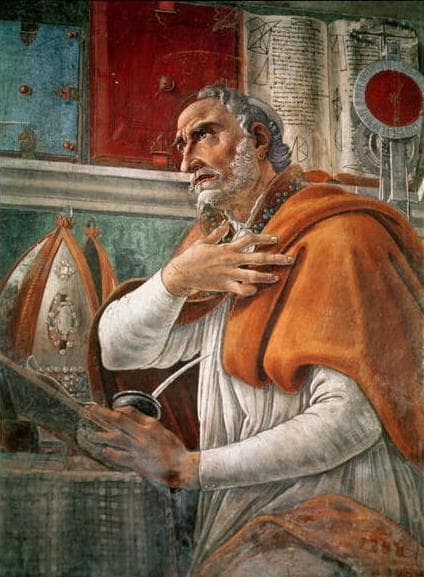
Augustine of Hippo
Confessions...thin, in the chamber of my thoughts, Truth, neither Hebrew, nor Greek, nor Latin, nor barbarian, without organs of voice or tongue, or sound of syllables, would say, "It is truth," and I forthwith should say confidently to that man of Thine, "thou sayest truly." Whereas then I cannot enquire of him, Thee, Thee I beseech, O Truth, full of Whom he spake truth, Thee, my God, I beseech, forgive my sins; and Thou, who gavest him Thy servant to speak these things, give to me also to understand them.
Behold, the heavens and the earth are; they proclaim that they were created; for they change and vary. Whereas whatsoever hath not been made, and yet is, hath nothing in it, which before it had not; and this it is, to change and vary. They proclaim also, that they made not themselves; "therefore we are, because we have been made; we were not therefore, before we were, so as to make ourselves." Now the evidence of the thing, is the voice of the speakers. Thou therefore, Lord, madest them; who art beautiful, for they are beautiful; who art good, for they are good; who art, for they are; yet are they not beautiful nor good, nor are they, as Thou…
This we know, thanks be to Thee. And our knowledge, compared with Thy knowledge, is ignorance. But how didst Thou make the heaven and the earth? and what the engine of Thy so mighty fabric? For it was not as a human artificer, forming one body from another, according to the discretion of his mind, which can in some way invest with such a form, as it seeth in itself by its inward eye. And whence should he be able to do this, unless Thou hadst made that mind? and he invests with a form what alre...
Continue reading →
3
⚖Measuring the Passing

Augustine of Hippo
ConfessionsThe author reiterates the difficulty of measuring time, noting that we cannot measure what does not exist (past/future) and yet the present lacks the 'space' required for measurement.
...ings present, sight; present of things future, expectation. If thus we be permitted to speak, I see three times, and I confess there are three. Let it be said too, "there be three times, past, present, and to come": in our incorrect way. See, I object not, nor gainsay, nor find fault, if what is so said be but understood, that neither what is to be, now is, nor what is past. For but few things are there, which we speak properly, most things improperly; still the things intended are understood.
I said then even now, we measure times as they pass, in order to be able to say, this time is twice so much as that one; or, this is just so much as that; and so of any other parts of time, which be measurable. Wherefore, as I said, we measure times as they pass. And if any should ask me, "How knowest thou?" I might answer, "I know, that we do measure, nor can we measure things that are not; and things past and to come, are not." But time present how do we measure, seeing it hath no space? It is measured while passing, but when it shall have passed, it is not measured; for there will be nothing to be measured.
But whence, by what way, and whither passes it while it is a measuring? whence, but from the future? Which way, but through the present? whither, but into the past? From that therefore, which is not yet, through that, which hath no space, into that, which now is not. Yet what do we measure, if not time in some space? For we do not say, single, and double, and triple, and equal, or any other like way that we speak of time, except of spaces of times. In what space then do we measure time passing?...
5
⚖Pride's Self-Deception

Augustine of Hippo
ConfessionsThe author describes his past pride and intellectual vanity, where he mistakenly attributed changeability to God rather than recognizing his own mutable nature.
...nions defile the conversation, if the reasonable soul itself be corrupted; as it was then in me, who knew not that it must be enlightened by another light, that it may be partaker of truth, seeing itself is not that nature of truth. For Thou shalt light my candle, O Lord my God, Thou shalt enlighten my darkness: and of Thy fulness have we all received, for Thou art the true light that lighteth every man that cometh into the world; for in Thee there is no variableness, neither shadow of change.
But I pressed towards Thee, and was thrust from Thee, that I might taste of death: for thou resistest the proud. But what prouder, than for me with a strange madness to maintain myself to be that by nature which Thou art? For whereas I was subject to change (so much being manifest to me, my very desire to become wise, being the wish, of worse to become better), yet chose I rather to imagine Thee subject to change, and myself not to be that which Thou art. Therefore I was repelled by Thee, and Thou resistedst my vain stiffneckedness, and I imagined corporeal forms, and, myself flesh, I accused flesh; and, a wind that passeth away, I returned…
Neither were they created for me by Thy truth, but by my vanity devised out of things corporeal. And I was wont to ask Thy faithful little ones, my fellow-citizens (from whom, unknown to myself, I stood exiled), I was wont, prating and foolishly, to ask them, "Why then doth the soul err which God created?" But I would not be asked, "Why then doth God err?" And I maintained that Thy unchangeable substance did err upon constraint, rather than confess that my changeable substance had gone astray v...
Continue reading →
2
⚖The Fleeting Present

Augustine of Hippo
ConfessionsThe author provides a logical deconstruction of time, concluding that the 'present' has no duration because it is merely a point of transition between the past and the future.
..., which alone we found could be called long, is abridged to the length scarce of one day. But let us examine that also; because neither is one day present as a whole. For it is made up of four and twenty hours of night and day: of which, the first hath the rest to come; the last hath them past; and any of the middle hath those before it past, those behind it to come. Yea, that one hour passeth away in flying particles. Whatsoever of it hath flown away, is past; whatsoever remaineth, is to come.
If an instant of time be conceived, which cannot be divided into the smallest particles of moments, that alone is it, which may be called present. Which yet flies with such speed from future to past, as not to be lengthened out with the least stay. For if it be, it is divided into past and future. The present hath no space. Where then is the time, which we may call long? Is it to come? Of it we do not say, "it is long"; because it is not yet, so as to be long; but we say, "it will be long."
When therefore will it be? For if even then, when it is yet to come, it shall not be long (because what can be long, as yet is not), and so it shall then be long, when from future which as yet is not, it shall begin now to be, and have become present, that so there should exist what may be long; then does time present cry out in the words above, that it cannot be long. And yet, Lord, we perceive intervals of times, and compare them, and say, some are shorter, and others longer. We measure als...
5
⚖Time's Fleeting Measure

Augustine of Hippo
ConfessionsA logical examination of the measurement of sound and time, noting that the present moment has no space and thus presents a paradox for measurement.
...e, O my God, do I measure, when I say, either indefinitely "this is a longer time than that," or definitely "this is double that"? That I measure time, I know; and yet I measure not time to come, for it is not yet; nor present, because it is not protracted by any space; nor past, because it now is not. What then do I measure? Times passing, not past? for so I said. Courage, my mind, and press on mightily. God is our helper, He made us, and not we ourselves. Press on where truth begins to dawn.
Suppose, now, the voice of a body begins to sound, and does sound, and sounds on, and list, it ceases; it is silence now, and that voice is past, and is no more a voice. Before it sounded, it was to come, and could not be measured, because as yet it was not, and now it cannot, because it is no longer. Then therefore while it sounded, it might; because there then was what might be measured. But yet even then it was not at a stay; for it was passing on, and passing away. Could it be measured the rather, for that? For while passing, it was being extended into some space of time, so that it might be measured, since the present hath no space.
If therefore then it might, then, lo, suppose another voice hath begun to sound, and still soundeth in one continued tenor without any interruption; let us measure it while it sounds; seeing when it hath left sounding, it will then be past, and nothing left to be measured; let us measure it verily, and tell how much it is. But it sounds still, nor can it be measured but from the instant it began in, unto the end it left in. For the very space between is the thing we measure, namely, from some b...
5