Time's Impossible Measure
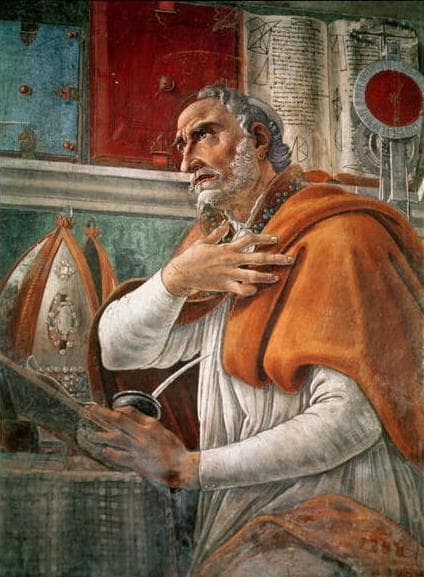
Augustine of Hippo
Confessions

Augustine hypothesizes that time is not an external physical reality but a 'protraction' or extension of the human mind itself.

...ot times); but when we utter the words and they pass by, and we say "it is a long stanza, because composed of so many verses; long verses, because consisting of so many feet; long feet, because prolonged by so many syllables; a long syllable because double to a short one." But neither do we this way obtain any certain measure of time; because it may be, that a shorter verse, pronounced more fully, may take up more time than a longer, pronounced hurriedly. And so for a verse, a foot, a syllable.
Whence it seemed to me, that time is nothing else than protraction; but of what, I know not; and I marvel, if it be not of the mind itself? For what, I beseech Thee, O my God, do I measure, when I say, either indefinitely "this is a longer time than that," or definitely "this is double that"? That I measure time, I know; and yet I measure not time to come, for it is not yet; nor present, because it is not protracted by any space; nor past, because it now is not. What then do I measure? Times passing, not past? for so I said.
Courage, my mind, and press on mightily. God is our helper, He made us, and not we ourselves. Press on where truth begins to dawn. Suppose, now, the voice of a body begins to sound, and does sound, and sounds on, and list, it ceases; it is silence now, and that voice is past, and is no more a voice. Before it sounded, it was to come, and could not be measured, because as yet it was not, and now it cannot, because it is no longer. Then therefore while it sounded, it might; because there then wa...
4
Life of Lives
Augustine of Hippo
Confessions

A poetic meditation on the hierarchy of existence, identifying God as the unchanging 'life of souls' who transcends physical bodies and mental fantasies.

...ll as we, and they are more certain than when we fancy them. And again, we do with more certainty fancy them, than by them conjecture other vaster and infinite bodies which have no being. Such empty husks was I then fed on; and was not fed. But Thou, my soul's Love, in looking for whom I fail, that I may become strong, art neither those bodies which we see, though in heaven; nor those which we see not there; for Thou hast created them, nor dost Thou account them among the chiefest of Thy works.
How far then art Thou from those fantasies of mine, fantasies of bodies which altogether are not, than which the images of those bodies, which are, are far more certain, and more certain still the bodies themselves, which yet Thou art not; no, nor yet the soul, which is the life of the bodies. So then, better and more certain is the life of the bodies than the bodies. But Thou art the life of souls, the life of lives, having life in Thyself; and changest not, life of my soul.
Where then wert Thou then to me, and how far from me? Far verily was I straying from Thee, barred from the very husks of the swine, whom with husks I fed. For how much better are the fables of poets and grammarians than these snares? For verses, and poems, and "Medea flying," are more profitable truly than these men's five elements, variously disguised, answering to five dens of darkness, which have no being, yet slay the believer. For verses and poems I can turn to true food, and "Medea flyin...
2
Creation's Testimony
Augustine of Hippo
Confessions

The author argues that the changeability of the heavens and earth proves they are created beings, distinct from the unchangeable beauty and goodness of the Creator.

...thin, in the chamber of my thoughts, Truth, neither Hebrew, nor Greek, nor Latin, nor barbarian, without organs of voice or tongue, or sound of syllables, would say, "It is truth," and I forthwith should say confidently to that man of Thine, "thou sayest truly." Whereas then I cannot enquire of him, Thee, Thee I beseech, O Truth, full of Whom he spake truth, Thee, my God, I beseech, forgive my sins; and Thou, who gavest him Thy servant to speak these things, give to me also to understand them.
Behold, the heavens and the earth are; they proclaim that they were created; for they change and vary. Whereas whatsoever hath not been made, and yet is, hath nothing in it, which before it had not; and this it is, to change and vary. They proclaim also, that they made not themselves; "therefore we are, because we have been made; we were not therefore, before we were, so as to make ourselves." Now the evidence of the thing, is the voice of the speakers. Thou therefore, Lord, madest them; who art beautiful, for they are beautiful; who art good, for they are good; who art, for they are; yet are they not beautiful nor good, nor are they, as Thou…
This we know, thanks be to Thee. And our knowledge, compared with Thy knowledge, is ignorance. But how didst Thou make the heaven and the earth? and what the engine of Thy so mighty fabric? For it was not as a human artificer, forming one body from another, according to the discretion of his mind, which can in some way invest with such a form, as it seeth in itself by its inward eye. And whence should he be able to do this, unless Thou hadst made that mind? and he invests with a form what alre...
Continue reading →
3
God's Eternal Rest
Augustine of Hippo
Confessions

A mystical observation on the paradox of God's eternal rest and constant work, asserting that things exist only because God sees them.

...or in them there was morning and evening. But the seventh day hath no evening, nor hath it setting; because Thou hast sanctified it to an everlasting continuance; that that which Thou didst after Thy works which were very good, resting the seventh day, although Thou madest them in unbroken rest, that may the voice of Thy Book announce beforehand unto us, that we also after our works (therefore very good, because Thou hast given them us), shall rest in Thee also in the Sabbath of eternal life.
For then shalt Thou rest in us, as now Thou workest in us; and so shall that be Thy rest through us, as these are Thy works through us. But Thou, Lord, ever workest, and art ever at rest. Nor dost Thou see in time, nor art moved in time, nor restest in a time; and yet Thou makest things seen in time, yea the times themselves, and the rest which results from time. We therefore see these things which Thou madest, because they are: but they are, because Thou seest them.
And we see without, that they are, and within, that they are good, but Thou sawest them there, when made, where Thou sawest them, yet to be made. And we were at a later time moved to do well, after our hearts had conceived of Thy Spirit; but in the former time we were moved to do evil, forsaking Thee; but Thou, the One, the Good God, didst never cease doing good. And we also have some good works, of Thy gift, but not eternal; after them we trust to rest in Thy great hallowing. But Thou, being t...
1
God's Non-Needy Creation
Augustine of Hippo
Confessions

The author argues that God's creation of man was not due to any divine need or lack, but rather an act of fullness so that man might receive well-being from his Creator.

..., and be converted, and call upon Thee, that calledst after me; for Thou, Lord, blottedst out all my evil deservings, so as not to repay into my hands, wherewith I fell from Thee; and Thou hast prevented all my well deservings, so as to repay the work of Thy hands wherewith Thou madest me; because before I was, Thou wert; nor was I any thing, to which Thou mightest grant to be; and yet behold, I am, out of Thy goodness, preventing all this which Thou hast made me, and whereof Thou hast made me.
For neither hadst Thou need of me, nor am I any such good, as to be helpful unto Thee, my Lord and God; not in serving Thee, as though Thou wouldest tire in working; or lest Thy power might be less, if lacking my service: nor cultivating Thy service, as a land, that must remain uncultivated, unless I cultivated Thee: but serving and worshipping Thee, that I might receive a well-being from Thee, from whom it comes, that I have a being capable of well-being. For of the fulness of Thy goodness, doth Thy creature subsist, that so a good, which could no ways profit Thee, nor was of Thee (lest so it should be equal to Thee), might yet be since it…
For what did heaven and earth, which Thou madest in the Beginning, deserve of Thee? Let those spiritual and corporeal natures which Thou madest in Thy Wisdom, say wherein they deserved of Thee, to depend thereon (even in that their several inchoate and formless state, whether spiritual or corporeal, ready to fall away into an immoderate liberty and far-distant unlikeliness unto Thee;--the spiritual, though without form, superior to the corporeal though formed, and the corporeal though without f...
Continue reading →
3