The author contrasts his intellectual prowess with his lack of piety, concluding that human wit is useless if it leads away from the protective 'shadow of God's wings'.
Intellect's Spiritual Failure
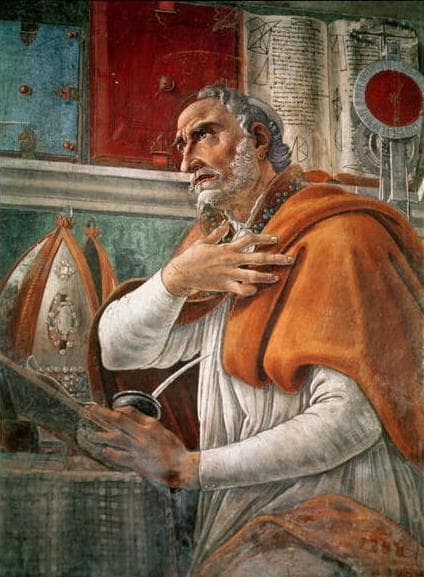
Augustine of Hippo
Confessions...lty, even by the studious and talented, until I attempted to explain them to such; when he most excelled in them who followed me not altogether slowly. But what did this further me, imagining that Thou, O Lord God, the Truth, wert a vast and bright body, and I a fragment of that body? Perverseness too great! But such was I. Nor do I blush, O my God, to confess to Thee Thy mercies towards me, and to call upon Thee, who blushed not then to profess to men my blasphemies, and to bark against Thee.
What profited me then my nimble wit in those sciences and all those most knotty volumes, unravelled by me, without aid from human instruction; seeing I erred so foully, and with such sacrilegious shamefulness, in the doctrine of piety? Or what hindrance was a far slower wit to Thy little ones, since they departed not far from Thee, that in the nest of Thy Church they might securely be fledged, and nourish the wings of charity, by the food of a sound faith. O Lord our God, under the shadow of Thy wings let us hope; protect us, and carry us. Thou wilt carry us both when little, and even to hoar hairs wilt Thou carry us; for our firmness, when…
Let us now, O Lord, return, that we may not be overturned, because with Thee our good lives without any decay, which good art Thou; nor need we fear, lest there be no place whither to return, because we fell from it: for through our absence, our mansion fell not--Thy eternity. BOOK V Accept the sacrifice of my confessions from the ministry of my tongue, which Thou hast formed and stirred up to confess unto Thy name. Heal Thou all my bones, and let them say, O Lord, who is like unto Thee?...
Continue reading →
2
⚖The Multiplicity of Truth

Augustine of Hippo
ConfessionsThe author argues for a pluralistic interpretation of Scripture, suggesting that a single text can contain multiple true meanings intended by God.
...h few words a copious meaning. And all we who, I confess, see and express the truth delivered in those words, let us love one another, and jointly love Thee our God, the fountain of truth, if we are athirst for it, and not for vanities; yea, let us so honour this Thy servant, the dispenser of this Scripture, full of Thy Spirit, as to believe that, when by Thy revelation he wrote these things, he intended that, which among them chiefly excels both for light of truth, and fruitfulness of profit.
So when one says, "Moses meant as I do"; and another, "Nay, but as I do," I suppose that I speak more reverently, "Why not rather as both, if both be true?" And if there be a third, or a fourth, yea if any other seeth any other truth in those words, why may not he be believed to have seen all these, through whom the One God hath tempered the holy Scriptures to the senses of many, who should see therein things true but divers? For I certainly (and fearlessly I speak it from my heart), that were I to indite any thing to have supreme authority, I should prefer so to write, that whatever truth any could apprehend on those matters, might be…
I will not therefore, O my God, be so rash, as not to believe, that Thou vouchsafedst as much to that great man. He without doubt, when he wrote those words, perceived and thought on what truth soever we have been able to find, yea and whatsoever we have not been able, nor yet are, but which may be found in them. Lastly, O Lord, who art God and not flesh and blood, if man did see less, could any thing be concealed from Thy good Spirit (who shall lead me into the land of uprightness), which Tho...
Continue reading →
5
⚖Time's Unknown Nature

Augustine of Hippo
ConfessionsAugustine admits his existential frustration and ignorance regarding the true nature of time, despite constantly speaking of it.
...at by which we measure how long it is, another; who sees not, which of the two is rather to be called time? For and if a body be sometimes moved, sometimes stands still, then we measure, not his motion only, but his standing still too by time; and we say, "it stood still, as much as it moved"; or "it stood still twice or thrice so long as it moved"; or any other space which our measuring hath either ascertained, or guessed; more or less, as we use to say. Time then is not the motion of a body.
And I confess to Thee, O Lord, that I yet know not what time is, and again I confess unto Thee, O Lord, that I know that I speak this in time, and that having long spoken of time, that very "long" is not long, but by the pause of time. How then know I this, seeing I know not what time is? or is it perchance that I know not how to express what I know? Woe is me, that do not even know, what I know not. Behold, O my God, before Thee I lie not; but as I speak, so is my heart. Thou shalt light my candle; Thou, O Lord my God, wilt enlighten my darkness.
Does not my soul most truly confess unto Thee, that I do measure times? Do I then measure, O my God, and know not what I measure? I measure the motion of a body in time; and the time itself do I not measure? Or could I indeed measure the motion of a body how long it were, and in how long space it could come from this place to that, without measuring the time in which it is moved? This same time then, how do I measure? do we by a shorter time measure a longer, as by the space of a cubit, the sp...
2
⚖Strength as Illusion

Augustine of Hippo
ConfessionsThe author warns against spiritual pride, advising that those who have avoided sin should love God even more for the mercy that preserved them.
...ve Thee, O Lord, and thank Thee, and confess unto Thy name; because Thou hast forgiven me these so great and heinous deeds of mine. To Thy grace I ascribe it, and to Thy mercy, that Thou hast melted away my sins as it were ice. To Thy grace I ascribe also whatsoever I have not done of evil; for what might I not have done, who even loved a sin for its own sake? Yea, all I confess to have been forgiven me; both what evils I committed by my own wilfulness, and what by Thy guidance I committed not.
What man is he, who, weighing his own infirmity, dares to ascribe his purity and innocency to his own strength; that so he should love Thee the less, as if he had less needed Thy mercy, whereby Thou remittest sins to those that turn to Thee? For whosoever, called by Thee, followed Thy voice, and avoided those things which he reads me recalling and confessing of myself, let him not scorn me, who being sick, was cured by that Physician, through whose aid it was that he was not, or rather was less, sick: and for this let him love Thee as much, yea and more; since by whom he sees me to have been recovered from such deep consumption of sin, by Him…
What fruit had I then (wretched man!) in those things, of the remembrance whereof I am now ashamed? Especially, in that theft which I loved for the theft's sake; and it too was nothing, and therefore the more miserable I, who loved it. Yet alone I had not done it: such was I then, I remember, alone I had never done it. I loved then in it also the company of the accomplices, with whom I did it? I did not then love nothing else but the theft, yea rather I did love nothing else; for that circumst...
Continue reading →
2
⚖The Image in Space

Augustine of Hippo
ConfessionsThe author laments his past intellectual errors regarding the nature of God and the human image, expressing shame for his confident assertions about uncertainties.
...Thy spiritual sons, whom of the Catholic Mother Thou hast born again through grace, as though they believed and conceived of Thee as bounded by human shape (although what a spiritual substance should be I had not even a faint or shadowy notion); yet, with joy I blushed at having so many years barked not against the Catholic faith, but against the fictions of carnal imaginations. For so rash and impious had I been, that what I ought by enquiring to have learned, I had pronounced on, condemning.
For Thou, Most High, and most near; most secret, and most present; Who hast not limbs some larger, some smaller, but art wholly every where, and no where in space, art not of such corporeal shape, yet hast Thou made man after Thine own image; and behold, from head to foot is he contained in space. Ignorant then how this Thy image should subsist, I should have knocked and proposed the doubt, how it was to be believed, not insultingly opposed it, as if believed. Doubt, then, what to hold for certain, the more sharply gnawed my heart, the more ashamed I was, that so long deluded and deceived by the promise of certainties, I had with childish…
For that they were falsehoods became clear to me later. However I was certain that they were uncertain, and that I had formerly accounted them certain, when with a blind contentiousness, I accused Thy Catholic Church, whom I now discovered, not indeed as yet to teach truly, but at least not to teach that for which I had grievously censured her. So I was confounded, and converted: and I joyed, O my God, that the One Only Church, the body of Thine Only Son (wherein the name of Christ had been put...
Continue reading →
2