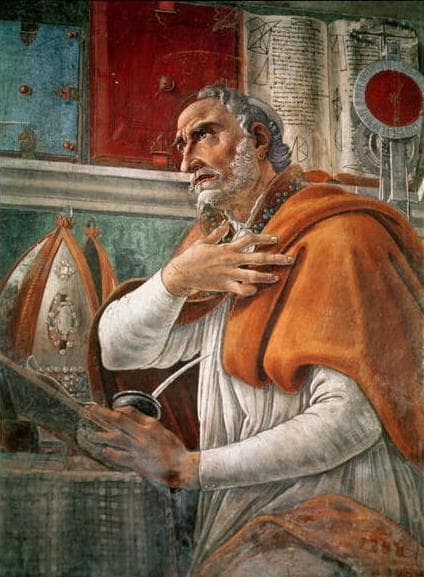
The author argues that infant innocence is a matter of physical limitation rather than moral purity, noting that babies exhibit the same selfish tempers that are considered intolerable in adults.
Infant Envy's Roots
Augustine of Hippo
Confessions...reproved. For those habits, when grown, we root out and cast away. Now no man, though he prunes, wittingly casts away what is good. Or was it then good, even for a while, to cry for what, if given, would hurt? bitterly to resent, that persons free, and its own elders, yea, the very authors of its birth, served it not? that many besides, wiser than it, obeyed not the nod of its good pleasure? to do its best to strike and hurt, because commands were not obeyed, which had been obeyed to its hurt?
The weakness then of infant limbs, not its will, is its innocence. Myself have seen and known even a baby envious; it could not speak, yet it turned pale and looked bitterly on its foster-brother. Who knows not this? Mothers and nurses tell you that they allay these things by I know not what remedies. Is that too innocence, when the fountain of milk is flowing in rich abundance, not to endure one to share it, though in extremest need, and whose very life as yet depends thereon? We bear gently with all this, not as being no or slight evils, but because they will disappear as years increase; for, though tolerated now, the very same tempers are…
Thou, then, O Lord my God, who gavest life to this my infancy, furnishing thus with senses (as we see) the frame Thou gavest, compacting its limbs, ornamenting its proportions, and, for its general good and safety, implanting in it all vital functions, Thou commandest me to praise Thee in these things, to confess unto Thee, and sing unto Thy name, Thou most Highest. For Thou art God, Almighty and Good, even hadst Thou done nought but only this, which none could do but Thou: whose Unity is the...
Continue reading →
6
⚖Sins' Mature Transfer

Augustine of Hippo
ConfessionsAugustine reflects on the transition from childhood sins to adult vices, while thanking God for the inherent instincts and senses granted to him in his youth.
...that I might have to give to boys, who sold me their play, which all the while they liked no less than I. In this play, too, I often sought unfair conquests, conquered myself meanwhile by vain desire of preeminence. And what could I so ill endure, or, when I detected it, upbraided I so fiercely, as that I was doing to others? and for which if, detected, I was upbraided, I chose rather to quarrel than to yield. And is this the innocence of boyhood? Not so, Lord, not so; I cry Thy mercy, my God.
For these very sins, as riper years succeed, these very sins are transferred from tutors and masters, from nuts and balls and sparrows, to magistrates and kings, to gold and manors and slaves, just as severer punishments displace the cane. It was the low stature then of childhood which Thou our King didst commend as an emblem of lowliness, when Thou saidst, Of such is the kingdom of heaven. Yet, Lord, to Thee, the Creator and Governor of the universe, most excellent and most good, thanks were due to Thee our God, even hadst Thou destined for me boyhood only. For even then I was, I lived, and felt; and had an implanted providence over my…
In so small a creature, what was not wonderful, not admirable? But all are gifts of my God: it was not I who gave them me; and good these are, and these together are myself. Good, then, is He that made me, and He is my good; and before Him will I exult for every good which of a boy I had. For it was my sin, that not in Him, but in His creatures--myself and others--I sought for pleasures, sublimities, truths, and so fell headlong into sorrows, confusions, errors. Thanks be to Thee, my joy and my...
Continue reading →
2
⚖Memory's Boundless Chamber

Augustine of Hippo
ConfessionsThe author analyzes the vast and incomprehensible nature of memory, arguing that the mind is too narrow to fully contain or understand its own power.
...ence again infer future actions, events and hopes, and all these again I reflect on, as present. "I will do this or that," say I to myself, in that great receptacle of my mind, stored with the images of things so many and so great, "and this or that will follow." "O that this or that might be!" "God avert this or that!" So speak I to myself: and when I speak, the images of all I speak of are present, out of the same treasury of memory; nor would I speak of any thereof, were the images wanting.
Great is this force of memory, excessive great, O my God; a large and boundless chamber! who ever sounded the bottom thereof? yet is this a power of mine, and belongs unto my nature; nor do I myself comprehend all that I am. Therefore is the mind too strait to contain itself. And where should that be, which it containeth not of itself? Is it without it, and not within? how then doth it not comprehend itself? A wonderful admiration surprises me, amazement seizes me upon this.
And men go abroad to admire the heights of mountains, the mighty billows of the sea, the broad tides of rivers, the compass of the ocean, and the circuits of the stars, and pass themselves by; nor wonder that when I spake of all these things, I did not see them with mine eyes, yet could not have spoken of them, unless I then actually saw the mountains, billows, rivers, stars which I had seen, and that ocean which I believe to be, inwardly in my memory, and that, with the same vast spaces betwee...
6
⚖Grief's Bitter Sweetness

Augustine of Hippo
ConfessionsThe author examines his own grief following a loss, questioning why the act of weeping feels sweet or comforting when the underlying experience is one of misery and bitterness.
...succeeded my friend, in the dearest of my affections. And now, Lord, these things are passed by, and time hath assuaged my wound. May I learn from Thee, who art Truth, and approach the ear of my heart unto Thy mouth, that Thou mayest tell me why weeping is sweet to the miserable? Hast Thou, although present every where, cast away our misery far from Thee? And Thou abidest in Thyself, but we are tossed about in divers trials. And yet unless we mourned in Thine ears, we should have no hope left.
Whence then is sweet fruit gathered from the bitterness of life, from groaning, tears, sighs, and complaints? Doth this sweeten it, that we hope Thou hearest? This is true of prayer, for therein is a longing to approach unto Thee. But is it also in grief for a thing lost, and the sorrow wherewith I was then overwhelmed? For I neither hoped he should return to life nor did I desire this with my tears; but I wept only and grieved. For I was miserable, and had lost my joy. Or is weeping indeed a bitter thing, and for very loathing of the things which we before enjoyed, does it then, when we shrink from them, please us?
But what speak I of these things? for now is no time to question, but to confess unto Thee. Wretched I was; and wretched is every soul bound by the friendship of perishable things; he is torn asunder when he loses them, and then he feels the wretchedness which he had ere yet he lost them. So was it then with me; I wept most bitterly, and found my repose in bitterness. Thus was I wretched, and that wretched life I held dearer than my friend. For though I would willingly have changed it, yet was...
2
⚖The Unfathomable Heart

Augustine of Hippo
ConfessionsThe author poetically describes the human condition as a 'great deep' where internal feelings are more numerous and complex than the hairs on one's head.
...are (though I myself did commend and love them), but had rather be unknown, than so known; and even hated, than so loved. Where now are the impulses to such various and divers kinds of loves laid up in one soul? Why, since we are equally men, do I love in another what, if I did not hate, I should not spurn and cast from myself? For it holds not, that as a good horse is loved by him, who would not, though he might, be that horse, therefore the same may be said of an actor, who shares our nature.
Do I then love in a man, what I hate to be, who am a man? Man himself is a great deep, whose very hairs Thou numberest, O Lord, and they fall not to the ground without Thee. And yet are the hairs of his head easier to be numbered than his feelings, and the beatings of his heart.
But that orator was of that sort whom I loved, as wishing to be myself such; and I erred through a swelling pride, and was tossed about with every wind, but yet was steered by Thee, though very secretly. And whence do I know, and whence do I confidently confess unto Thee, that I had loved him more for the love of his commenders, than for the very things for which he was commended? Because, had he been unpraised, and these self-same men had dispraised him, and with dispraise and contempt told t...
2