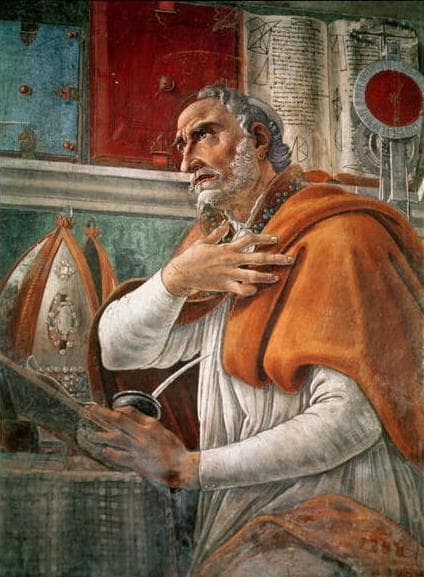
Mercy Over Merit
Augustine of Hippo
Confessions

The author warns that even a commendable life requires divine mercy, asserting that human merits are actually gifts from God rather than personal achievements.

...y years wept for me that I might live in Thine eyes), let him not deride me; but rather, if he be one of large charity, let him weep himself for my sins unto Thee, the Father of all the brethren of Thy Christ. But now, with a heart cured of that wound, wherein it might seem blameworthy for an earthly feeling, I pour out unto Thee, our God, in behalf of that Thy handmaid, a far different kind of tears, flowing from a spirit shaken by the thoughts of the dangers of every soul that dieth in Adam.
And although she having been quickened in Christ, even before her release from the flesh, had lived to the praise of Thy name for her faith and conversation; yet dare I not say that from what time Thou regeneratedst her by baptism, no word issued from her mouth against Thy Commandment. Thy Son, the Truth, hath said, Whosoever shall say unto his brother, Thou fool, shall be in danger of hell fire. And woe be even unto the commendable life of men, if, laying aside mercy, Thou shouldest examine it. But because Thou art not extreme in enquiring after sins, we confidently hope to find some place with Thee. But whosoever reckons up his real merits…
O that men would know themselves to be men; and that he that glorieth would glory in the Lord. I therefore, O my Praise and my Life, God of my heart, laying aside for a while her good deeds, for which I give thanks to Thee with joy, do now beseech Thee for the sins of my mother. Hearken unto me, I entreat Thee, by the Medicine of our wounds, Who hung upon the tree, and now sitting at Thy right hand maketh intercession to Thee for us. I know that she dealt mercifully, and from her heart forgave...
Continue reading →
2
The Self-Resting God
Augustine of Hippo
Confessions

The author contrasts the temporary and often evil-inclined nature of human works with the eternal, self-sufficient rest of God.

...orks through us. But Thou, Lord, ever workest, and art ever at rest. Nor dost Thou see in time, nor art moved in time, nor restest in a time; and yet Thou makest things seen in time, yea the times themselves, and the rest which results from time. We therefore see these things which Thou madest, because they are: but they are, because Thou seest them. And we see without, that they are, and within, that they are good, but Thou sawest them there, when made, where Thou sawest them, yet to be made.
And we were at a later time moved to do well, after our hearts had conceived of Thy Spirit; but in the former time we were moved to do evil, forsaking Thee; but Thou, the One, the Good God, didst never cease doing good. And we also have some good works, of Thy gift, but not eternal; after them we trust to rest in Thy great hallowing. But Thou, being the Good which needeth no good, art ever at rest, because Thy rest is Thou Thyself.
And what man can teach man to understand this? or what Angel, an Angel? or what Angel, a man? Let it be asked of Thee, sought in Thee, knocked for at Thee; so, so shall it be received, so shall it be found, so shall it be opened. Amen. GRATIAS TIBI DOMINE...
2
Strength Through Christ
Augustine of Hippo
Confessions

The author emphasizes human dependency on divine strength, famously asking God to grant the power to obey whatever commands He chooses to give.

...om Thee it was, that both might know from Whom it was. I heard another voice of Thine, Go not after thy lusts, and from thy pleasure turn away. Yea by Thy favour have I heard that which I have much loved; neither if we eat, shall we abound; neither if we eat not, shall we lack; which is to say, neither shall the one make me plenteous, nor the other miserable. I heard also another, for I have learned in whatsoever state I am, therewith to be content; I know how to abound, and how to suffer need.
I can do all things through Christ that strengtheneth me. Behold a soldier of the heavenly camp, not the dust which we are. But remember, Lord, that we are dust, and that of dust Thou hast made man; and he was lost and is found. Nor could he of himself do this, because he whom I so loved, saying this through the in-breathing of Thy inspiration, was of the same dust. I can do all things (saith he) through Him that strengtheneth me. Strengthen me, that I can. Give what Thou enjoinest, and enjoin what Thou wilt. He confesses to have received, and when he glorieth, in the Lord he glorieth.
Another have I heard begging that he might receive. Take from me (saith he) the desires of the belly; whence it appeareth, O my holy God, that Thou givest, when that is done which Thou commandest to be done. Thou hast taught me, good Father, that to the pure, all things are pure; but that it is evil unto the man that eateth with offence; and, that every creature of Thine is good, and nothing to be refused, which is received with thanksgiving; and that meat commendeth us not to God; and, that n...
3
Continency's Divine Source
Augustine of Hippo
Confessions

The author argues that human self-control is not an inherent power but a gift from God that must be requested through faith.

...e state of marriage." While I went over these things, and these winds shifted and drove my heart this way and that, time passed on, but I delayed to turn to the Lord; and from day to day deferred to live in Thee, and deferred not daily to die in myself. Loving a happy life, I feared it in its own abode, and sought it, by fleeing from it. I thought I should be too miserable, unless folded in female arms; and of the medicine of Thy mercy to cure that infirmity I thought not, not having tried it.
As for continency, I supposed it to be in our own power (though in myself I did not find that power), being so foolish as not to know what is written, None can be continent unless Thou give it; and that Thou wouldest give it, if with inward groanings I did knock at Thine ears, and with a settled faith did cast my care on Thee.
Alypius indeed kept me from marrying; alleging that so could we by no means with undistracted leisure live together in the love of wisdom, as we had long desired. For himself was even then most pure in this point, so that it was wonderful; and that the more, since in the outset of his youth he had entered into that course, but had not stuck fast therein; rather had he felt remorse and revolting at it, living thenceforth until now most continently. But I opposed him with the examples of those w...
3
The Mediator's Intercession
Augustine of Hippo
Confessions

A prayerful petition seeking divine wisdom through the Scriptures, centered on the role of Christ as the mediator and creator.

...easures of the flesh, or necessaries for the body and for this life of our pilgrimage: all which shall be added unto those that seek Thy kingdom and Thy righteousness. Behold, O Lord my God, wherein is my desire. The wicked have told me of delights, but not such as Thy law, O Lord. Behold, wherein is my desire. Behold, Father, behold, and see and approve; and be it pleasing in the sight of Thy mercy, that I may find grace before Thee, that the inward parts of Thy words be opened to me knocking.
I beseech by our Lord Jesus Christ Thy Son, the Man of Thy right hand, the Son of man, whom Thou hast established for Thyself, as Thy Mediator and ours, through Whom Thou soughtest us, not seeking Thee, but soughtest us, that we might seek Thee,--Thy Word, through Whom Thou madest all things, and among them, me also;--Thy Only-Begotten, through Whom Thou calledst to adoption the believing people, and therein me also;--I beseech Thee by Him, who sitteth at Thy right hand, and intercedeth with Thee for us, in Whom are hidden all the treasures of wisdom and knowledge. These do I seek in Thy books.
Of Him did Moses write; this saith Himself; this saith the Truth. I would hear and understand, how "In the Beginning Thou madest the heaven and earth." Moses wrote this, wrote and departed, passed hence from Thee to Thee; nor is he now before me. For if he were, I would hold him and ask him, and beseech him by Thee to open these things unto me, and would lay the ears of my body to the sounds bursting out of his mouth. And should he speak Hebrew, in vain will it strike on my senses, nor would a...
2