The author posits that human knowledge and perception of goodness are actually manifestations of God acting through the individual.
God's Vision Through Us
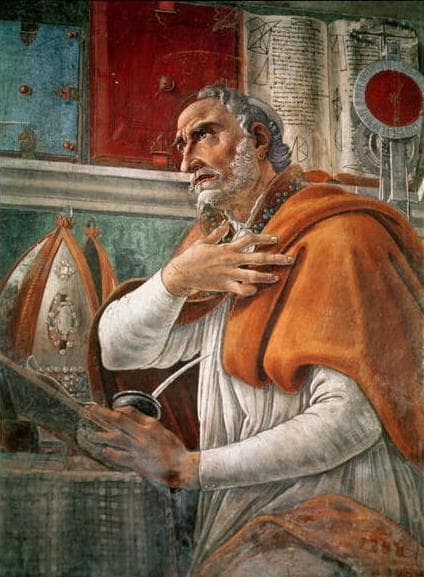
Augustine of Hippo
Confessions...is in him? even so the things of God knoweth no one, but the Spirit of God. Now we (saith he) have received, not the spirit of this world, but the Spirit which is of God, that we might know the things that are freely given to us of God. And I am admonished, "Truly the things of God knoweth no one, but the Spirit of God: how then do we also know, what things are given us of God?" Answer is made me; "because the things which we know by His Spirit, even these no one knoweth, but the Spirit of God.
For as it is rightly said unto those that were to speak by the Spirit of God, it is not ye that speak: so is it rightly said to them that know through the Spirit of God, 'It is not ye that know.' And no less then is it rightly said to those that see through the Spirit of God, 'It is not ye that see'; so whatsoever through the Spirit of God they see to be good, it is not they, but God that sees that it is good."
It is one thing then for a man to think that to be ill which is good, as the forenamed do; another, that that which is good, a man should see that it is good (as Thy creatures be pleasing unto many, because they be good, whom yet Thou pleasest not in them, when they prefer to enjoy them, to Thee); and another, that when a man sees a thing that it is good, God should in him see that it is good, so, namely, that He should be loved in that which He made, Who cannot be loved, but by the Holy Ghost...
6
⚖Faith's Healing Paradox

Augustine of Hippo
ConfessionsAugustine describes his intellectual journey from the empty promises of the Manichees to the more honest, faith-based approach of the Catholic Church.
...he things I saw not, as I was that seven and three are ten. For I was not so mad as to think that even this could not be comprehended; but I desired to have other things as clear as this, whether things corporeal, which were not present to my senses, or spiritual, whereof I knew not how to conceive, except corporeally. And by believing might I have been cured, that so the eyesight of my soul being cleared, might in some way be directed to Thy truth, which abideth always, and in no part faileth.
But as it happens that one who has tried a bad physician, fears to trust himself with a good one, so was it with the health of my soul, which could not be healed but by believing, and lest it should believe falsehoods, refused to be cured; resisting Thy hands, Who hast prepared the medicines of faith, and hast applied them to the diseases of the whole world, and given unto them so great authority. Being led, however, from this to prefer the Catholic doctrine, I felt that her proceeding was more unassuming and honest, in that she required to be believed things not demonstrated (whether it was that they could in themselves be demonstrated but…
Then Thou, O Lord, little by little with most tender and most merciful hand, touching and composing my heart, didst persuade me--considering what innumerable things I believed, which I saw not, nor was present while they were done, as so many things in secular history, so many reports of places and of cities, which I had not seen; so many of friends, so many of physicians, so many continually of other men, which unless we should believe, we should do nothing at all in this life; lastly, with ho...
Continue reading →
2
⚖Truth Beyond Individual Minds

Augustine of Hippo
ConfessionsThe author argues that objective truth exists outside of individuals in an unchangeable divine source, making human disputes over subjective interpretation secondary to that Truth.
...have that his own which belongs to all, is driven from what is in common to his own; that is, from truth, to a lie. For he that speaketh a lie, speaketh it of his own. Hearken, O God, Thou best judge; Truth Itself, hearken to what I shall say to this gainsayer, hearken, for before Thee do I speak, and before my brethren, who employ Thy law lawfully, to the end of charity: hearken and behold, if it please Thee, what I shall say to him. For this brotherly and peaceful word do I return unto Him:
"If we both see that to be true that Thou sayest, and both see that to be true that I say, where, I pray Thee, do we see it? Neither I in thee, nor thou in me; but both in the unchangeable Truth itself, which is above our souls." Seeing then we strive not about the very light of the Lord God, why strive we about the thoughts of our neighbour which we cannot so see, as the unchangeable Truth is seen: for that, if Moses himself had appeared to us and said, "This I meant"; neither so should we see it, but should believe it.
Let us not then be puffed up for one against another, above that which is written: let us love the Lord our God with all our heart, with all our soul, and with all our mind: and our neighbour as ourself. With a view to which two precepts of charity, unless we believe that Moses meant, whatsoever in those books he did mean, we shall make God a liar, imagining otherwise of our fellow servant's mind, than he hath taught us. Behold now, how foolish it is, in such abundance of most true meanings, as...
3
⚖Time's Unknown Nature

Augustine of Hippo
ConfessionsAugustine admits his existential frustration and ignorance regarding the true nature of time, despite constantly speaking of it.
...at by which we measure how long it is, another; who sees not, which of the two is rather to be called time? For and if a body be sometimes moved, sometimes stands still, then we measure, not his motion only, but his standing still too by time; and we say, "it stood still, as much as it moved"; or "it stood still twice or thrice so long as it moved"; or any other space which our measuring hath either ascertained, or guessed; more or less, as we use to say. Time then is not the motion of a body.
And I confess to Thee, O Lord, that I yet know not what time is, and again I confess unto Thee, O Lord, that I know that I speak this in time, and that having long spoken of time, that very "long" is not long, but by the pause of time. How then know I this, seeing I know not what time is? or is it perchance that I know not how to express what I know? Woe is me, that do not even know, what I know not. Behold, O my God, before Thee I lie not; but as I speak, so is my heart. Thou shalt light my candle; Thou, O Lord my God, wilt enlighten my darkness.
Does not my soul most truly confess unto Thee, that I do measure times? Do I then measure, O my God, and know not what I measure? I measure the motion of a body in time; and the time itself do I not measure? Or could I indeed measure the motion of a body how long it were, and in how long space it could come from this place to that, without measuring the time in which it is moved? This same time then, how do I measure? do we by a shorter time measure a longer, as by the space of a cubit, the sp...
2
⚖Time's Impossible Measure

Augustine of Hippo
ConfessionsA logical investigation into the nature of time, questioning how we can measure the past or future since they do not currently exist.
...ong? Is it to come? Of it we do not say, "it is long"; because it is not yet, so as to be long; but we say, "it will be long." When therefore will it be? For if even then, when it is yet to come, it shall not be long (because what can be long, as yet is not), and so it shall then be long, when from future which as yet is not, it shall begin now to be, and have become present, that so there should exist what may be long; then does time present cry out in the words above, that it cannot be long.
And yet, Lord, we perceive intervals of times, and compare them, and say, some are shorter, and others longer. We measure also, how much longer or shorter this time is than that; and we answer, "This is double, or treble; and that, but once, or only just so much as that." But we measure times as they are passing, by perceiving them; but past, which now are not, or the future, which are not yet, who can measure? unless a man shall presume to say, that can be measured, which is not. When then time is passing, it may be perceived and measured; but when it is past, it cannot, because it is not.
I ask, Father, I affirm not: O my God, rule and guide me. "Who will tell me that there are not three times (as we learned when boys, and taught boys), past, present, and future; but present only, because those two are not? Or are they also; and when from future it becometh present, doth it come out of some secret place; and so, when retiring, from present it becometh past? For where did they, who foretold things to come, see them, if as yet they be not? For that which is not, cannot be seen. A...
5