The author reflects on his childhood resistance to study, acknowledging that while his teachers had worldly motives, God used their force and his own errors for his ultimate benefit.
Forced Learning's Paradox
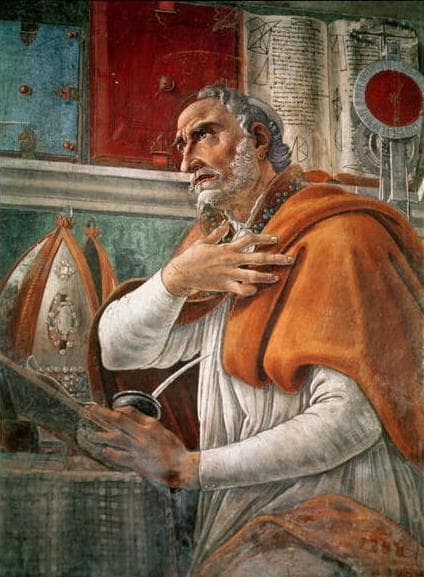
Augustine of Hippo
Confessions...aptised?" but as to bodily health, no one says, "Let him be worse wounded, for he is not yet healed." How much better then, had I been at once healed; and then, by my friends' and my own, my soul's recovered health had been kept safe in Thy keeping who gavest it. Better truly. But how many and great waves of temptation seemed to hang over me after my boyhood! These my mother foresaw; and preferred to expose to them the clay whence I might afterwards be moulded, than the very cast, when made.
In boyhood itself, however (so much less dreaded for me than youth), I loved not study, and hated to be forced to it. Yet I was forced; and this was well done towards me, but I did not well; for, unless forced, I had not learnt. But no one doth well against his will, even though what he doth, be well. Yet neither did they well who forced me, but what was well came to me from Thee, my God. For they were regardless how I should employ what they forced me to learn, except to satiate the insatiate desires of a wealthy beggary, and a shameful glory. But Thou, by whom the very hairs of our head are numbered, didst use for my good the error of all…
So by those who did not well, Thou didst well for me; and by my own sin Thou didst justly punish me. For Thou hast commanded, and so it is, that every inordinate affection should be its own punishment. But why did I so much hate the Greek, which I studied as a boy? I do not yet fully know. For the Latin I loved; not what my first masters, but what the so-called grammarians taught me. For those first lessons, reading, writing and arithmetic, I thought as great a burden and penalty as any Greek....
Continue reading →
2
⚖Error's Divine Use

Augustine of Hippo
ConfessionsThe author argues that God uses human errors and sins as instruments of justice, asserting that every disordered affection inherently punishes itself.
...r me than youth), I loved not study, and hated to be forced to it. Yet I was forced; and this was well done towards me, but I did not well; for, unless forced, I had not learnt. But no one doth well against his will, even though what he doth, be well. Yet neither did they well who forced me, but what was well came to me from Thee, my God. For they were regardless how I should employ what they forced me to learn, except to satiate the insatiate desires of a wealthy beggary, and a shameful glory.
But Thou, by whom the very hairs of our head are numbered, didst use for my good the error of all who urged me to learn; and my own, who would not learn, Thou didst use for my punishment--a fit penalty for one, so small a boy and so great a sinner. So by those who did not well, Thou didst well for me; and by my own sin Thou didst justly punish me. For Thou hast commanded, and so it is, that every inordinate affection should be its own punishment.
But why did I so much hate the Greek, which I studied as a boy? I do not yet fully know. For the Latin I loved; not what my first masters, but what the so-called grammarians taught me. For those first lessons, reading, writing and arithmetic, I thought as great a burden and penalty as any Greek. And yet whence was this too, but from the sin and vanity of this life, because I was flesh, and a breath that passeth away and cometh not again? For those first lessons were better certainly, because m...
2
⚖Sins' Mature Transfer

Augustine of Hippo
ConfessionsAugustine reflects on the transition from childhood sins to adult vices, while thanking God for the inherent instincts and senses granted to him in his youth.
...that I might have to give to boys, who sold me their play, which all the while they liked no less than I. In this play, too, I often sought unfair conquests, conquered myself meanwhile by vain desire of preeminence. And what could I so ill endure, or, when I detected it, upbraided I so fiercely, as that I was doing to others? and for which if, detected, I was upbraided, I chose rather to quarrel than to yield. And is this the innocence of boyhood? Not so, Lord, not so; I cry Thy mercy, my God.
For these very sins, as riper years succeed, these very sins are transferred from tutors and masters, from nuts and balls and sparrows, to magistrates and kings, to gold and manors and slaves, just as severer punishments displace the cane. It was the low stature then of childhood which Thou our King didst commend as an emblem of lowliness, when Thou saidst, Of such is the kingdom of heaven. Yet, Lord, to Thee, the Creator and Governor of the universe, most excellent and most good, thanks were due to Thee our God, even hadst Thou destined for me boyhood only. For even then I was, I lived, and felt; and had an implanted providence over my…
In so small a creature, what was not wonderful, not admirable? But all are gifts of my God: it was not I who gave them me; and good these are, and these together are myself. Good, then, is He that made me, and He is my good; and before Him will I exult for every good which of a boy I had. For it was my sin, that not in Him, but in His creatures--myself and others--I sought for pleasures, sublimities, truths, and so fell headlong into sorrows, confusions, errors. Thanks be to Thee, my joy and my...
Continue reading →
2
⚖Vision on the Rule

Augustine of Hippo
ConfessionsAugustine recounts a prophetic dream his mother had, which served as a divine assurance of his eventual conversion to the faith.
...ith and spirit which she had from Thee, discerned the death wherein I lay, and Thou heardest her, O Lord; Thou heardest her, and despisedst not her tears, when streaming down, they watered the ground under her eyes in every place where she prayed; yea Thou heardest her. For whence was that dream whereby Thou comfortedst her; so that she allowed me to live with her, and to eat at the same table in the house, which she had begun to shrink from, abhorring and detesting the blasphemies of my error?
For she saw herself standing on a certain wooden rule, and a shining youth coming towards her, cheerful and smiling upon her, herself grieving, and overwhelmed with grief. But he having (in order to instruct, as is their wont not to be instructed) enquired of her the causes of her grief and daily tears, and she answering that she was bewailing my perdition, he bade her rest contented, and told her to look and observe, "That where she was, there was I also." And when she looked, she saw me standing by her in the same rule. Whence was this, but that Thine ears were towards her heart? O Thou Good omnipotent, who so carest for every one of us, as…
Whence was this also, that when she had told me this vision, and I would fain bend it to mean, "That she rather should not despair of being one day what I was"; she presently, without any hesitation, replies: "No; for it was not told me that, 'where he, there thou also'; but 'where thou, there he also'?" I confess to Thee, O Lord, that to the best of my remembrance (and I have oft spoken of this), that Thy answer, through my waking mother,--that she was not perplexed by the plausibility of my...
Continue reading →
1
⚖Scriptures as Antidote

Augustine of Hippo
ConfessionsAugustine reflects on how his study of Platonic philosophy served as a necessary but incomplete precursor to the Scriptures, teaching him to distinguish between intellectual presumption and humble confession.
...ure ground alone, that they are." Of these things I was assured, yet too unsure to enjoy Thee. I prated as one well skilled; but had I not sought Thy way in Christ our Saviour, I had proved to be, not skilled, but killed. For now I had begun to wish to seem wise, being filled with mine own punishment, yet I did not mourn, but rather scorn, puffed up with knowledge. For where was that charity building upon the foundation of humility, which is Christ Jesus? or when should these books teach me it?
Upon these, I believe, Thou therefore willedst that I should fall, before I studied Thy Scriptures, that it might be imprinted on my memory how I was affected by them; and that afterwards when my spirits were tamed through Thy books, and my wounds touched by Thy healing fingers, I might discern and distinguish between presumption and confession; between those who saw whither they were to go, yet saw not the way, and the way that leadeth not to behold only but to dwell in the beatific country. For had I first been formed in Thy Holy Scriptures, and hadst Thou in the familiar use of them grown sweet unto me, and had I then fallen upon those…
Most eagerly then did I seize that venerable writing of Thy Spirit; and chiefly the Apostle Paul. Whereupon those difficulties vanished away, wherein he once seemed to me to contradict himself, and the text of his discourse not to agree with the testimonies of the Law and the Prophets. And the face of that pure word appeared to me one and the same; and I learned to rejoice with trembling. So I began; and whatsoever truth I had read in those other books, I found here amid the praise of Thy Grac...
Continue reading →
2