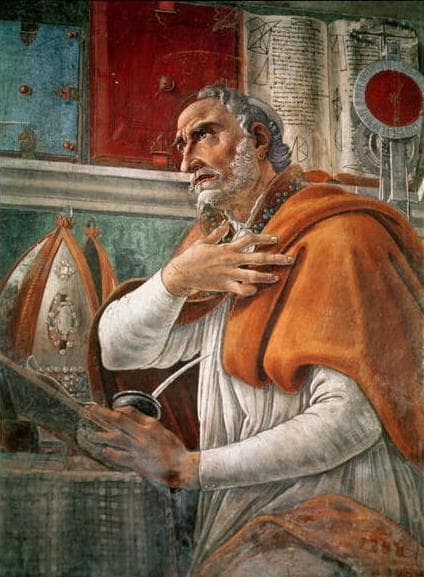
The Unchanging Will
Augustine of Hippo
Confessions

The author defines the nature of God as eternal and immutable, arguing that a varying will is incompatible with immortality.

...ray, and remembered Thee. I heard Thy voice behind me, calling to me to return, and scarcely heard it, through the tumultuousness of the enemies of peace. And now, behold, I return in distress and panting after Thy fountain. Let no man forbid me! of this will I drink, and so live. Let me not be mine own life; from myself I lived ill, death was I to myself; and I revive in Thee. Do Thou speak unto me, do Thou discourse unto me. I have believed Thy Books, and their words be most full of mystery.
Already Thou hast told me with a strong voice, O Lord, in my inner ear, that Thou art eternal, Who only hast immortality; since Thou canst not be changed as to figure or motion, nor is Thy will altered by times: seeing no will which varies is immortal. This is in Thy sight clear to me, and let it be more and more cleared to me, I beseech Thee; and in the manifestation thereof, let me with sobriety abide under Thy wings.
Thou hast told me also with a strong voice, O Lord, in my inner ear, that Thou hast made all natures and substances, which are not what Thyself is, and yet are; and that only is not from Thee, which is not, and the motion of the will from Thee who art, unto that which in a less degree is, because such motion is transgression and sin; and that no man's sin doth either hurt Thee, or disturb the order of Thy government, first or last. This is in Thy sight clear unto me, and let it be more and more...
2
Eternity's Ever-Present Now
Augustine of Hippo
Confessions

The author describes God's relationship to time, asserting that the divine 'Today' is an unchanging eternity that precedes and surpasses all past and future.

...f all ages? or what times should there be, which were not made by Thee? or how should they pass by, if they never were? Seeing then Thou art the Creator of all times, if any time was before Thou madest heaven and earth, why say they that Thou didst forego working? For that very time didst Thou make, nor could times pass by, before Thou madest those times. But if before heaven and earth there was no time, why is it demanded, what Thou then didst? For there was no "then," when there was no time.
Nor dost Thou by time, precede time: else shouldest Thou not precede all times. But Thou precedest all things past, by the sublimity of an ever-present eternity; and surpassest all future because they are future, and when they come, they shall be past; but Thou art the Same, and Thy years fail not. Thy years neither come nor go; whereas ours both come and go, that they all may come. Thy years stand together, because they do stand; nor are departing thrust out by coming years, for they pass not away; but ours shall all be, when they shall no more be. Thy years are one day; and Thy day is not daily, but To-day, seeing Thy To-day gives not place…
therefore didst Thou beget The Coeternal, to whom Thou saidst, This day have I begotten Thee. Thou hast made all things; and before all times Thou art: neither in any time was time not. At no time then hadst Thou not made any thing, because time itself Thou madest. And no times are coeternal with Thee, because Thou abidest; but if they abode, they should not be times. For what is time? Who can readily and briefly explain this? Who can even in thought comprehend it, so as to utter a word about...
Continue reading →
1
Eternity's Unchangeable Making
Augustine of Hippo
Confessions

The author analyzes the logical priority of formless matter over formed objects, using the relationship between sound and tune as a systemic example.

...t, if nothing after?" But when he says, God made matter first formless, then formed, there is no absurdity, if he be but qualified to discern, what precedes by eternity, what by time, what by choice, and what in original. By eternity, as God is before all things; by time, as the flower before the fruit; by choice, as the fruit before the flower; by original, as the sound before the tune. Of these four, the first and last mentioned, are with extreme difficulty understood, the two middle, easily.
For a rare and too lofty a vision is it, to behold Thy Eternity, O Lord, unchangeably making things changeable; and thereby before them. And who, again, is of so sharp-sighted understanding, as to be able without great pains to discern, how the sound is therefore before the tune; because a tune is a formed sound; and a thing not formed, may exist; whereas that which existeth not, cannot be formed.
Thus is the matter before the thing made; not because it maketh it, seeing itself is rather made; nor is it before by interval of time; for we do not first in time utter formless sounds without singing, and subsequently adapt or fashion them into the form of a chant, as wood or silver, whereof a chest or vessel is fashioned. For such materials do by time also precede the forms of the things made of them, but in singing it is not so; for when it is sung, its sound is heard; for there is not firs...
4
Fantasy's Empty Feast
Augustine of Hippo
Confessions

Augustine recounts his past error of seeking truth in empty fantasies and material metaphors, comparing the lack of spiritual nourishment he found to the illusory food in a dream.

...hings beautiful. O Truth, Truth, how inwardly did even then the marrow of my soul pant after Thee, when they often and diversely, and in many and huge books, echoed of Thee to me, though it was but an echo? And these were the dishes wherein to me, hungering after Thee, they, instead of Thee, served up the Sun and Moon, beautiful works of Thine, but yet Thy works, not Thyself, no nor Thy first works. For Thy spiritual works are before these corporeal works, celestial though they be, and shining.
But I hungered and thirsted not even after those first works of Thine, but after Thee Thyself, the Truth, in whom is no variableness, neither shadow of turning: yet they still set before me in those dishes, glittering fantasies, than which better were it to love this very sun (which is real to our sight at least), than those fantasies which by our eyes deceive our mind. Yet because I thought them to be Thee, I fed thereon; not eagerly, for Thou didst not in them taste to me as Thou art; for Thou wast not these emptinesses, nor was I nourished by them, but exhausted rather. Food in sleep shows very like our food awake; yet are not those asleep…
But those were not even any way like to Thee, as Thou hast now spoken to me; for those were corporeal fantasies, false bodies, than which these true bodies, celestial or terrestrial, which with our fleshly sight we behold, are far more certain: these things the beasts and birds discern as well as we, and they are more certain than when we fancy them. And again, we do with more certainty fancy them, than by them conjecture other vaster and infinite bodies which have no being. Such empty husks wa...
Continue reading →
2
Fleeing the Omnipresent
Augustine of Hippo
Confessions

The author explains the omnipresence of God, noting that those who try to flee from Him only succeed in blinding themselves and hurting their own nature.

...their weariness arise towards Thee, leaning on those things which Thou hast created, and passing on to Thyself, who madest them wonderfully; and there is refreshment and true strength. Let the restless, the godless, depart and flee from Thee; yet Thou seest them, and dividest the darkness. And behold, the universe with them is fair, though they are foul. And how have they injured Thee? or how have they disgraced Thy government, which, from the heaven to this lowest earth, is just and perfect?
For whither fled they, when they fled from Thy presence? or where dost not Thou find them? But they fled, that they might not see Thee seeing them, and, blinded, might stumble against Thee (because Thou forsakest nothing Thou hast made); that the unjust, I say, might stumble upon Thee, and justly be hurt; withdrawing themselves from thy gentleness, and stumbling at Thy uprightness, and falling upon their own ruggedness. Ignorant, in truth, that Thou art every where, Whom no place encompasseth! and Thou alone art near, even to those that remove far from Thee.
Let them then be turned, and seek Thee; because not as they have forsaken their Creator, hast Thou forsaken Thy creation. Let them be turned and seek Thee; and behold, Thou art there in their heart, in the heart of those that confess to Thee, and cast themselves upon Thee, and weep in Thy bosom, after all their rugged ways. Then dost Thou gently wipe away their tears, and they weep the more, and joy in weeping; even for that Thou, Lord,--not man of flesh and blood, but--Thou, Lord, who madest t...
2