The author explains that while individual parts of creation are good, the totality of creation is 'very good' because of the beautiful order and harmony of the whole.
The Whole's Greater Beauty
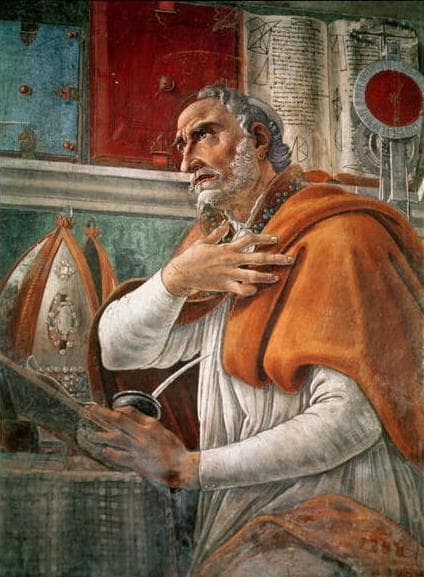
Augustine of Hippo
Confessions...whereas they be ignorant, why this is to be done, and to what end; neither do they feed these, nor are these fed by them; because neither do the one do it out of an holy and right intent; nor do the other rejoice at their gifts, whose fruit they as yet behold not. For upon that is the mind fed, of which it is glad. And therefore do not the fishes and whales feed upon such meats, as the earth brings not forth until after it was separated and divided from the bitterness of the waves of the sea.
And Thou, O God, sawest every thing that Thou hadst made, and, behold, it was very good. Yea we also see the same, and behold, all things are very good. Of the several kinds of Thy works, when Thou hadst said "let them be," and they were, Thou sawest each that it was good. Seven times have I counted it to be written, that Thou sawest that that which Thou madest was good: and this is the eighth, that Thou sawest every thing that Thou hadst made, and, behold, it was not only good, but also very good, as being now altogether. For severally, they were only good; but altogether, both good, and very good. All beautiful bodies express the same; by…
And I looked narrowly to find, whether seven, or eight times Thou sawest that Thy works were good, when they pleased Thee; but in Thy seeing I found no times, whereby I might understand that Thou sawest so often, what Thou madest. And I said, "Lord, is not this Thy Scripture true, since Thou art true, and being Truth, hast set it forth? why then dost Thou say unto me, 'that in Thy seeing there be no times'; whereas this Thy Scripture tells me, that what Thou madest each day, Thou sawest that i...
Continue reading →
4
⚖Love Through the Maker

Augustine of Hippo
ConfessionsThe author instructs others to redirect their love for physical bodies and souls back toward the Creator, in whom all things are firmly established.
...please thee. For what we speak also, by the same sense of the flesh thou hearest; yet wouldest not thou have the syllables stay, but fly away, that others may come, and thou hear the whole. And so ever, when any one thing is made up of many, all of which do not exist together, all collectively would please more than they do severally, could all be perceived collectively. But far better than these is He who made all; and He is our God, nor doth He pass away, for neither doth aught succeed Him.
If bodies please thee, praise God on occasion of them, and turn back thy love upon their Maker; lest in these things which please thee, thou displease. If souls please thee, be they loved in God: for they too are mutable, but in Him are they firmly stablished; else would they pass, and pass away. In Him then be they beloved; and carry unto Him along with thee what souls thou canst, and say to them, "Him let us love, Him let us love: He made these, nor is He far off. For He did not make them, and so depart, but they are of Him, and in Him.
See there He is, where truth is loved. He is within the very heart, yet hath the heart strayed from Him. Go back into your heart, ye transgressors, and cleave fast to Him that made you. Stand with Him, and ye shall stand fast. Rest in Him, and ye shall be at rest. Whither go ye in rough ways? Whither go ye? The good that you love is from Him; but it is good and pleasant through reference to Him, and justly shall it be embittered, because unjustly is any thing loved which is from Him, if He be f...
3
⚖God as Essence and Life

Augustine of Hippo
ConfessionsThe author meditates on the eternal nature of God's 'today,' which provides the measure for all passing time and sustains the existence of all things that flow through it.
.... Dost Thou mock me for asking this, and bid me praise Thee and acknowledge Thee, for that I do know? I acknowledge Thee, Lord of heaven and earth, and praise Thee for my first rudiments of being, and my infancy, whereof I remember nothing; for Thou hast appointed that man should from others guess much as to himself; and believe much on the strength of weak females. Even then I had being and life, and (at my infancy's close) I could seek for signs whereby to make known to others my sensations.
Whence could such a being be, save from Thee, Lord? Shall any be his own artificer? or can there elsewhere be derived any vein, which may stream essence and life into us, save from thee, O Lord, in whom essence and life are one? for Thou Thyself art supremely Essence and Life. For Thou art most high, and art not changed, neither in Thee doth to-day come to a close; yet in Thee doth it come to a close; because all such things also are in Thee. For they had no way to pass away, unless Thou upheldest them. And since Thy years fail not, Thy years are one to-day. How many of ours and our fathers' years have flowed away through Thy "to-day," and…
But Thou art still the same, and all things of tomorrow, and all beyond, and all of yesterday, and all behind it, Thou hast done to-day. What is it to me, though any comprehend not this? Let him also rejoice and say, What thing is this? Let him rejoice even thus! and be content rather by not discovering to discover Thee, than by discovering not to discover Thee. Hear, O God. Alas, for man's sin! So saith man, and Thou pitiest him; for Thou madest him, but sin in him Thou madest not. Who remind...
Continue reading →
1
⚖Eternity's Unchanging Will

Augustine of Hippo
ConfessionsThe author presents the logical challenges regarding God's activity before creation, questioning the nature of eternity and the divine will.
...corruption, and crown me with loving kindness and tender mercies, and shalt satisfy my desire with good things, because my youth shall be renewed like an eagle's. For in hope we are saved, wherefore we through patience wait for Thy promises. Let him that is able, hear Thee inwardly discoursing out of Thy oracle: I will boldly cry out, How wonderful are Thy works, O Lord, in Wisdom hast Thou made them all; and this Wisdom is the Beginning, and in that Beginning didst Thou make heaven and earth.
Lo, are they not full of their old leaven, who say to us, "What was God doing before He made heaven and earth? For if (say they) He were unemployed and wrought not, why does He not also henceforth, and for ever, as He did heretofore? For did any new motion arise in God, and a new will to make a creature, which He had never before made, how then would that be a true eternity, where there ariseth a will, which was not? For the will of God is not a creature, but before the creature; seeing nothing could be created, unless the will of the Creator had preceded.
The will of God then belongeth to His very Substance. And if aught have arisen in God's Substance, which before was not, that Substance cannot be truly called eternal. But if the will of God has been from eternity that the creature should be, why was not the creature also from eternity?" Who speak thus, do not yet understand Thee, O Wisdom of God, Light of souls, understand not yet how the things be made, which by Thee, and in Thee are made: yet they strive to comprehend things eternal, whilst...
3
⚖Form Before Matter

Augustine of Hippo
ConfessionsThe author uses the analogy of singing to argue that in certain creations, form and matter are simultaneous rather than sequential in time.
...our, the first and last mentioned, are with extreme difficulty understood, the two middle, easily. For a rare and too lofty a vision is it, to behold Thy Eternity, O Lord, unchangeably making things changeable; and thereby before them. And who, again, is of so sharp-sighted understanding, as to be able without great pains to discern, how the sound is therefore before the tune; because a tune is a formed sound; and a thing not formed, may exist; whereas that which existeth not, cannot be formed.
Thus is the matter before the thing made; not because it maketh it, seeing itself is rather made; nor is it before by interval of time; for we do not first in time utter formless sounds without singing, and subsequently adapt or fashion them into the form of a chant, as wood or silver, whereof a chest or vessel is fashioned. For such materials do by time also precede the forms of the things made of them, but in singing it is not so; for when it is sung, its sound is heard; for there is not first a formless sound, which is afterwards formed into a chant.
For each sound, so soon as made, passeth away, nor canst thou find ought to recall and by art to compose. So then the chant is concentrated in its sound, which sound of his is his matter. And this indeed is formed, that it may be a tune; and therefore (as I said) the matter of the sound is before the form of the tune; not before, through any power it hath to make it a tune; for a sound is no way the workmaster of the tune; but is something corporeal, subjected to the soul which singeth, whereof...
4