Augustine defines time not as an external movement, but as a measurement of internal impressions held within the mind's memory.
Memory's Time Measure
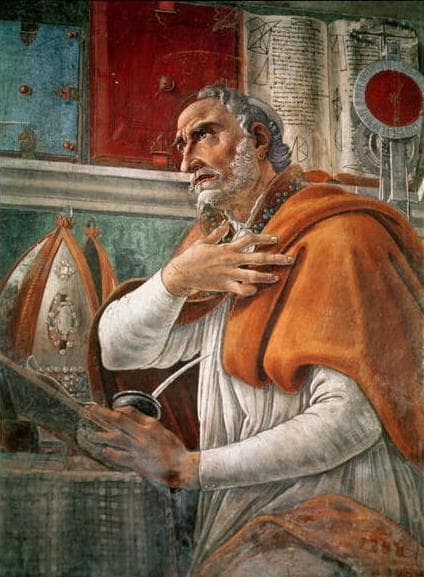
Augustine of Hippo
Confessions...long one do I measure as present, seeing I measure it not till it be ended? Now his ending is his passing away. What then is it I measure? where is the short syllable by which I measure? where the long which I measure? Both have sounded, have flown, passed away, are no more; and yet I measure, and confidently answer (so far as is presumed on a practised sense) that as to space of time this syllable is but single, that double. And yet I could not do this, unless they were already past and ended.
It is not then themselves, which now are not, that I measure, but something in my memory, which there remains fixed. It is in thee, my mind, that I measure times. Interrupt me not, that is, interrupt not thyself with the tumults of thy impressions. In thee I measure times; the impression, which things as they pass by cause in thee, remains even when they are gone; this it is which still present, I measure, not the things which pass by to make this impression. This I measure, when I measure times. Either then this is time, or I do not measure times.
What when we measure silence, and say that this silence hath held as long time as did that voice? do we not stretch out our thought to the measure of a voice, as if it sounded, that so we may be able to report of the intervals of silence in a given space of time? For though both voice and tongue be still, yet in thought we go over poems, and verses, and any other discourse, or dimensions of motions, and report as to the spaces of times, how much this is in respect of that, no otherwise than if...
2
⚖The Sleeping Self

Augustine of Hippo
ConfessionsThe author observes the strange discrepancy between his waking and sleeping self, questioning where reason goes when the senses are lulled.
...t it, it was done, even before I became a dispenser of Thy Sacrament. But there yet live in my memory (whereof I have much spoken) the images of such things as my ill custom there fixed; which haunt me, strengthless when I am awake: but in sleep, not only so as to give pleasure, but even to obtain assent, and what is very like reality. Yea, so far prevails the illusion of the image, in my soul and in my flesh, that, when asleep, false visions persuade to that which when waking, the true cannot.
Am I not then myself, O Lord my God? And yet there is so much difference betwixt myself and myself, within that moment wherein I pass from waking to sleeping, or return from sleeping to waking! Where is reason then, which, awake, resisteth such suggestions? And should the things themselves be urged on it, it remaineth unshaken. Is it clasped up with the eyes? is it lulled asleep with the senses of the body? And whence is it that often even in sleep we resist, and mindful of our purpose, and abiding most chastely in it, yield no assent to such enticements?
And yet so much difference there is, that when it happeneth otherwise, upon waking we return to peace of conscience: and by this very difference discover that we did not, what yet we be sorry that in some way it was done in us. Art Thou not mighty, God Almighty, so as to heal all the diseases of my soul, and by Thy more abundant grace to quench even the impure motions of my sleep! Thou wilt increase, Lord, Thy gifts more and more in me, that my soul may follow me to Thee, disentangled from the...
2
⚖Memory of Forgetfulness

Augustine of Hippo
ConfessionsA logical investigation into the nature of memory and forgetfulness, questioning how the mind can retain the concept of 'forgetting' without losing the memory itself.
...s image, but the image itself is present to me, calling it to mind. I name memory, and I recognise what I name. And where do I recognise it, but in the memory itself? Is it also present to itself by its image, and not by itself? What, when I name forgetfulness, and withal recognise what I name? whence should I recognise it, did I not remember it? I speak not of the sound of the name, but of the thing which it signifies: which if I had forgotten, I could not recognise what that sound signifies.
When then I remember memory, memory itself is, through itself, present with itself: but when I remember forgetfulness, there are present both memory and forgetfulness; memory whereby I remember, forgetfulness which I remember. But what is forgetfulness, but the privation of memory? How then is it present that I remember it, since when present I cannot remember? But if what we remember we hold it in memory, yet, unless we did remember forgetfulness, we could never at the hearing of the name recognise the thing thereby signified, then forgetfulness is retained by memory. Present then it is, that we forget not, and being so, we forget. It is to…
Who now shall search out this? who shall comprehend how it is? Lord, I, truly, toil therein, yea and toil in myself; I am become a heavy soil requiring over much sweat of the brow. For we are not now searching out the regions of heaven, or measuring the distances of the stars, or enquiring the balancings of the earth. It is I myself who remember, I the mind. It is not so wonderful, if what I myself am not, be far from me. But what is nearer to me than myself? And lo, the force of mine own memo...
Continue reading →
3
⚖The Divided Self

Augustine of Hippo
ConfessionsThe author observes the disturbing power of dreams and memories, noting the existential gap between his rational waking self and the version of himself that succumbs to illusions in sleep.
...ve, who ever burnest and never consumest! O charity, my God, kindle me. Thou enjoinest continency: give me what Thou enjoinest, and enjoin what Thou wilt. Verily Thou enjoinest me continency from the lust of the flesh, the lust of the eyes, and the ambition of the world. Thou enjoinest continency from concubinage; and for wedlock itself, Thou hast counselled something better than what Thou hast permitted. And since Thou gavest it, it was done, even before I became a dispenser of Thy Sacrament.
But there yet live in my memory (whereof I have much spoken) the images of such things as my ill custom there fixed; which haunt me, strengthless when I am awake: but in sleep, not only so as to give pleasure, but even to obtain assent, and what is very like reality. Yea, so far prevails the illusion of the image, in my soul and in my flesh, that, when asleep, false visions persuade to that which when waking, the true cannot. Am I not then myself, O Lord my God? And yet there is so much difference betwixt myself and myself, within that moment wherein I pass from waking to sleeping, or return from sleeping to waking!
Where is reason then, which, awake, resisteth such suggestions? And should the things themselves be urged on it, it remaineth unshaken. Is it clasped up with the eyes? is it lulled asleep with the senses of the body? And whence is it that often even in sleep we resist, and mindful of our purpose, and abiding most chastely in it, yield no assent to such enticements? And yet so much difference there is, that when it happeneth otherwise, upon waking we return to peace of conscience: and by this ve...
2
⚖Memory's Retrieval Struggle

Augustine of Hippo
ConfessionsAn epistemological definition of 'cogitation' as the process of collecting and arranging scattered, non-sensory knowledge already stored within the memory.
...mended them to it, laying them up as it were, whence I might bring them forth when I willed. In my heart then they were, even before I learned them, but in my memory they were not. Where then? or wherefore, when they were spoken, did I acknowledge them, and said, "So is it, it is true," unless that they were already in the memory, but so thrown back and buried as it were in deeper recesses, that had not the suggestion of another drawn them forth I had perchance been unable to conceive of them?
Wherefore we find, that to learn these things whereof we imbibe not the images by our senses, but perceive within by themselves, without images, as they are, is nothing else, but by conception, to receive, and by marking to take heed that those things which the memory did before contain at random and unarranged, be laid up at hand as it were in that same memory where before they lay unknown, scattered and neglected, and so readily occur to the mind familiarised to them. And how many things of this kind does my memory bear which have been already found out, and as I said, placed as it were at hand, which we are said to have learned and come to…
For cogo (collect) and cogito (re-collect) have the same relation to each other as ago and agito, facio and factito. But the mind hath appropriated to itself this word (cogitation), so that, not what is "collected" any how, but what is "recollected," i.e., brought together, in the mind, is properly said to be cogitated, or thought upon. The memory containeth also reasons and laws innumerable of numbers and dimensions, none of which hath any bodily sense impressed; seeing they have neither colo...
Continue reading →
6