Famine for Inward Food
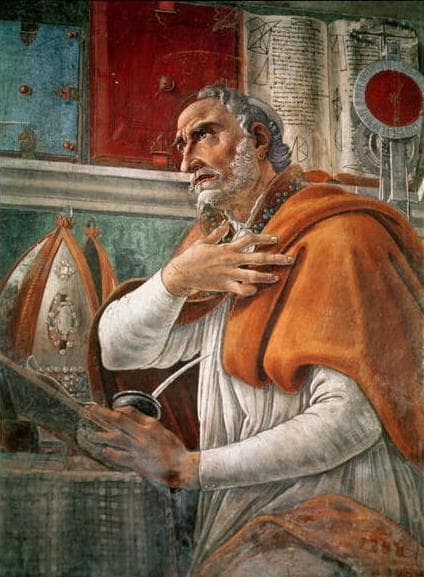
Augustine of Hippo
Confessions

Augustine describes a period of spiritual sickness where he sought earthly love to fill an inner void, despite feeling a loathing for the very sustenance he lacked.

...life imperturbable. Whoso enters into Thee, enters into the joy of his Lord: and shall not fear, and shall do excellently in the All-Excellent. I sank away from Thee, and I wandered, O my God, too much astray from Thee my stay, in these days of my youth, and I became to myself a barren land. BOOK III To Carthage I came, where there sang all around me in my ears a cauldron of unholy loves. I loved not yet, yet I loved to love, and out of a deep-seated want, I hated myself for wanting not.
I sought what I might love, in love with loving, and safety I hated, and a way without snares. For within me was a famine of that inward food, Thyself, my God; yet, through that famine I was not hungered; but was without all longing for incorruptible sustenance, not because filled therewith, but the more empty, the more I loathed it. For this cause my soul was sickly and full of sores, it miserably cast itself forth, desiring to be scraped by the touch of objects of sense.
Yet if these had not a soul, they would not be objects of love. To love then, and to be beloved, was sweet to me; but more, when I obtained to enjoy the person I loved, I defiled, therefore, the spring of friendship with the filth of concupiscence, and I beclouded its brightness with the hell of lustfulness; and thus foul and unseemly, I would fain, through exceeding vanity, be fine and courtly. I fell headlong then into the love wherein I longed to be ensnared. My God, my Mercy, with how much...
2
Perception's Relativity
Augustine of Hippo
Confessions

The author posits that the perceived 'evil' in God's creation is actually a matter of subjective unfitness or the observer's own spiritual sickness.

...u containest all things in Thine hand in Thy Truth; and all things are true so far as they nor is there any falsehood, unless when that is thought to be, which is not. And I saw that all things did harmonise, not with their places only, but with their seasons. And that Thou, who only art Eternal, didst not begin to work after innumerable spaces of times spent; for that all spaces of times, both which have passed, and which shall pass, neither go nor come, but through Thee, working and abiding.
And I perceived and found it nothing strange, that bread which is pleasant to a healthy palate is loathsome to one distempered: and to sore eyes light is offensive, which to the sound is delightful. And Thy righteousness displeaseth the wicked; much more the viper and reptiles, which Thou hast created good, fitting in with the inferior portions of Thy Creation, with which the very wicked also fit in; and that the more, by how much they be unlike Thee; but with the superior creatures, by how much they become more like to Thee.
And I enquired what iniquity was, and found it to be no substance, but the perversion of the will, turned aside from Thee, O God, the Supreme, towards these lower things, and casting out its bowels, and puffed up outwardly. And I wondered that I now loved Thee, and no phantasm for Thee. And yet did I not press on to enjoy my God; but was borne up to Thee by Thy beauty, and soon borne down from Thee by mine own weight, sinking with sorrow into these inferior things. This weight was carnal custo...
4
Return to the Fountain
Augustine of Hippo
Confessions

The author admits to his past spiritual darkness and wandering, expressing a desperate, panting desire to return to the divine source of life.

...hrough the sweetness of that most happy contemplation of Thyself, strongly restrain its own changeableness; and without any fall since its first creation, cleaving close unto Thee, is placed beyond all the rolling vicissitude of times. Yea, neither is this very formlessness of the earth, invisible, and without form, numbered among the days. For where no figure nor order is, there does nothing come, or go; and where this is not, there plainly are no days, nor any vicissitude of spaces of times.
O let the Light, the Truth, the Light of my heart, not mine own darkness, speak unto me. I fell off into that, and became darkened; but even thence, even thence I loved Thee. I went astray, and remembered Thee. I heard Thy voice behind me, calling to me to return, and scarcely heard it, through the tumultuousness of the enemies of peace. And now, behold, I return in distress and panting after Thy fountain. Let no man forbid me! of this will I drink, and so live. Let me not be mine own life; from myself I lived ill, death was I to myself; and I revive in Thee.
Do Thou speak unto me, do Thou discourse unto me. I have believed Thy Books, and their words be most full of mystery. Already Thou hast told me with a strong voice, O Lord, in my inner ear, that Thou art eternal, Who only hast immortality; since Thou canst not be changed as to figure or motion, nor is Thy will altered by times: seeing no will which varies is immortal. This is in Thy sight clear to me, and let it be more and more cleared to me, I beseech Thee; and in the manifestation thereof,...
2
The Present's Exclusive Reality
Augustine of Hippo
Confessions

The author posits that past and future only exist as 'present' states within the mind, where the past is a present memory and the future a present expectation.

...it becometh present, doth it come out of some secret place; and so, when retiring, from present it becometh past? For where did they, who foretold things to come, see them, if as yet they be not? For that which is not, cannot be seen. And they who relate things past, could not relate them, if in mind they did not discern them, and if they were not, they could no way be discerned. Things then past and to come, are." Permit me, Lord, to seek further. O my hope, let not my purpose be confounded.
For if times past and to come be, I would know where they be. Which yet if I cannot, yet I know, wherever they be, they are not there as future, or past, but present. For if there also they be future, they are not yet there; if there also they be past, they are no longer there. Wheresoever then is whatsoever is, it is only as present. Although when past facts are related, there are drawn out of the memory, not the things themselves which are past, but words which, conceived by the images of the things, they, in passing, have through the senses left as traces in the mind.
Thus my childhood, which now is not, is in time past, which now is not: but now when I recall its image, and tell of it, I behold it in the present, because it is still in my memory. Whether there be a like cause of foretelling things to come also; that of things which as yet are not, the images may be perceived before, already existing, I confess, O my God, I know not. This indeed I know, that we generally think before on our future actions, and that that forethinking is present, but the actio...
4
Custom vs Divine Command
Augustine of Hippo
Confessions

A rule for action stating that while social customs should generally be followed, divine commands must always take precedence over human laws.

...neighbour as himself? Therefore are those foul offences which be against nature, to be every where and at all times detested and punished; such as were those of the men of Sodom: which should all nations commit, they should all stand guilty of the same crime, by the law of God, which hath not so made men that they should so abuse one another. For even that intercourse which should be between God and us is violated, when that same nature, of which He is Author, is polluted by perversity of lust.
But those actions which are offences against the customs of men, are to be avoided according to the customs severally prevailing; so that a thing agreed upon, and confirmed, by custom or law of any city or nation, may not be violated at the lawless pleasure of any, whether native or foreigner. For any part which harmoniseth not with its whole, is offensive. But when God commands a thing to be done, against the customs or compact of any people, though it were never by them done heretofore, it is to be done; and if intermitted, it is to be restored; and if never ordained, is now to be ordained.
For lawful if it be for a king, in the state which he reigns over, to command that which no one before him, nor he himself heretofore, had commanded, and to obey him cannot be against the common weal of the state (nay, it were against it if he were not obeyed, for to obey princes is a general compact of human society); how much more unhesitatingly ought we to obey God, in all which He commands, the Ruler of all His creatures! For as among the powers in man's society, the greater authority is ob...
4