A reflection on how the principle of ruling through fear is a relic of a lawless state of nature that has no place in a civilized society protected by the State.
Fear in Civilization
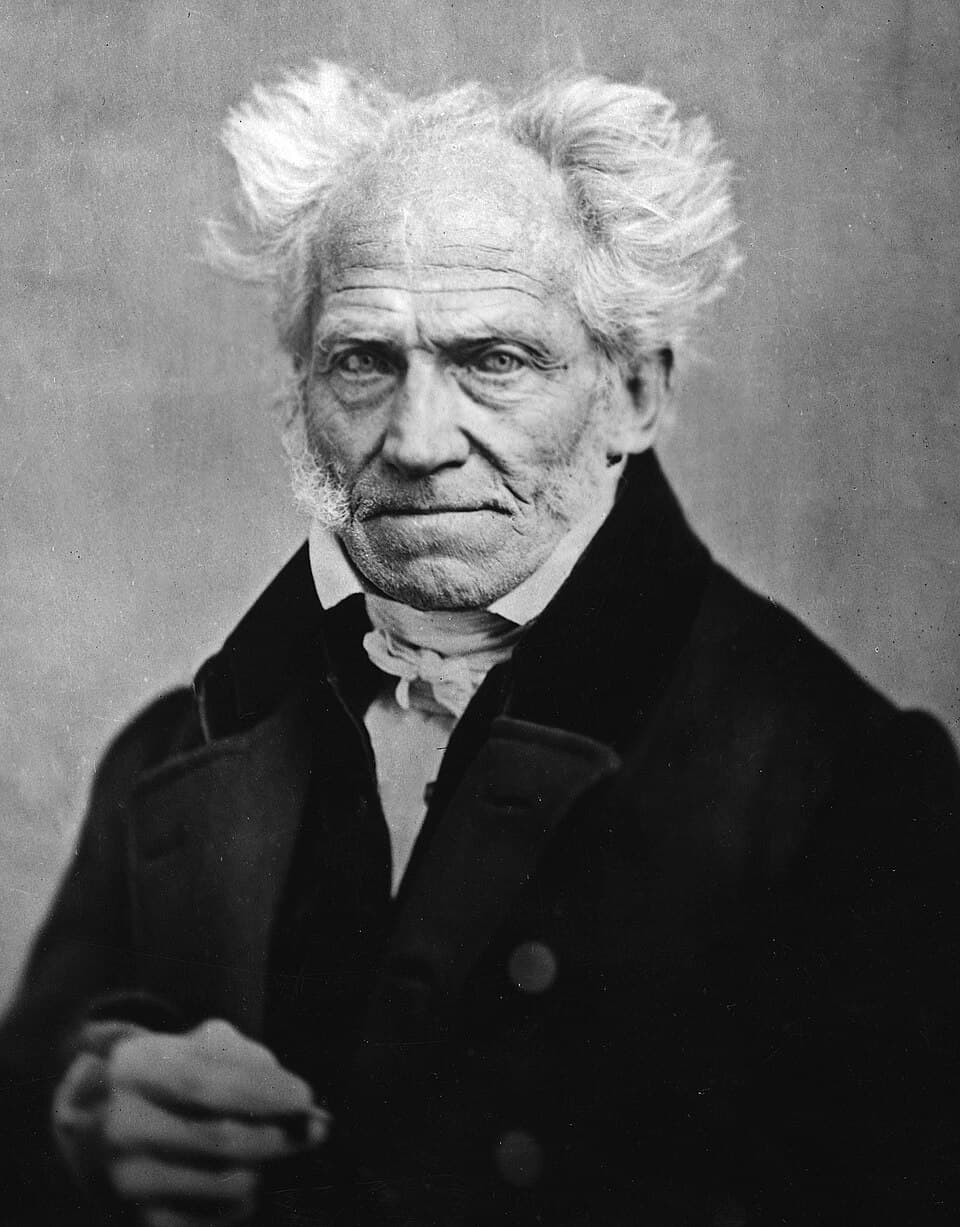
Arthur Schopenhauer
The Wisdom of Life...which comes to much the same thing as if you were to prove the warmth of your room by holding your hand on the thermometer and so make it rise. In fact, the kernel of the matter is this: whereas civic honor aims at peaceable intercourse, and consists in the opinion of other people that we deserve full confidence, because we pay unconditional respect to their rights; knightly honor, on the other hand, lays down that we are to be feared, as being determined at all costs to maintain our own.
As not much reliance can be placed upon human integrity, the principle that it is more essential to arouse fear than to invite confidence would not, perhaps, be a false one, if we were living in a state of nature, where every man would have to protect himself and directly maintain his own rights. But in civilized life, where the State undertakes the protection of our person and property, the principle is no longer applicable: it stands, like the castles and watch-towers of the age when might was right, a useless and forlorn object, amidst well-tilled fields and frequented roads, or even railways.
Accordingly, the application of knightly honor, which still recognizes this principle, is confined to those small cases of personal assault which meet with but slight punishment at the hands of the law, or even none at all, for de minimis non,--mere trivial wrongs, committed sometimes only in jest. The consequence of this limited application of the principle is that it has forced itself into an exaggerated respect for the value of the person,--a respect utterly alien to the nature, constitut...
6
⚖Intellect's Superfluous Gift

Arthur Schopenhauer
The Wisdom of LifeThe author suggests that most people oscillate between boredom and pain, and that only those with a 'superfluity of intellect' can escape this cycle through a rich and painless inner life.
...the preference over all his other occupations: by the constant growth of insight and knowledge, this intellectual life, like a slowly-forming work of art, will acquire a consistency, a permanent intensity, a unity which becomes ever more and more complete; compared with which, a life devoted to the attainment of personal comfort, a life that may broaden indeed, but can never be deepened, makes but a poor show: and yet, as I have said, people make this baser sort of existence an end in itself.
The ordinary life of every day, so far as it is not moved by passion, is tedious and insipid; and if it is so moved, it soon becomes painful. Those alone are happy whom nature has favored with some superfluity of intellect, something beyond what is just necessary to carry out the behests of their will; for it enables them to lead an intellectual life as well, a life unattended by pain and full of vivid interests.
Mere leisure, that is to say, intellect unoccupied in the service of the will, is not of itself sufficient: there must be a real superfluity of power, set free from the service of the will and devoted to that of the intellect; for, as Seneca says, otium sine litteris mors est et vivi hominis sepultura--illiterate leisure is a form of death, a living tomb. Varying with the amount of the superfluity, there will be countless developments in this second life, the life of the mind; it may be the m...
2
⚖Opinion's Tyranny

Arthur Schopenhauer
The Wisdom of LifeThe author identifies the excessive valuation of public opinion as a universal human error that causes people to sacrifice their health, peace, and even lives for mere reputation.
...everything men devote their lives to attain, sparing no effort and encountering a thousand toils and dangers in the process, has, in the end, no further object than to raise themselves in the estimation of others; when we see that not only offices, titles, decorations, but also wealth, nay, even knowledge[1] and art, are striven for only to obtain, as the ultimate goal of all effort, greater respect from one's fellowmen,--is not this a lamentable proof of the extent to which human folly can go?
To set much too high a value on other people's opinion is a common error everywhere; an error, it may be, rooted in human nature itself, or the result of civilization, and social arrangements generally; but, whatever its source, it exercises a very immoderate influence on all we do, and is very prejudicial to our happiness. We can trace it from a timorous and slavish regard for what other people will say, up to the feeling which made Virginius plunge the dagger into his daughter's heart, or induces many a man to sacrifice quiet, riches, health and even life itself, for posthumous glory.
Undoubtedly this feeling is a very convenient instrument in the hands of those who have the control or direction of their fellowmen; and accordingly we find that in every scheme for training up humanity in the way it should go, the maintenance and strengthening of the feeling of honor occupies an important place. But it is quite a different matter in its effect on human happiness, of which it is here our object to treat; and we should rather be careful to dissuade people from setting too much s...
6
⚖The Opinion Thorn

Arthur Schopenhauer
The Wisdom of LifeThe author reflects on how most human anxiety stems from a preoccupation with the opinions of others and suggests that reducing this impulse is essential for peace of mind.
...thing has been known to happen. Mateo Aleman tells us, in the Introduction to his celebrated romance, Juzman de Alfarache, that many infatuated criminals, instead of devoting their last hours to the welfare of their souls, as they ought to have done, neglect this duty for the purpose of preparing and committing to memory a speech to be made from the scaffold. I take these extreme cases as being the best illustrations to what I mean; for they give us a magnified reflection of our own nature.
The anxieties of all of us, our worries, vexations, bothers, troubles, uneasy apprehensions and strenuous efforts are due, in perhaps the large majority of instances, to what other people will say; and we are just as foolish in this respect as those miserable criminals. Envy and hatred are very often traceable to a similar source. Now, it is obvious that happiness, which consists for the most part in peace of mind and contentment, would be served by nothing so much as by reducing this impulse of human nature within reasonable limits,--which would perhaps make it one fiftieth part of what it is now. By doing so, we should get rid of a thorn in…
But it is a very difficult task, because the impulse in question is a natural and innate perversity of human nature. Tacitus says, The lust of fame is the last that a wise man shakes off[1] The only way of putting an end to this universal folly is to see clearly that it is a folly; and this may be done by recognizing the fact that most of the opinions in men's heads are apt to be false, perverse, erroneous and absurd, and so in themselves unworthy of attention; further, that other people's op...
Continue reading →
2
⚖Will's Constant Tickling

Arthur Schopenhauer
The Wisdom of LifeThe author posits that ordinary people seek constant excitement of the will to avoid boredom, often through trivial means like card-playing, which he views as a mark of vulgarity.
...wledge is all in all. Further, intellectual pleasures are accessible entirely and only through the medium of the intelligence, and are limited by its capacity. For all the wit there is in the world is useless to him who has none. Still this advantage is accompanied by a substantial disadvantage; for the whole of Nature shows that with the growth of intelligence comes increased capacity for pain, and it is only with the highest degree of intelligence that suffering reaches its supreme point.]
The normal, ordinary man takes a vivid interest in anything only in so far as it excites his will, that is to say, is a matter of personal interest to him. But constant excitement of the will is never an unmixed good, to say the least; in other words, it involves pain. Card-playing, that universal occupation of "good society" everywhere, is a device for providing this kind of excitement, and that, too, by means of interests so small as to produce slight and momentary, instead of real and permanent, pain. Card-playing is, in fact, a mere tickling of the will. [Footnote 1: Vulgarity is, at bottom, the kind of consciousness in which the will…
Therefore, when the will makes no demands, supplies no motives, strong or weak, the intellect entirely loses its power, and the result is complete vacancy of mind. Now will without intellect is the most vulgar and common thing in the world, possessed by every blockhead, who, in the gratification of his passions, shows the stuff of which he is made. This is the condition of mind called vulgarity, in which the only active elements are the organs of sense, and that small amount of intellect wh...
Continue reading →
6